As some will have noted, there were a lot of reports yesterday on the fact that £50 billion of banks notes are missing in the UK economy. This got me thinking. And as a result I have to suggest that finding that £50 billion of cash would not be hard. Here’s how to do it.
More from Richard Murphy
There is a growing and numbing realisation of just how bad Sunak's budget really was. Worse, he’s even now saying that there is nothing he can do about poverty. This is a long thread to explain why he’s failing and what we can do about it if we want to change our politics.
For those who don’t want to read a long Twitter thread there is a blog version here. https://t.co/AuTdAr1f1n if you want a summary of the whole thread it’s this: the neoliberal thinking that all our main political parties subscribe to is now bankrupt. We need something new now.
Sunak faced a challenge this week. A winning Chancellor has to decide how to secure the support their party needs to win elections. In that case there will always be winners and losers in a budget. So Sunak had to make decisions.
However, it’s fair to say that decisions are always constrained. No budget has, I suspect, ever delivered precisely the policies any Chancellor has really wanted. That’s because all politicians are fantasists and reality has to be addressed as well in any budget.
The overwhelming realities that Sunak needed to address yesterday were really not hard to spot. First, there was the real economic chaos created by shortages in the economy. These are the result of Covid, Brexit and now war, but which heavily pre-dated the last.
For those who don’t want to read a long Twitter thread there is a blog version here. https://t.co/AuTdAr1f1n if you want a summary of the whole thread it’s this: the neoliberal thinking that all our main political parties subscribe to is now bankrupt. We need something new now.
Sunak faced a challenge this week. A winning Chancellor has to decide how to secure the support their party needs to win elections. In that case there will always be winners and losers in a budget. So Sunak had to make decisions.
However, it’s fair to say that decisions are always constrained. No budget has, I suspect, ever delivered precisely the policies any Chancellor has really wanted. That’s because all politicians are fantasists and reality has to be addressed as well in any budget.
The overwhelming realities that Sunak needed to address yesterday were really not hard to spot. First, there was the real economic chaos created by shortages in the economy. These are the result of Covid, Brexit and now war, but which heavily pre-dated the last.
More from Economy

On Jan 6, 2021, the always stellar Mr @deepakshenoy tweeted, this:
https://t.co/fa3GX9VnW0
Innocuous 1 sentence, but its a full economic theory at play.
Let me break it down for you. (1/n)
On September 30, 2020, I wrote an article for @CFASocietyIndia where I explained that RBI is all set to lose its ability to set interest rates if it continues to fiddle with the exchange rate (2/n)
What do I mean, "fiddle with the exchange rate"?
In essence, if RBI opts and continues to manage exchange rate, then that is "fiddling with the exchange rate"
RBI has done that in the past and has restarted it in 2020 - very explicitly. (3/n)
First in March 2020, it opened a Dollar/INR swap of $2B with far leg to be unwound in September 2020.
Implying INR will be bought from the open markets in order to prevent INR from falling vis a vis USD (4/n)
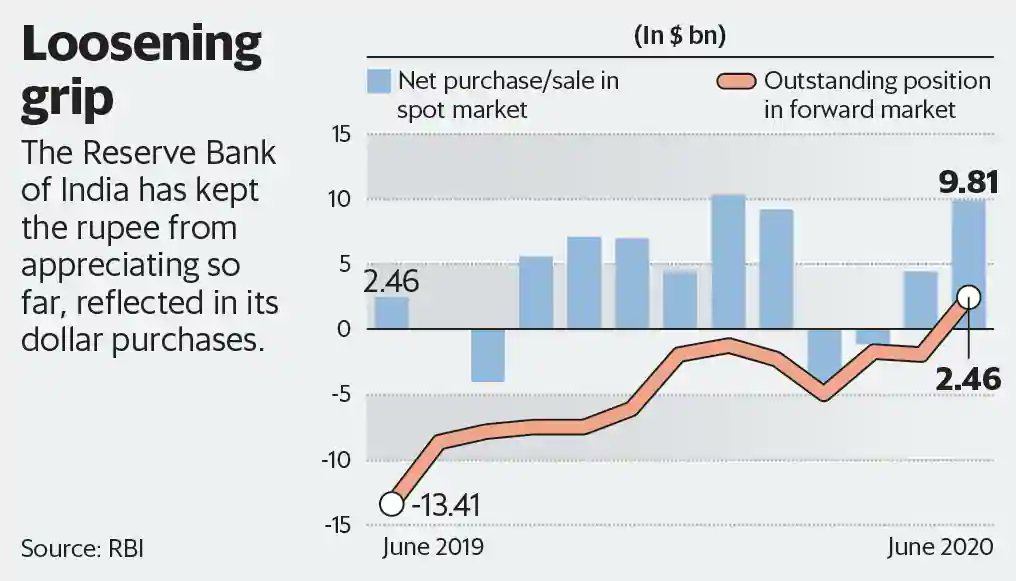
The Second aspect is now, that dollar inflow is happening, and the forex reserves swelled -> implying the rupee is appreciating, RBI again intervened from September, by selling INR in spot markets. (5/n)
https://t.co/9kpWP7ovyM
https://t.co/fa3GX9VnW0
Innocuous 1 sentence, but its a full economic theory at play.
Let me break it down for you. (1/n)
91 day TBills at 3.03%. Interest rates are even lower than RBI has them.
— Deepak Shenoy (@deepakshenoy) January 6, 2021
On September 30, 2020, I wrote an article for @CFASocietyIndia where I explained that RBI is all set to lose its ability to set interest rates if it continues to fiddle with the exchange rate (2/n)
What do I mean, "fiddle with the exchange rate"?
In essence, if RBI opts and continues to manage exchange rate, then that is "fiddling with the exchange rate"
RBI has done that in the past and has restarted it in 2020 - very explicitly. (3/n)
First in March 2020, it opened a Dollar/INR swap of $2B with far leg to be unwound in September 2020.
Implying INR will be bought from the open markets in order to prevent INR from falling vis a vis USD (4/n)
The Second aspect is now, that dollar inflow is happening, and the forex reserves swelled -> implying the rupee is appreciating, RBI again intervened from September, by selling INR in spot markets. (5/n)
https://t.co/9kpWP7ovyM



In this paper, we study vote choices of voters who are left-wing on economic issues and authoritarian/nationalist on cultural issues, especially immigration. For these voters, there is no often party combining positions in this way.
In the data from the Campaign Panel of the German Election Study 2017, many voters prefer higher social benefits and taxes and want to restrict immigration. @ches_data show that no party bundles issue positions in this way.
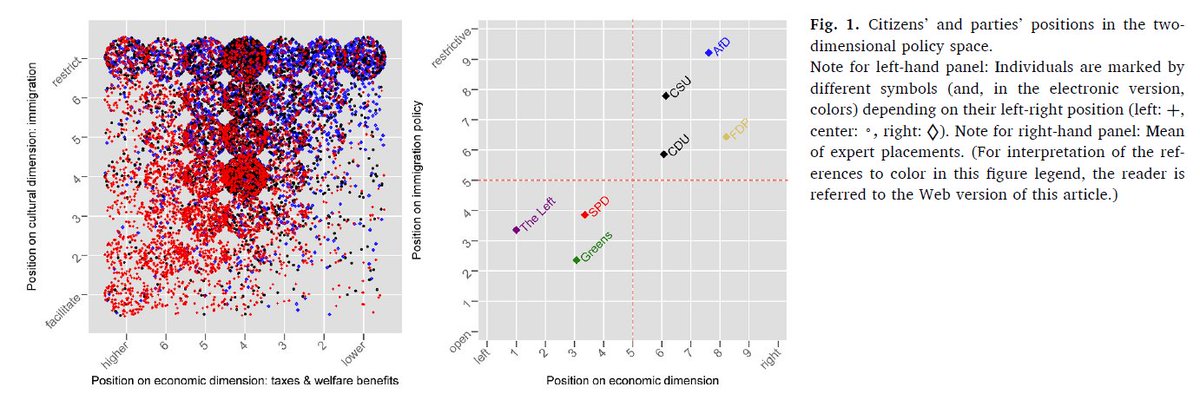
In the article, we show that many such “left-authoritarians” perceive the party they voted for to also hold a left-authoritarian position. Interestingly, this includes many AfD voters who report a perceived left-wing economic position of the party.
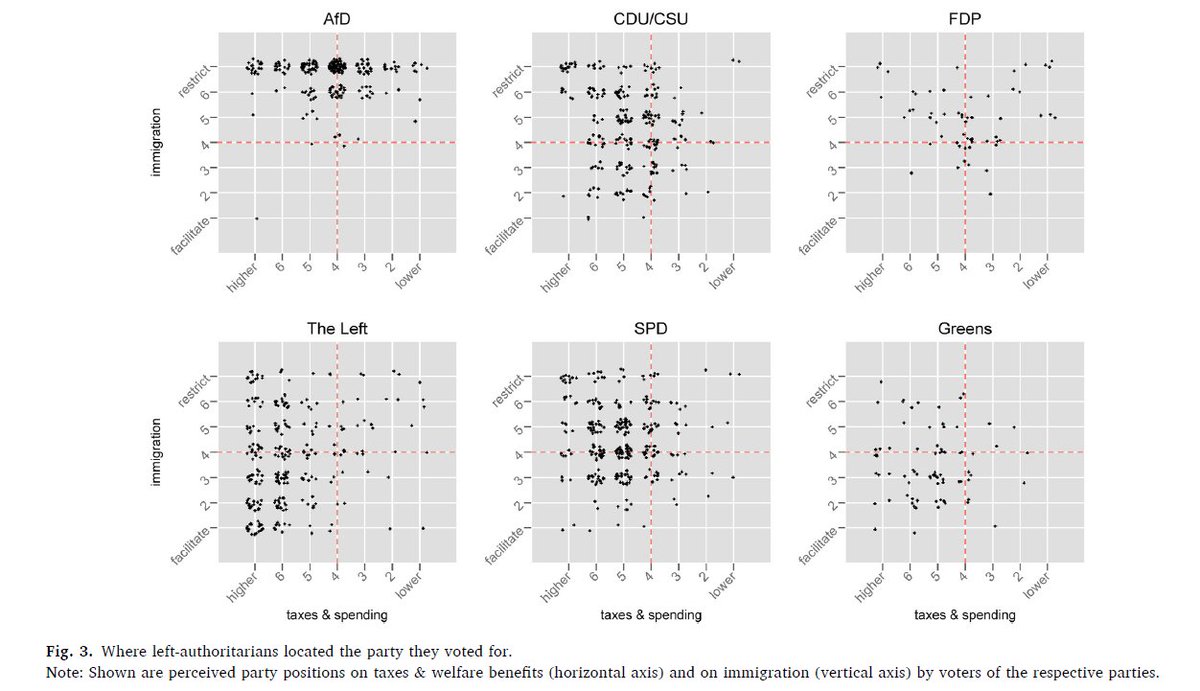
Our statistical models study the interplay between this (mis-)perceived congruence and issue importance, using an open-ended question on the most important political problem in Germany.
We find that (mis-)perceived congruence and issue importance interactively shape the left-authoritarian vote. Simply, perceived congruence matters more on an important issue—and issue salience matters most if voters accurately perceive incongruent party supply.
Vol 70 Apr | '#Vote choices of left-#authoritarians: Misperceived congruence and issue #salience' by @NilsSteiner and Sven Hillen is now available @ches_data @german_gles #Germany https://t.co/pmCoP5t7CL pic.twitter.com/Vl8rCahcZL
— Electoral Studies (@ElectoralStdies) January 30, 2021
In the data from the Campaign Panel of the German Election Study 2017, many voters prefer higher social benefits and taxes and want to restrict immigration. @ches_data show that no party bundles issue positions in this way.
In the article, we show that many such “left-authoritarians” perceive the party they voted for to also hold a left-authoritarian position. Interestingly, this includes many AfD voters who report a perceived left-wing economic position of the party.
Our statistical models study the interplay between this (mis-)perceived congruence and issue importance, using an open-ended question on the most important political problem in Germany.
We find that (mis-)perceived congruence and issue importance interactively shape the left-authoritarian vote. Simply, perceived congruence matters more on an important issue—and issue salience matters most if voters accurately perceive incongruent party supply.


You May Also Like




First thread of the year because I have time during MCO. As requested, a thread on the gods and spirits of Malay folk religion. Some are indigenous, some are of Indian origin, some have Islamic
Before I begin, it might be worth explaining the Malay conception of the spirit world. At its deepest level, Malay religious belief is animist. All living beings and even certain objects are said to have a soul. Natural phenomena are either controlled by or personified as spirits
Although these beings had to be respected, not all of them were powerful enough to be considered gods. Offerings would be made to the spirits that had greater influence on human life. Spells and incantations would invoke their
Two known examples of such elemental spirits that had god-like status are Raja Angin (king of the wind) and Mambang Tali Arus (spirit of river currents). There were undoubtedly many more which have been lost to time
Contact with ancient India brought the influence of Hinduism and Buddhism to SEA. What we now call Hinduism similarly developed in India out of native animism and the more formal Vedic tradition. This can be seen in the multitude of sacred animals and location-specific Hindu gods
i wonder if you can make a thread bout witchcraft in malaysia.. or list of our own local gods/deites..
— r a y a \U0001f319 (@lcvelylilith) February 20, 2020
Before I begin, it might be worth explaining the Malay conception of the spirit world. At its deepest level, Malay religious belief is animist. All living beings and even certain objects are said to have a soul. Natural phenomena are either controlled by or personified as spirits
Although these beings had to be respected, not all of them were powerful enough to be considered gods. Offerings would be made to the spirits that had greater influence on human life. Spells and incantations would invoke their
Animist ceremonies of a religious or magical nature were normally held for the purpose of divination or making a request. This would either be done at a keramat or at a shrine similar to the Thai spirit houses or Chinese roadside shrines pic.twitter.com/I1hliyi0x3
— \u2745\u1710\u170b\u1713\u170e (@uglyluhan) June 16, 2019
Two known examples of such elemental spirits that had god-like status are Raja Angin (king of the wind) and Mambang Tali Arus (spirit of river currents). There were undoubtedly many more which have been lost to time
Contact with ancient India brought the influence of Hinduism and Buddhism to SEA. What we now call Hinduism similarly developed in India out of native animism and the more formal Vedic tradition. This can be seen in the multitude of sacred animals and location-specific Hindu gods