0/ Predictions for 2021:
(This is not investment advice, or any other type of advice. DYOR)
More from Crypto

Out of curiosity I dug into how NFT's actually reference the media you're "buying" and my eyebrows are now orbiting the moon
Short version:
The NFT token you bought either points to a URL on the internet, or an IPFS hash. In most circumstances it references an IPFS gateway on the internet run by the startup you bought the NFT from.
Oh, and that URL is not the media. That URL is a JSON metadata file
Here's an example. This artwork is by Beeple and sold via Nifty:
https://t.co/TlJKH8kAew
The NFT token is for this JSON file hosted directly on Nifty's servers:
https://t.co/GQUaCnObvX
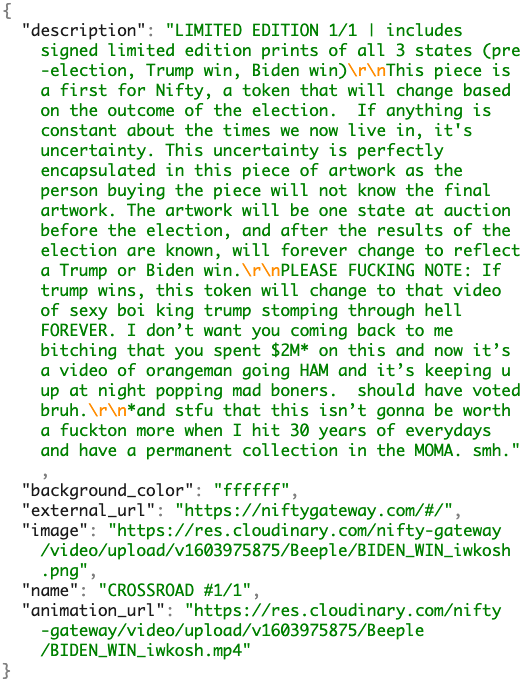
THAT file refers to the actual media you just "bought". Which in this case is hosted via a @cloudinary CDN, served by Nifty's servers again.
So if Nifty goes bust, your token is now worthless. It refers to nothing. This can't be changed.
"But you said some use IPFS!"
Let's look at the $65m Beeple, sold by Christies. Fancy.
https://t.co/1G9nCAdetk
That NFT token refers directly to an IPFS hash (https://t.co/QUdtdgtssH). We can take that IPFS hash and fetch the JSON metadata using a public gateway:
https://t.co/CoML7psBhF

Short version:
The NFT token you bought either points to a URL on the internet, or an IPFS hash. In most circumstances it references an IPFS gateway on the internet run by the startup you bought the NFT from.
Oh, and that URL is not the media. That URL is a JSON metadata file
Here's an example. This artwork is by Beeple and sold via Nifty:
https://t.co/TlJKH8kAew
The NFT token is for this JSON file hosted directly on Nifty's servers:
https://t.co/GQUaCnObvX
THAT file refers to the actual media you just "bought". Which in this case is hosted via a @cloudinary CDN, served by Nifty's servers again.
So if Nifty goes bust, your token is now worthless. It refers to nothing. This can't be changed.
"But you said some use IPFS!"
Let's look at the $65m Beeple, sold by Christies. Fancy.
https://t.co/1G9nCAdetk
That NFT token refers directly to an IPFS hash (https://t.co/QUdtdgtssH). We can take that IPFS hash and fetch the JSON metadata using a public gateway:
https://t.co/CoML7psBhF


Michael Pettis @michaelxpettis argues that it is not always obvious who (China or the U.S.) adjusts best to "turbulent changes."
Bitcoin answers that question.
Thread:
World economies currently suffer four major redistribution challenges:
The most important is increasing government stealth use of the monetary system to confiscate assets from productive actors.
/2
That process is exacerbated by "Cantillon Effect" transfers to interest groups close to government ("the entitled class," public sector workers, the medical industrial complex, academia, etc....), which is destroying much of that wealth /3
The shadow nature (see Keynes) of government inflation makes the process unidentifiable, un-addressable and undemocratic.
The biggest victims (America's poorly educated young) are unequipped to counter generational confiscation tactics of today's wily senior beneficiaries. /4
Government control of the numéraire in key economic statistics (GDP, inflation, etc...) makes it impossible for economic actors to measure progress and liabilities. /5
Bitcoin answers that question.
Thread:
1/11
— Michael Pettis (@michaelxpettis) January 11, 2021
An article worth thinking about: \u201cAs changes to the world structure accelerate, China\u2019s rule is in sharp contrast with the turmoil in the West,\u201d says Beijing.
I agree, but I draw a different conclusion. The world is certainly currently going...https://t.co/ugha7ygqqx
World economies currently suffer four major redistribution challenges:
The most important is increasing government stealth use of the monetary system to confiscate assets from productive actors.
/2
That process is exacerbated by "Cantillon Effect" transfers to interest groups close to government ("the entitled class," public sector workers, the medical industrial complex, academia, etc....), which is destroying much of that wealth /3
The shadow nature (see Keynes) of government inflation makes the process unidentifiable, un-addressable and undemocratic.
The biggest victims (America's poorly educated young) are unequipped to counter generational confiscation tactics of today's wily senior beneficiaries. /4
Government control of the numéraire in key economic statistics (GDP, inflation, etc...) makes it impossible for economic actors to measure progress and liabilities. /5

Back with another #FreeLoveFriday. Last time, we covered how Mastercoin/@Omni_Layer pioneered digital asset issuance on blockchains. Today, let’s discuss @Chainlink and the vital role it plays in connecting blockchains to the real world.
I have said repeatedly that digital asset issuance is the killer application for blockchains. The next frontier is bringing real world assets to networks like @AvalancheAVAX, but we often face a significant problem:
Namely, how do you get data from the real world onto blockchains and into applications running on them? More critically, how do you achieve that securely and transparently in real-time? Smart contracts are tamper-proof, but they're only as reliable as their input data.
Enter ChainLink in September 2017, with a whitepaper outlining a vision for a decentralized network of “oracles,” entities that inject facts from the external world into blockchains in a suitable format for smart contracts.
Until ChainLink, oracles were trusted and centralized. This is a huge problem for high-value assets and smart contracts. High value projects, such as @CelsiusNetwork, @synthetix_io, @Aaveaave and others depend critically on oracle data.
Back with another #FreeLoveFriday. My first thread focused on what I love about Bitcoin, and features we borrowed for @AvalancheAVAX. Today, let's focus on @Omni_Layer, or as OGs knew it, Mastercoin https://t.co/fXFgmaeUEz
— Emin G\xfcn Sirer (@el33th4xor) January 15, 2021
I have said repeatedly that digital asset issuance is the killer application for blockchains. The next frontier is bringing real world assets to networks like @AvalancheAVAX, but we often face a significant problem:
Namely, how do you get data from the real world onto blockchains and into applications running on them? More critically, how do you achieve that securely and transparently in real-time? Smart contracts are tamper-proof, but they're only as reliable as their input data.
Enter ChainLink in September 2017, with a whitepaper outlining a vision for a decentralized network of “oracles,” entities that inject facts from the external world into blockchains in a suitable format for smart contracts.
Until ChainLink, oracles were trusted and centralized. This is a huge problem for high-value assets and smart contracts. High value projects, such as @CelsiusNetwork, @synthetix_io, @Aaveaave and others depend critically on oracle data.

1/ A thread on Nexgen’s Arrow & the #uranium cycle ($NXE)
2/ Given the scale and cost structure of Arrow, it makes sense that investors are intensely focused on its delivery timeline. This thread will discuss possible timelines, current market expectations (i.e., what’s “priced in”) & how different Arrow scenarios will impact the mkt.
3/ As you can see from the litany of responses to Michael’s tweet, there is great skepticism in the market regarding Arrow’s timeline. This is largely due to a bearish narrative conveyed by competing CEO’s whose assets only hold value if Arrow is substantially delayed.
4/ Those who played “King of the Hill” as a child would remember that it is the person at the top who is constantly attacked, not the kid sitting at the bottom of the hill in the mud. No one cares enough about that kid to attack them. This is a good parable for $NXE & Uranium.
5/ First a quick note on “this cycle” – Segra generally defines this cycle as the deficits forecasted from the mid-2020s to late-2030s. When people imply an asset producing in the mid-to-late 2020s will “miss the cycle”, they clearly have not done any real S/D modelling.
Can anyone tell me an estimated time frame that Nexgen could be permitted, start building their mine and be producing #uranium ??? @quakes99 @JekyllCapital @travmcph @NexGenEnergy $nxe
— Michael Pierce (@Big_U_Dawg) January 22, 2021
2/ Given the scale and cost structure of Arrow, it makes sense that investors are intensely focused on its delivery timeline. This thread will discuss possible timelines, current market expectations (i.e., what’s “priced in”) & how different Arrow scenarios will impact the mkt.
3/ As you can see from the litany of responses to Michael’s tweet, there is great skepticism in the market regarding Arrow’s timeline. This is largely due to a bearish narrative conveyed by competing CEO’s whose assets only hold value if Arrow is substantially delayed.
4/ Those who played “King of the Hill” as a child would remember that it is the person at the top who is constantly attacked, not the kid sitting at the bottom of the hill in the mud. No one cares enough about that kid to attack them. This is a good parable for $NXE & Uranium.
5/ First a quick note on “this cycle” – Segra generally defines this cycle as the deficits forecasted from the mid-2020s to late-2030s. When people imply an asset producing in the mid-to-late 2020s will “miss the cycle”, they clearly have not done any real S/D modelling.