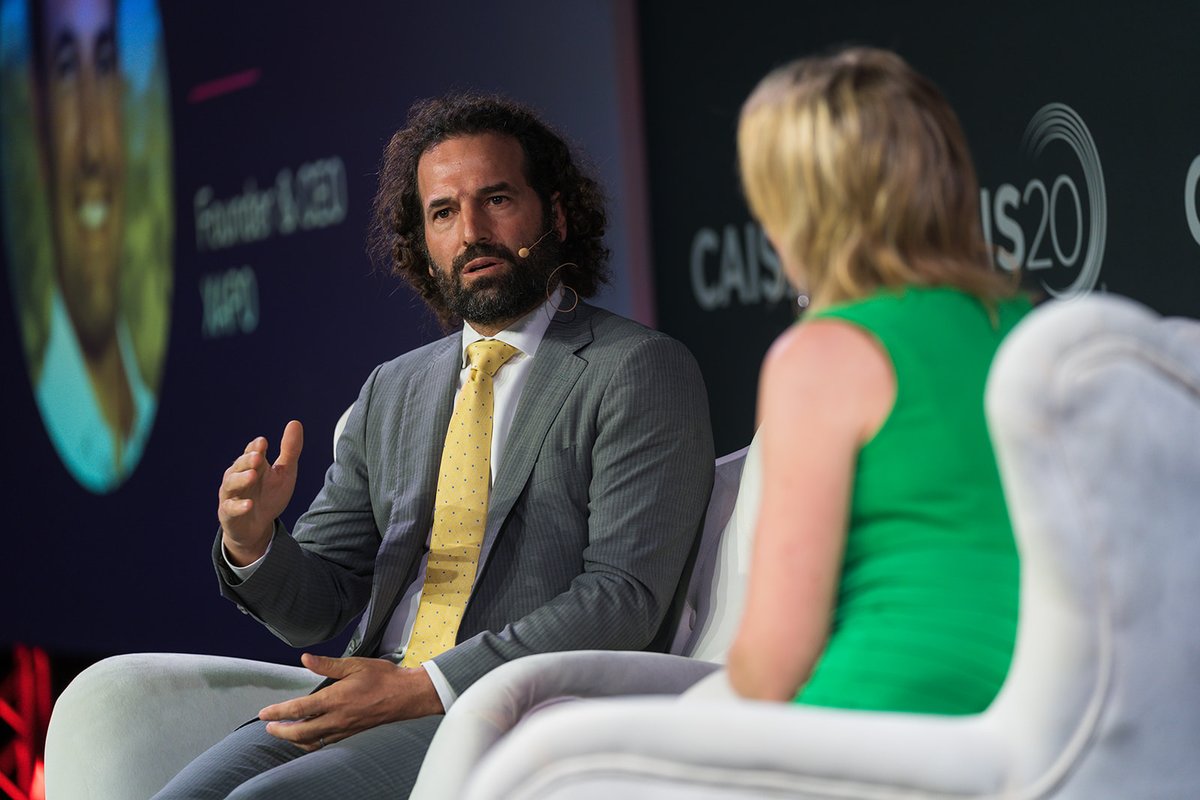
0/ First, if you don't know Wences, you should.
He founded Xapo, a Bitcoin custodian in 2014.
He's also a board member at Libra, PayPal, and Kiva.
But most importantly, he's responsible for bringing thousands of people into Bitcoin.
I'd recommend his podcast with
@laurashin
1/ PART ONE
Bitcoin right now is similar to the Internet in 1994.
You don't need to know how the Internet works to understand it.
You don't need to know how Bitcoin works to understand it.
Investors who understand this will have an advantage over investors who don't.
2/ Up until Bitcoin, all computer platforms belonged to a person, company, or government.
Those platforms had to obey the will of their owners and the rules of the jurisdiction where they resided.
Bitcoin takes control away from the owners.
3/ A sovereign only obeys its own rules, no one can impose rules on a sovereign.
Kings and Queens used to be sovereign.
Then nation states became sovereign.
Now, for the first time, a computer platform has the aspiration to be sovereign.
This is revolutionary.
4/ The main resources securing Bitcoin sovereignty are the Bitcoin miners and the Bitcoin nodes.
Miners secure it because they get paid in Bitcoin to do so.
If you were to remove the Bitcoin, miners would stop mining and Bitcoin would not be very robust nor sovereign.
5/ Bitcoin's main use case:
Use Bitcoin to run a global system of value and settlement.
This is no different than what gold was for 2,000 years and or what the US dollar has been for the last 70 years.
6/ Bitcoin is superior to gold and to the dollar as a global non-political standard of value.
Why?
a) 21M Bitcoin hardcap
b) Bitcoin is open and uncensorable
This allows for unprecedented economic freedom similar to how the internet allowed for freedom of information.
7/ Bitcoin vs. Gold
Gold has the advantage that it is tangible and many people (especially boomers) prefer assets they can touch.
Gold also has in its favor that it has been around for over 2,000 years, and it may be impossible for Bitcoin to match that history and reputation.
8/ Bitcoin vs. the dollar
The dollar has the advantage that it is already understood and accepted globally and it is a platform with remarkable network effects.
9/ These qualities may be too much for Bitcoin to overcome.
Or it may be that we collectively come to appreciate the advantages of a digital unit that cannot be inflated or censored.
Only time will tell.
10/ Traditional investors argue that Bitcoin does not produce earnings or dividends and it does not generate interest.
That’s correct.
Most forms of good money have no intrinsic value.
11/ Gold, the US dollar and national currencies don't have intrinsic value but because they have had a monetary value for a long time people perceive them as being intrinsically valuable.
The main hurdle Bitcoin has to clear is to develop a similar social perception of value.
12/ If Bitcoin succeeds it will most likely not replace any national currency.
It may be a supranational currency that exists on top of all national currencies.
In other words, it could become a global non-political standard of value and settlement.
13/ In a world in which Bitcoin succeeds, all currencies may be quoted in satoshis (the smallest fraction of a Bitcoin).
When your granddaughter asks what is the price of the New Zealand dollar she may receive an answer in satoshis: the New Zealand dollar is 72 satoshis today.
14/ And the price of the Turkish Lira? 21 satoshis today
The US dollar? 107 satoshis
A barrel of oil? 5,600 satoshis today
The GDP of Indonesia? 1,417,007 Bitcoin
You get the idea.
Then all of these values would be easily comparable across time and across geographies.
15/ Granddaughter: How did you keep track when you did not have Bitcoin?
You: We used the US dollar.
Granddaughter: But isn’t that the currency of the United States?
You: Yes
Granddaughter: But then how did you keep track of the US dollar?
She will think we were weird.
16/ Bitcoin is an open protocol, not a company.
Once a protocol gets established it almost never changes.
We only use one web protocol and one email protocol.
Right now it looks like the standard protocol for a sovereign platform will be Bitcoin.
17/ When should I buy Bitcoin?
The Bitcoin price rallies are Bitcoin’s best moments but they are also its most dangerous and vulneread the word and how more people want to own it.
The Bitcoin price rallies are Bitcoin’s best moments but they are also its most dangerous.
18/ Every Bitcoin bear market is about working out the excesses of the rally.
During the rally too many people buy too many Bitcoin thinking that they will be able to sell them for a big gain very soon.
Usually that does not happen.
19/ If Bitcoin succeeds it is likely that the price will do another 5 of these rallies over the next 7 to 10 years.
Anyone who tells you that they know what the price of Bitcoin will be next week is either ignorant or outright lying to you.
It's best to dollar cost average.
20/ PART TWO
First, Bitcoin is not guaranteed to succeed.
But the numbers and amount of investment and activity in the space sure point to its success.
Wences put Bitcoin's chance of success in 2019 at 50%+.
And a lot has happened since then!
21/ If Bitcoin succeeds, 1 Bitcoin may be worth more than $1 million in 7-10 years.
That is 30x what it’s worth today ($30k).
Based on this, you should allocate 5% to Bitcoin.
*Wences used 1% when Bitcoin was at $4,000*
22/ Let’s use a $10M portfolio.
$10M portfolio invests $500,000 (5%).
If Bitcoin fails, this portfolio will lose $500,000, or 5% over the next 3-5 years.
If Bitcoin succeeds, that $500,000 will grow to more than $15M.
23/ The 5% has now grown into more than the value of the original portfolio.
It’s nearly impossible to find an asset that is so misplaced and where possible outcomes are so asymmetrical.
Bitcoin offers a unique opportunity for a 5% exposure to produce a life changing outcome.
24/ It would be irresponsible to have an exposure to Bitcoin that one cannot afford to lose because the risk of losing the principal is still real.
But it would be almost as irresponsible to not have any exposure at all.
25/ If you enjoyed this thread, share it with an investor, a friend, or a family member.
Follow me for more threads like this one:
@JasonYanowitz And most importantly...
Go read the actual post by Wences! It's much better than this summarized thread.
https://t.co/TLLOf1BBIj