A brexit advent calendar to count down to loss of our EU rights
— European Unity #FBPE \U0001f1ea\U0001f1fa\U0001f4b6\u2b50\ufe0f (@EuropeanUnity1) December 31, 2020
Box 31: Boris Johnson told us:
\u201cI\u2019m in favour of the single market\u201d
\u201cThe cost of getting out will be virtually nil\u201d
\u201cWe have an oven ready deal\u201d
\u201cThere is no threat to the Erasmus scheme\u201d
\u201cF**k business\u201d pic.twitter.com/w8KxDJYV4x
#Brexitadventcalendar
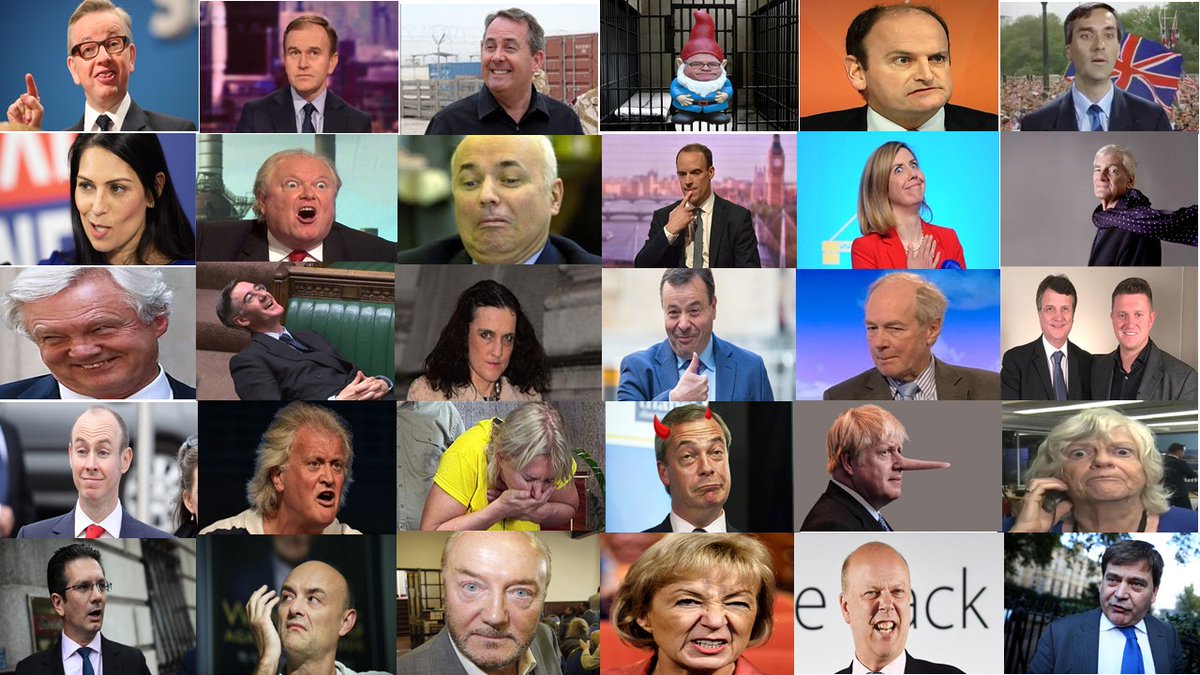
31 liars & hypocrites who facilitated brexit
Some are mad, some are bad
All are millionaires, some are billionaires
They’ll profit from UK companies failing, keep their money abroad to avoid UK tax and travel freely with their EU passports
#RejoinEU
A brexit advent calendar to count down to loss of our EU rights
— European Unity #FBPE \U0001f1ea\U0001f1fa\U0001f4b6\u2b50\ufe0f (@EuropeanUnity1) December 30, 2020
Box 30: Nigel Farage told us:
\u201cIn a 52-48 referendum this would be unfinished business by a long way\u201d
\u201cI never promised brexit would be a huge success\u201d
\u201cIf brexit is a disaster, I will go and live abroad\u201d pic.twitter.com/UfO9gzoUPD
A brexit advent calendar to count down to loss of our EU rights
— European Unity #FBPE \U0001f1ea\U0001f1fa\U0001f4b6\u2b50\ufe0f (@EuropeanUnity1) December 29, 2020
Box 29: Andrea Leadsom told us:
\u201cI don\u2019t think the UK should leave the EU. It would be a disaster for our economy & lead to a decade of uncertainty\u201d
\u201cMy expectation is that there will not be an economic impact\u201d pic.twitter.com/SMSQ6ruG2h
A brexit advent calendar to count down to loss of our EU rights
— European Unity #FBPE \U0001f1ea\U0001f1fa\U0001f4b6\u2b50\ufe0f (@EuropeanUnity1) December 28, 2020
Box 28: Andrew Bridgen told us:
\u201cAs an English person I have the right to go to Ireland, I believe I can ask for a passport can\u2019t I?\u201d
\u201cWe won\u2019t be crashing out, we\u2019ll be cashing in\u201d pic.twitter.com/jFINFu8xNe
A brexit advent calendar to count down to loss of our EU rights
— European Unity #FBPE \U0001f1ea\U0001f1fa\U0001f4b6\u2b50\ufe0f (@EuropeanUnity1) December 27, 2020
Box 27: Dominic Cummings told us:
\u201cWe do not have to use the Article 50 process\u201d
\u201cThere are good grounds to offer the public a voice on what the deal looks like. I think there\u2019s a strong democratic case for it.\u201d pic.twitter.com/rSWoetlMRK
A brexit advent calendar to count down to loss of our EU rights
— European Unity #FBPE \U0001f1ea\U0001f1fa\U0001f4b6\u2b50\ufe0f (@EuropeanUnity1) December 26, 2020
Box 26: George Galloway told us:
\u201cI strongly support the European Union\u201d
\u201cIn the many conversations I have had with him, Nigel Farage has never betrayed a sliver of racist thinking and my antenna is sharp\u201d pic.twitter.com/OAhCygrx91
A brexit advent calendar to count down to loss of our EU rights
— European Unity #FBPE \U0001f1ea\U0001f1fa\U0001f4b6\u2b50\ufe0f (@EuropeanUnity1) December 25, 2020
Box 25: Ann Widdecombe told us:
\u201cThere is a pattern throughout history of oppressed people turning on their oppressors, slaves against their owners, colonies against empires and that is why Britain is leaving\u201d pic.twitter.com/UMuVMWc7R4
A brexit advent calendar to count down to loss of our EU rights
— European Unity #FBPE \U0001f1ea\U0001f1fa\U0001f4b6\u2b50\ufe0f (@EuropeanUnity1) December 24, 2020
Box 24: Chris Grayling told us:
\u201cThere will be a free trade agreement. It will take a relatively short period of time in my view\u201d
\u201cNobody has ever said the negotiation would be straightforward\u201d pic.twitter.com/95ZE9kPyft
A brexit advent calendar to count down to loss of our EU rights
— European Unity #FBPE \U0001f1ea\U0001f1fa\U0001f4b6\u2b50\ufe0f (@EuropeanUnity1) December 23, 2020
Box 23: Richard Tice told us:
\u201cI don\u2019t think there\u2019d be any disruption at all\u201d
\u201cWe export a lot of lamb to the EU so our exports may reduce but actually our British consumers can eat a lot more\u201d#BrexitReality pic.twitter.com/BV4aytF1zk
More from Brexit


You May Also Like

The entire discussion around Facebook’s disclosures of what happened in 2016 is very frustrating. No exec stopped any investigations, but there were a lot of heated discussions about what to publish and when.
In the spring and summer of 2016, as reported by the Times, activity we traced to GRU was reported to the FBI. This was the standard model of interaction companies used for nation-state attacks against likely US targeted.
In the Spring of 2017, after a deep dive into the Fake News phenomena, the security team wanted to publish an update that covered what we had learned. At this point, we didn’t have any advertising content or the big IRA cluster, but we did know about the GRU model.
This report when through dozens of edits as different equities were represented. I did not have any meetings with Sheryl on the paper, but I can’t speak to whether she was in the loop with my higher-ups.
In the end, the difficult question of attribution was settled by us pointing to the DNI report instead of saying Russia or GRU directly. In my pre-briefs with members of Congress, I made it clear that we believed this action was GRU.
The story doesn\u2019t say you were told not to... it says you did so without approval and they tried to obfuscate what you found. Is that true?
— Sarah Frier (@sarahfrier) November 15, 2018
In the spring and summer of 2016, as reported by the Times, activity we traced to GRU was reported to the FBI. This was the standard model of interaction companies used for nation-state attacks against likely US targeted.
In the Spring of 2017, after a deep dive into the Fake News phenomena, the security team wanted to publish an update that covered what we had learned. At this point, we didn’t have any advertising content or the big IRA cluster, but we did know about the GRU model.
This report when through dozens of edits as different equities were represented. I did not have any meetings with Sheryl on the paper, but I can’t speak to whether she was in the loop with my higher-ups.
In the end, the difficult question of attribution was settled by us pointing to the DNI report instead of saying Russia or GRU directly. In my pre-briefs with members of Congress, I made it clear that we believed this action was GRU.