

Classical Libraries (thread)


More from Book


Aboriginal self-government - legal and constitutional issues 1995 Ottawa, Canada- Royal Commission on Aboriginal Peoples #Metis
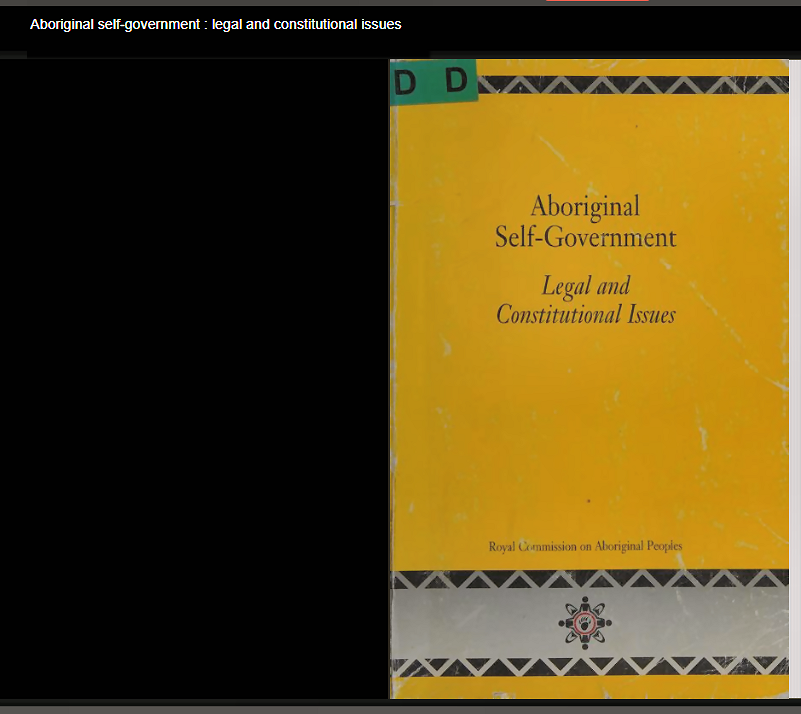
Aboriginal self-government - legal and constitutional issues 1995 Ottawa, Canada- Royal Commission on Aboriginal Peoples- pg141. - papers argues that it is logical and sensible to consider persons of mixed ancestry of all kinds to be within sec. 91(24) jurisdiction and that the
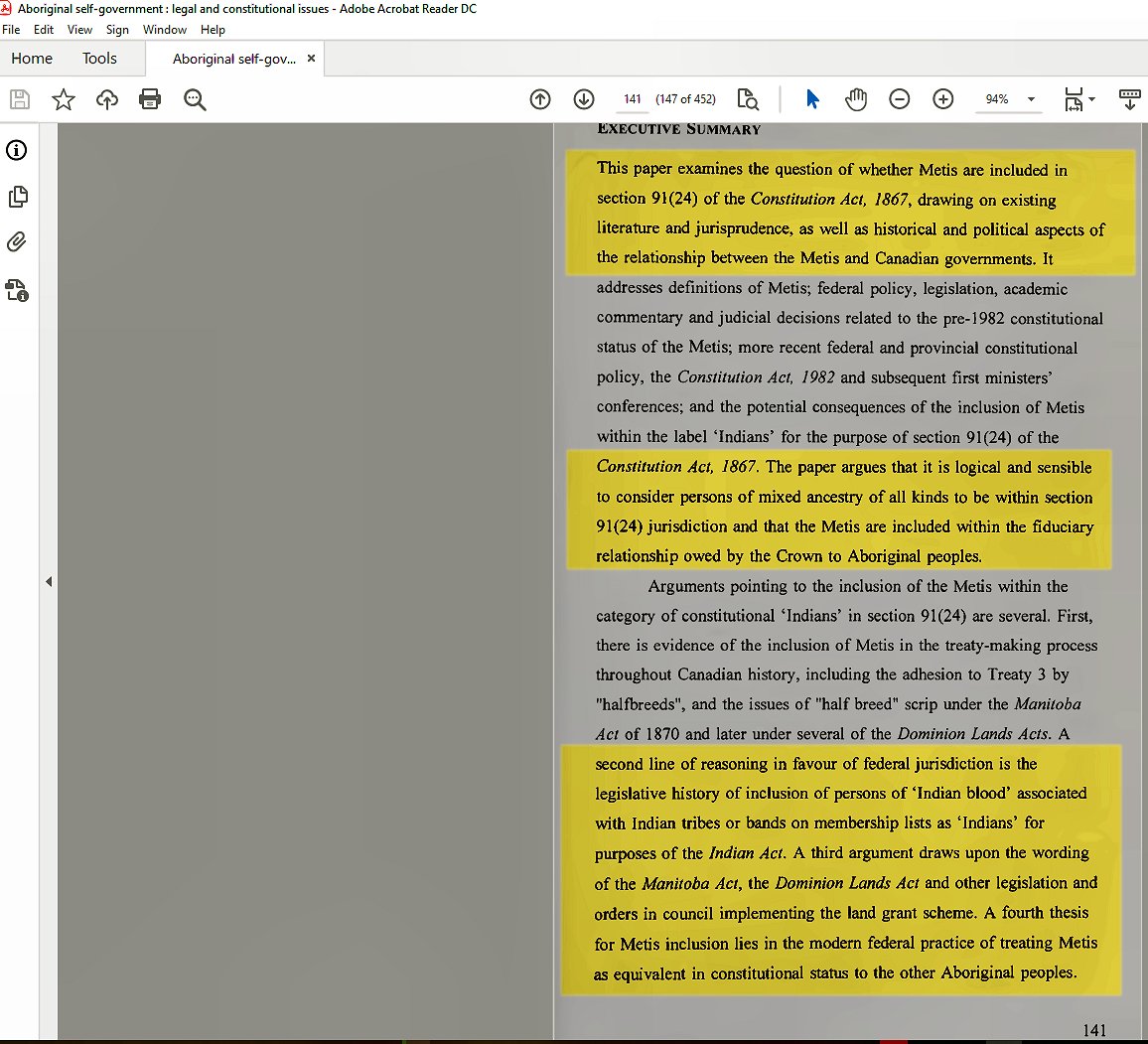
Metis are included within the fiduciary relationship owed by the crown to the Aboriginal peoples. (pg142) The recognition of Metis as one of the "aboriginal peoples of Canada" in section 35 of the Constitution Act 1982, reinforces this federal practice. "It is concluded that
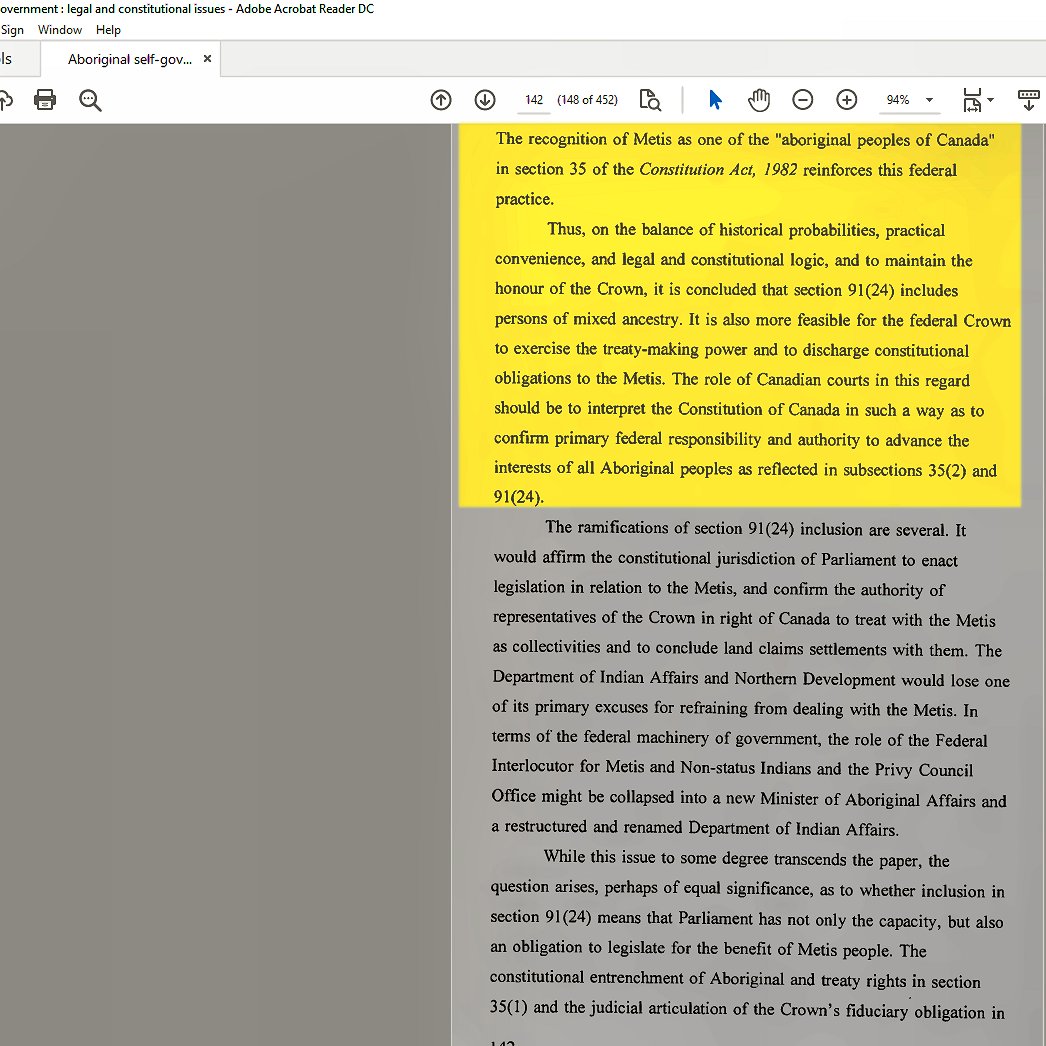
sec 91(24) includes persons of mixed ancestry." pg143- "the Guerin case suggests that the federal gov. may be breaching its fiduciary obligations if it refuses to initiate legislation needed to acknowledge the existence of certain Aboriginal peoples or to meet basic economic
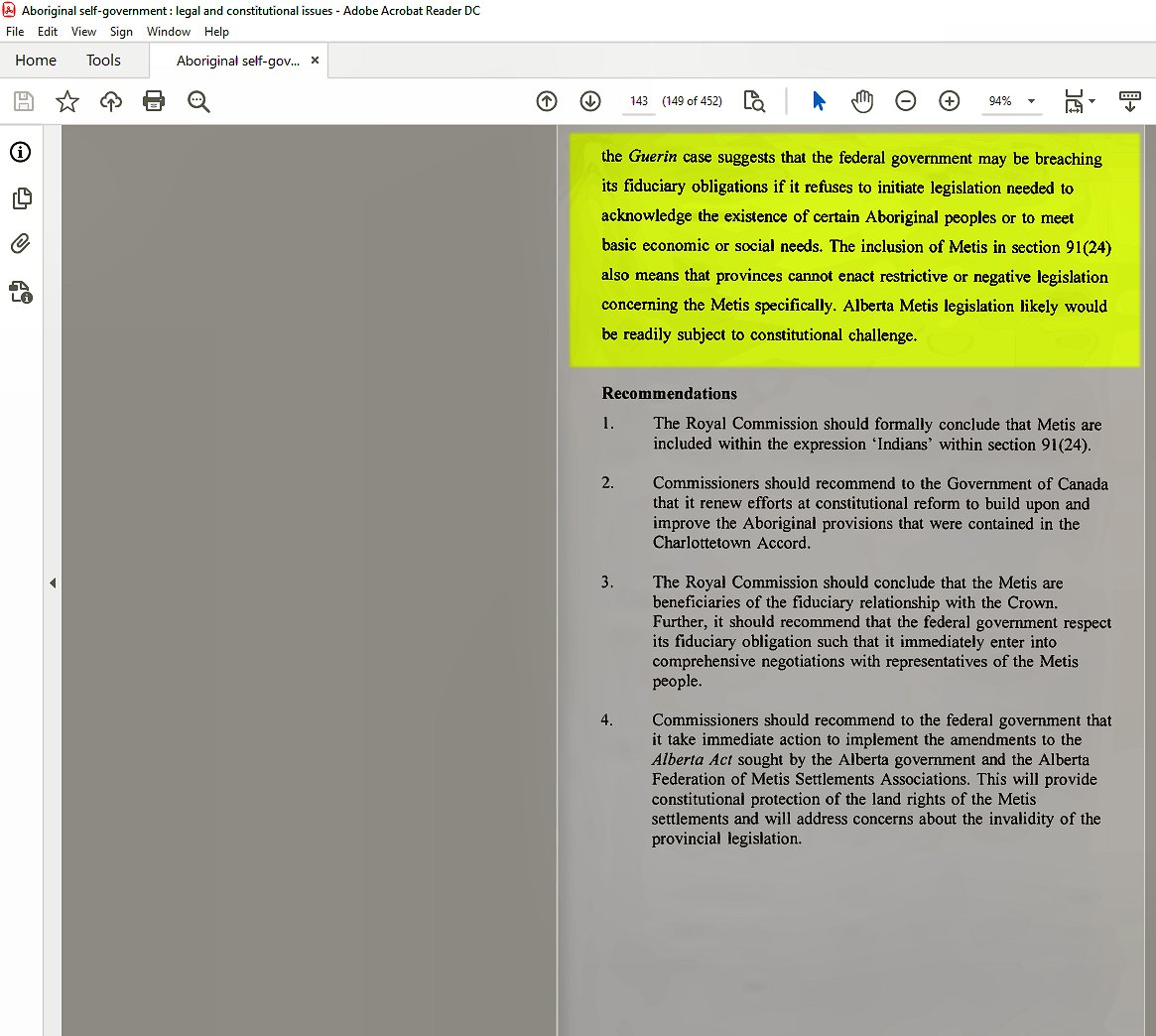
or social needs." https://t.co/90gG3LeCFC -
RELATED CASES AND POSTS
Guerin v. The Queen, [1984] 2 SCR 335
Aboriginal self-government - legal and constitutional issues 1995 Ottawa, Canada- Royal Commission on Aboriginal Peoples- pg141. - papers argues that it is logical and sensible to consider persons of mixed ancestry of all kinds to be within sec. 91(24) jurisdiction and that the
Metis are included within the fiduciary relationship owed by the crown to the Aboriginal peoples. (pg142) The recognition of Metis as one of the "aboriginal peoples of Canada" in section 35 of the Constitution Act 1982, reinforces this federal practice. "It is concluded that
sec 91(24) includes persons of mixed ancestry." pg143- "the Guerin case suggests that the federal gov. may be breaching its fiduciary obligations if it refuses to initiate legislation needed to acknowledge the existence of certain Aboriginal peoples or to meet basic economic
or social needs." https://t.co/90gG3LeCFC -
RELATED CASES AND POSTS
Guerin v. The Queen, [1984] 2 SCR 335


We had a conversation on the podcast about the racialization of dog breeds, where we talked to @BronwenDickey, the author of Pitbull: The Battle Over an American Icon.
In the 1930s, Pitbulls — which, as Bronwen pointed out to me over and over, don’t constitute a dog breed but a shape — used to be seen as the trusty sidekick of the proletariat, the Honda Civic of canines. (Think of “the Little Rascals” dog.)
.
That began changing in the postwar years and the rise of the suburbs. A pedigreed dog became a status symbol for the burgeoning white middle class. And pitbulls got left behind in the cities.
Aside: USians have flitted between different “dangerous” breeds and media-fueled panics around specific dogs. (anti-German xenophobia in the late 1800s fueled extermination programs of the spitz, a little German dog that newspapers said was vicious and spread disease.)
Some previously “dangerous” dogs get rebranded over the years — German shepherds, Dobermans, Rottweilers. But the thing their respective periods of contempt and concern had to do is that they were associated with some contemporarily undesirable group.
Michael Tesler in @FiveThirtyEight bringing some data to bear on my tweets about @ReverendWarnock\u2019s dog ad. A piece worth reading, and a reminder: It\u2019s never \u201cjust a dog,\u201d y\u2019all.https://t.co/ijQvTDOdvj pic.twitter.com/sp05Bhueob
— Hakeem Jefferson (@hakeemjefferson) December 15, 2020
In the 1930s, Pitbulls — which, as Bronwen pointed out to me over and over, don’t constitute a dog breed but a shape — used to be seen as the trusty sidekick of the proletariat, the Honda Civic of canines. (Think of “the Little Rascals” dog.)
.
That began changing in the postwar years and the rise of the suburbs. A pedigreed dog became a status symbol for the burgeoning white middle class. And pitbulls got left behind in the cities.
Aside: USians have flitted between different “dangerous” breeds and media-fueled panics around specific dogs. (anti-German xenophobia in the late 1800s fueled extermination programs of the spitz, a little German dog that newspapers said was vicious and spread disease.)
Some previously “dangerous” dogs get rebranded over the years — German shepherds, Dobermans, Rottweilers. But the thing their respective periods of contempt and concern had to do is that they were associated with some contemporarily undesirable group.

It has been exactly 3 years to "how fund managers .." was released. The book took a lot of time to write. Here is a short thread about how it happened ..
2/n the idea came from @kan_writersside who got me in touch with Dibakar Ghosh at @Rupa_Books .. we discussed the idea that it has been 2 decades to the fund management industry and it deserves a book. A lot was written about about Bharat Shah, Prashant Jain and S.Arora..
3/n but there was not much information about investment philosophies and the overall environment of the mid 90s and later on. Kanishk and Dibakar wanted a broader book for everyone and not just the stock market reader. We went to work
4/n we decided to write about the dotcom boom and bust where it all started. The start fund managers came from there. In Feb 2000 IT index had a pe multiple of 420 and the market cap of the sector was 34% of the market. Banks were 5% and some analysts were still bullish
5/n prashant Jain was one of the few fund managers who was out of the sector in November itself and was quietly watching the index go up. There were others but the legend of Jain was at the top of the mind because it is believed he refused to meet the CFO of a big IT company ..
Bharat shah's Word of wisdom
— Investment Books (@InvestmentBook1) December 5, 2020
-Thumb rule to create Value Investing
Image Courtesy : @ms89_meet
How Fund Managers are Making You Rich: Discover Ways to Tame the Bear and Ride the Bull by @lonelycrowd https://t.co/hKirKY0BtC pic.twitter.com/mbh2gm3Iuo
2/n the idea came from @kan_writersside who got me in touch with Dibakar Ghosh at @Rupa_Books .. we discussed the idea that it has been 2 decades to the fund management industry and it deserves a book. A lot was written about about Bharat Shah, Prashant Jain and S.Arora..
3/n but there was not much information about investment philosophies and the overall environment of the mid 90s and later on. Kanishk and Dibakar wanted a broader book for everyone and not just the stock market reader. We went to work
4/n we decided to write about the dotcom boom and bust where it all started. The start fund managers came from there. In Feb 2000 IT index had a pe multiple of 420 and the market cap of the sector was 34% of the market. Banks were 5% and some analysts were still bullish
5/n prashant Jain was one of the few fund managers who was out of the sector in November itself and was quietly watching the index go up. There were others but the legend of Jain was at the top of the mind because it is believed he refused to meet the CFO of a big IT company ..
You May Also Like











Took me 5 years to get the best Chartink scanners for Stock Market, but you’ll get it in 5 mminutes here ⏰
Do Share the above tweet 👆
These are going to be very simple yet effective pure price action based scanners, no fancy indicators nothing - hope you liked it.
https://t.co/JU0MJIbpRV
52 Week High
One of the classic scanners very you will get strong stocks to Bet on.
https://t.co/V69th0jwBr
Hourly Breakout
This scanner will give you short term bet breakouts like hourly or 2Hr breakout
Volume shocker
Volume spurt in a stock with massive X times
Do Share the above tweet 👆
These are going to be very simple yet effective pure price action based scanners, no fancy indicators nothing - hope you liked it.
https://t.co/JU0MJIbpRV
52 Week High
One of the classic scanners very you will get strong stocks to Bet on.
https://t.co/V69th0jwBr
Hourly Breakout
This scanner will give you short term bet breakouts like hourly or 2Hr breakout
Volume shocker
Volume spurt in a stock with massive X times