All Threads















#thread
👇
Strong marketing game, super hard work, can stream for 24 hours and currently leading a new streamer movement with the #24hrstartup challenge.
Make it bigger than yourself.
👉 @thepatwalls
Made the awesome https://t.co/lBYn9nP3KJ which works perfectly and saved me hours and hours.
Make a simple, helpful product.
👉 @gvrizzo
Making the stylish @threader_app looking for maximum integration with Twitter (it might even become part of Twitter one day...)
Raise the bar for quality, look for seamless integrations.
👉 @marie_dm_ + @yesnoornext
Successfully monetized a tiny social network @wip without screwing his users, focusing on the maker community.
A small engaged community is enough.
👉 @marckohlbrugge


The tidbits of wisdom acquired while reading Samhitas- an entirely different lesson learnt every single time!
— Dr Vishakha Moghe \U0001f1ee\U0001f1f3 (@drmoghes) June 5, 2021
A language can be just so full with consciousness and wisdom!!
Wonder how on earth they call #Sanskrit a dead language?
At best, people are willing to admit that it has a great literature and a cultural value at the other end, there are people who consider it as a mysterious combination of words to create a religious atmosphere through prayers, chanting, incantations, etc.
But Sanskrit is much more than that and possesses within itself many of the attributes of a great and useful language.
It is both a science and an art combined in one. As a language, Sanskrit has a degree of permanence which no other language has. In olden days, when teaching
was oral, there was a need to keep information in tact and pass them on from generation to generation accurately. This led, on one hand, to a strong emphasis towards versification, poetry and phonetics. On the other side, formulae were devised of inventing and converting words
in such a way that chances of distortion were kept at a minimum.
3. After Panini's grammer, Sanskrit language was so much standardized that further linguistic development was not possible. By a general consensus the world over, it is well recognized that Sanskrit literature,


This is ridiculous. Students were asked for their views on this example and several others. The study findings and conclusions were about student responses not the substance of each case. Could\u2019ve used hypotheticals. The responses not the cases were the basis of the conclusions.
— Eric Kaufmann (@epkaufm) February 17, 2021
Here is the incident Kaufmann incorporated into his study, as told by a Cardiff professor who was there. As you can see, the incident involved the university intervening to *uphold* free speech principles:
The UK govt\u2019s paper on free speech in Unis (with implications for Wales) is getting a lot of attention.
— Richard Wyn Jones (@RWynJones) February 16, 2021
Worth noting then that an important part of the evidence-base on which it rests relates to (demonstrably false) claims about my own institution
1/https://t.co/buoGE7ocG7
Here is the first mention of the Greer at Cardiff incident in Kaufmann's report. It refers to the "concrete case" of the "no-platforming of Germaine Greer". Any reasonable reader would assume that refers to an incident of no-platforming instead of its opposite.

Here is the next mention of Greer in the report. The text asks whether the University "should have overruled protestors" and "stepped in...and guaranteed Greer the right to speak". Again the strong implication is that this did not happen and Greer was "no platformed".
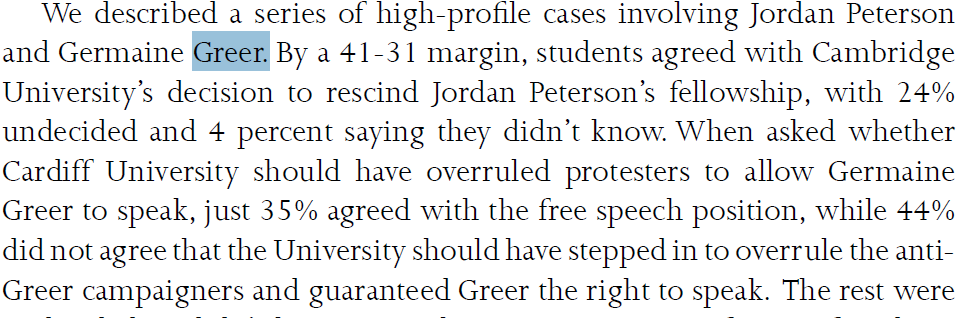
The authors could easily have added a footnote at this point explaining what actually happened in Cardiff. They did not.

It was actually the shakti form of devi which took birth as Sati in Daksh's house who acquired this name due to her satya swarup.
Everyone is aware of the story as to why Sati jumped into the Yagya fire.
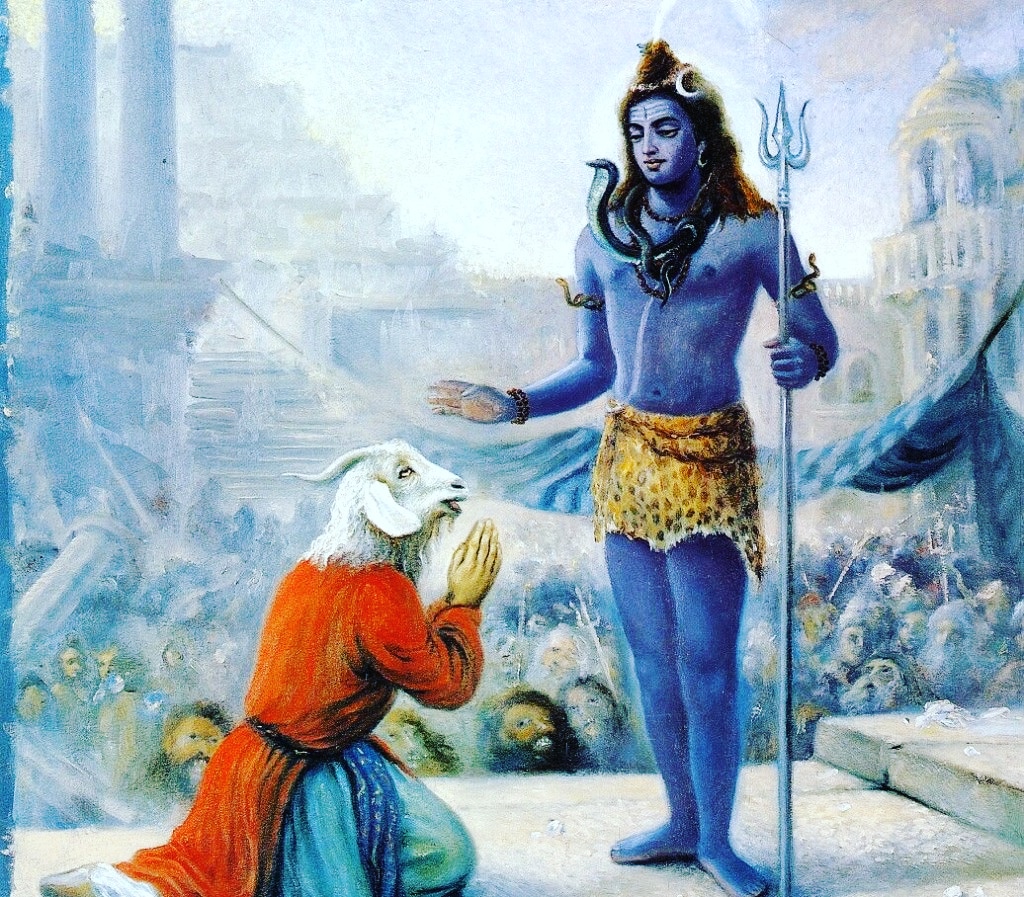
But there is a story behind the reason for the negative behaviour of Daksh.
It so happened that once Rishi Durvasa went to Devi Jambunadeshwari and after her darshan recited the Mayabeej mantra. The devi happily gave him a divine Garland. Durvasa happily accepted it and left.
On his way he met Daksh who was eager to get the divine Garland. He requested the Rishi to give him that Garland. Knowing that Daksh was a good person, Durvasa gave the garland to him.
But Daksh casually kept the garland on his bed and went about doing his earthly instinctive work. Due to this insulting behaviour of Daksh for the divine garland, he developed a negative feeling for Shiva and Sati(Aadi Shakti).
Source - Devi puran
Instagram link👇
https://t.co/papGLZvcaI