One of the authors of the Policy Exchange report on academic free speech thinks it is "ridiculous" to expect him to accurately portray an incident at Cardiff University in his study, both in the reporting and in a question put to a student sample.

Here is the incident Kaufmann incorporated into his study, as told by a Cardiff professor who was there. As you can see, the incident involved the university intervening to *uphold* free speech principles:
https://t.co/c0aOGU9aUZ
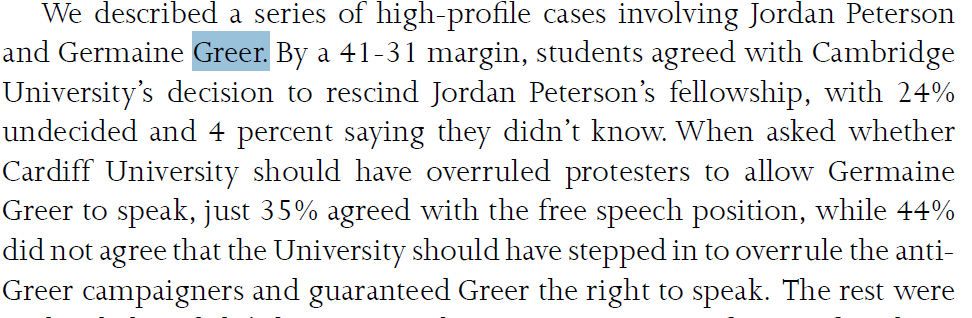
Here is the first mention of the Greer at Cardiff incident in Kaufmann's report. It refers to the "concrete case" of the "no-platforming of Germaine Greer". Any reasonable reader would assume that refers to an incident of no-platforming instead of its opposite.
Here is the next mention of Greer in the report. The text asks whether the University "should have overruled protestors" and "stepped in...and guaranteed Greer the right to speak". Again the strong implication is that this did not happen and Greer was "no platformed".
The authors could easily have added a footnote at this point explaining what actually happened in Cardiff. They did not.
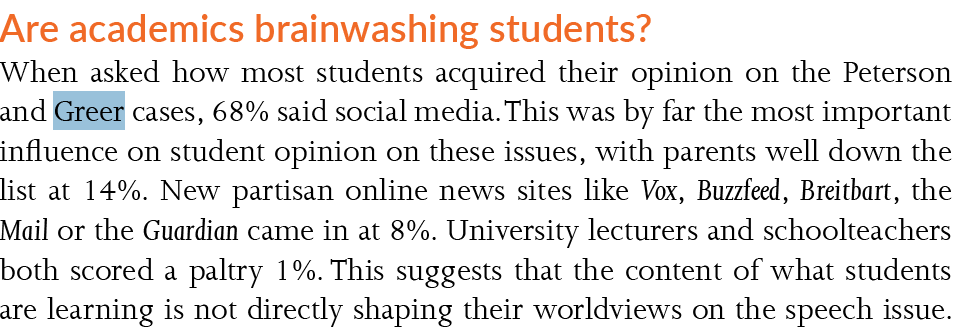
Here is another section of the text, where the authors consider where students "acquired their opinion" about the "Greer case". Again, the implication is that the "Greer case" is, as it was initially described, an incident of university sanctioned no-platforming
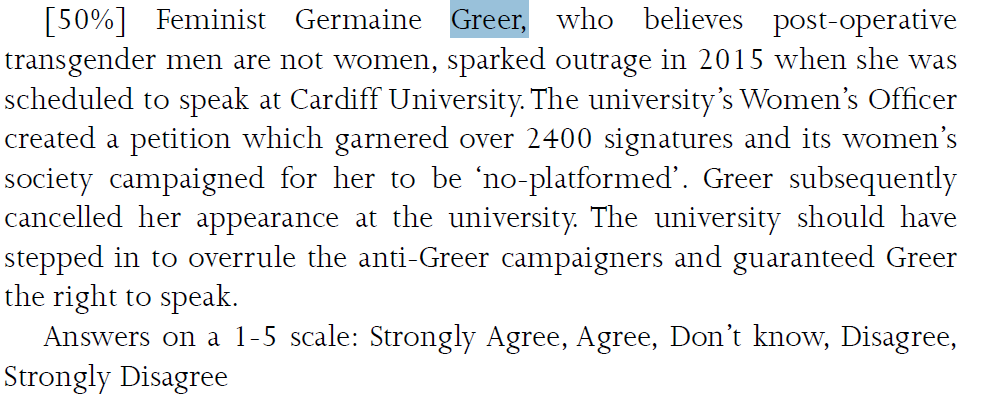
And here is the kicker - the actual question asked to students in the study. This quite clearly presents the Greer incident as a matter of historical fact, which occurred as presented. It is not presented as a scenario or thought experiment.
The question is deceptive. It asks students to pass judgement on an actual university failing to intervene to prevent the actual cancellation of an actual event. But the actual university in question *did* intervene to ensure the actual event *did occur*.
Why does all this matter? Because the report in question is being used to argue for heavy handed government interventions to deal with universities' alleged failure to protect free speech. Kaufmann, one of the main authors, has written in emotive language of "woke sorcerers"
who must be prevented from suppressing free debate. Any academic should be free to criticise university policy and culture. But that criticism should be grounded in factual evidence. The evidence presented as fact in this case is nothing of the sort.
This is not a minor error. The study questionnaire could have presented cases as scenarios or thought experiments. It did not. It presented the case in question as fact. The report could have caveated the findings, explaining the real context. It did not.
These errors, and the reasons they are problematic, have been pointed out to Kaufmann. He has dismissed them as "ridiculous". You can judge for yourselves - I have presented all the evidence here. Personally, I think it is "ridiculous" than an academic misrepresent in this way
Therefore, I ask again that Kaufmann take the step he has so far resisted taking, and amend his report to include a correct statement about the event in Cardiff, making it clear to his readers (who include the Education Secretary, who has cited this report heavily) are aware
that an event he presents to his student sample, and presents to his readers, as an incident of a university failing to stand up to a no-platforming campaign was in fact an incident of a university standing against a no-platforming campaign and ensuring an event happens.
I hope that @epkaufm will reconsider his views on this and amend his report. He should also apologise to Cardiff University for misrepresenting their behaviour repeatedly with regards the Greer case.
Further testimony on this from the individual responsible for organising and managing the Germaine Greer event at Cardiff:
https://t.co/0PxLlWLxxh

More from Culture

Best books I read in 2020

1. Atomic Habits by @JamesClear

“If you show up at the gym 5 days in a row—even for 2 minutes—you're casting votes for your new identity. You’re not worried about getting in shape. Youre focused on becoming the type of person who doesn’t miss workouts”


Good Reasons for Bad Feelings

https://t.co/KZDqte19nG

2. “social anxiety is overwhelmingly common. Natural selection shaped us to care enormously what other people think..We constantly monitor how much others value us..Low self-esteem is a signal to try harder to please others”


The True Believer by Eric Hoffer

https://t.co/uZT4kdhzvZ

“Hatred is the most accessible and comprehensive of all unifying agents...Mass movements can rise and spread without belief in a God, but never without a believe in a devil.”


Grandstanding

https://t.co/4Of58AZUj8

"if politics becomes a morality pageant, then the contestants have an incentive to keep problems intact...politics becomes a forum to show off moral qualities...people will be dedicated to activism for its own sake, as a vehicle to preen"


Warriors and Worriers by Joyce Benenson

https://t.co/yLC4eGHEd4

“Across diverse cultures, a man who lives in the house with another man’s children is about 60 times more likely than the biological father to kill those children.”
A thread of very good, wonderful, truly Super Bowls.

Translucent agate bowl with ornamental grooves and coffee-and-cream marbling. Found near Qift in southern Egypt. 300 - 1,000 BC. 📷 Getty Museum https://t.co/W1HfQZIG2V


Technicolor dreambowl, found in a grave near Zadar on Croatia's Dalmatian Coast. Made by melding and winding thin bars of glass, each adulterated with different minerals to get different colors. 1st century AD. 📷 Zadar Museum of Ancient Glass
https://t.co/H9VfNrXKQK


100,000-year-old abalone shells used to mix red ocher, marrow, charcoal, and water into a colorful paste. Possibly the oldest artist's palettes ever discovered. Blombos Cave, South Africa. 📷https://t.co/0fMeYlOsXG


Reed basket bowl with shell and feather ornaments. Possibly from the Southern Pomo or Lake Miwok cultures. Found in Santa Barbara, CA, circa 1770. 📷 British Museum https://t.co/F4Ix0mXAu6


Wooden bowl with concentric circles and rounded rim, most likely made of umbrella thorn acacia (Vachellia/Acacia tortilis). Qumran. 1st Century BCE. 📷 https://t.co/XZCw67Ho03

You May Also Like