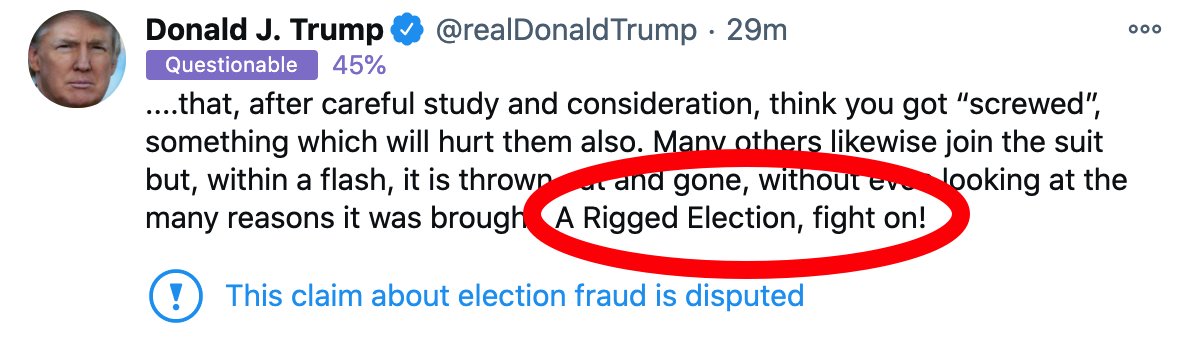
Big conspiracy theory right now is that NPR "mistakenly" published news on what conspiracy theorists believe was a planned faked invasion ahead of time. Just look at the time when this was published and look at the headline they are saying! Here's why that's idiotic.
More from Trump
Trump: Day 1,407 (THREAD)
-13,454,254 Cases of COVID-19 in US
-US CV-19 Death Toll Rises to 271,026
-Day 20 Since Biden Declared Winner
-Day 424 at a Trump-owned Property
-Touts Assassination of Iran Scientist
-Appointed Judge Rejects PA Lawsuit
-$3M Recount Increases Biden Lead
https://t.co/hOfTV6hRNx
https://t.co/KYBIm6Qohw
https://t.co/Bj5tluZ5dh
https://t.co/Q9YG4btKvH
-13,454,254 Cases of COVID-19 in US
-US CV-19 Death Toll Rises to 271,026
-Day 20 Since Biden Declared Winner
-Day 424 at a Trump-owned Property
-Touts Assassination of Iran Scientist
-Appointed Judge Rejects PA Lawsuit
-$3M Recount Increases Biden Lead
https://t.co/hOfTV6hRNx
According to the press pool, Trump arrived at his Trump-branded golf club this morning in Sterling, VA.
— Alamo_On_The_Rise \u2197\ufe0f\U0001f198 \U0001f1fa\U0001f1f2 (@AlamoOnTheRise) November 27, 2020
This is Trump's 315th day at a golf club and 424th day at a Trump property since taking office at our expense as the outbreak continues to ravage our country. https://t.co/zaNo0gWEpY
https://t.co/KYBIm6Qohw
along the "presidential" motorcade route today. pic.twitter.com/eIkQi5ZhtC
— ActivistKathy (@activistkathy) November 27, 2020
https://t.co/Bj5tluZ5dh
The sign I was holding as Trump pulled into his golf course. Visible in above picture! pic.twitter.com/kYC5aQJB8A
— William D Johnson (@GMUBillJohnson) November 27, 2020
https://t.co/Q9YG4btKvH
Reminder: Trump said, if elected, he would never see his golf courses ... would be working all the time #TrumpLies pic.twitter.com/Kj6aFVoeaw
— Alamo_On_The_Rise \u2197\ufe0f\U0001f198 \U0001f1fa\U0001f1f2 (@AlamoOnTheRise) September 20, 2020
You May Also Like
A brief analysis and comparison of the CSS for Twitter's PWA vs Twitter's legacy desktop website. The difference is dramatic and I'll touch on some reasons why.
Legacy site *downloads* ~630 KB CSS per theme and writing direction.
6,769 rules
9,252 selectors
16.7k declarations
3,370 unique declarations
44 media queries
36 unique colors
50 unique background colors
46 unique font sizes
39 unique z-indices
https://t.co/qyl4Bt1i5x
PWA *incrementally generates* ~30 KB CSS that handles all themes and writing directions.
735 rules
740 selectors
757 declarations
730 unique declarations
0 media queries
11 unique colors
32 unique background colors
15 unique font sizes
7 unique z-indices
https://t.co/w7oNG5KUkJ
The legacy site's CSS is what happens when hundreds of people directly write CSS over many years. Specificity wars, redundancy, a house of cards that can't be fixed. The result is extremely inefficient and error-prone styling that punishes users and developers.
The PWA's CSS is generated on-demand by a JS framework that manages styles and outputs "atomic CSS". The framework can enforce strict constraints and perform optimisations, which is why the CSS is so much smaller and safer. Style conflicts and unbounded CSS growth are avoided.
Legacy site *downloads* ~630 KB CSS per theme and writing direction.
6,769 rules
9,252 selectors
16.7k declarations
3,370 unique declarations
44 media queries
36 unique colors
50 unique background colors
46 unique font sizes
39 unique z-indices
https://t.co/qyl4Bt1i5x
PWA *incrementally generates* ~30 KB CSS that handles all themes and writing directions.
735 rules
740 selectors
757 declarations
730 unique declarations
0 media queries
11 unique colors
32 unique background colors
15 unique font sizes
7 unique z-indices
https://t.co/w7oNG5KUkJ
The legacy site's CSS is what happens when hundreds of people directly write CSS over many years. Specificity wars, redundancy, a house of cards that can't be fixed. The result is extremely inefficient and error-prone styling that punishes users and developers.
The PWA's CSS is generated on-demand by a JS framework that manages styles and outputs "atomic CSS". The framework can enforce strict constraints and perform optimisations, which is why the CSS is so much smaller and safer. Style conflicts and unbounded CSS growth are avoided.