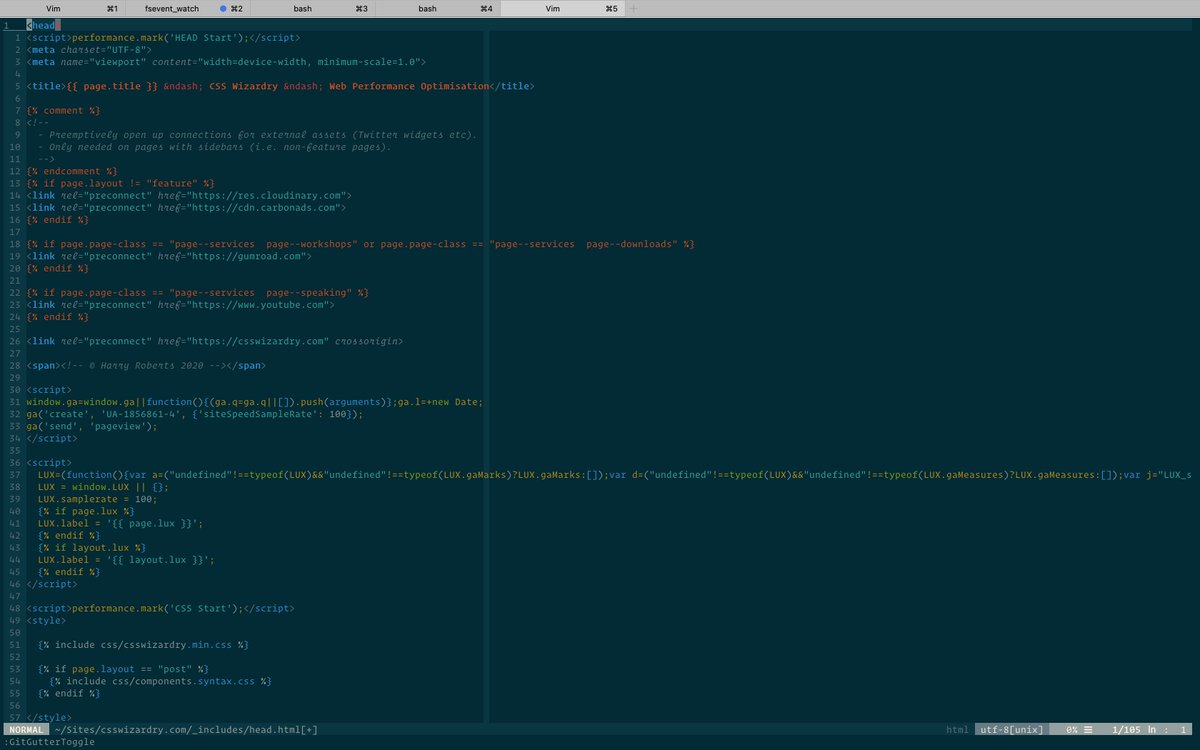
🧵 Two of my most- and first-used checks when doing a performance audit are surprisingly old school: 1) Validate HTML 2) Disable JS.
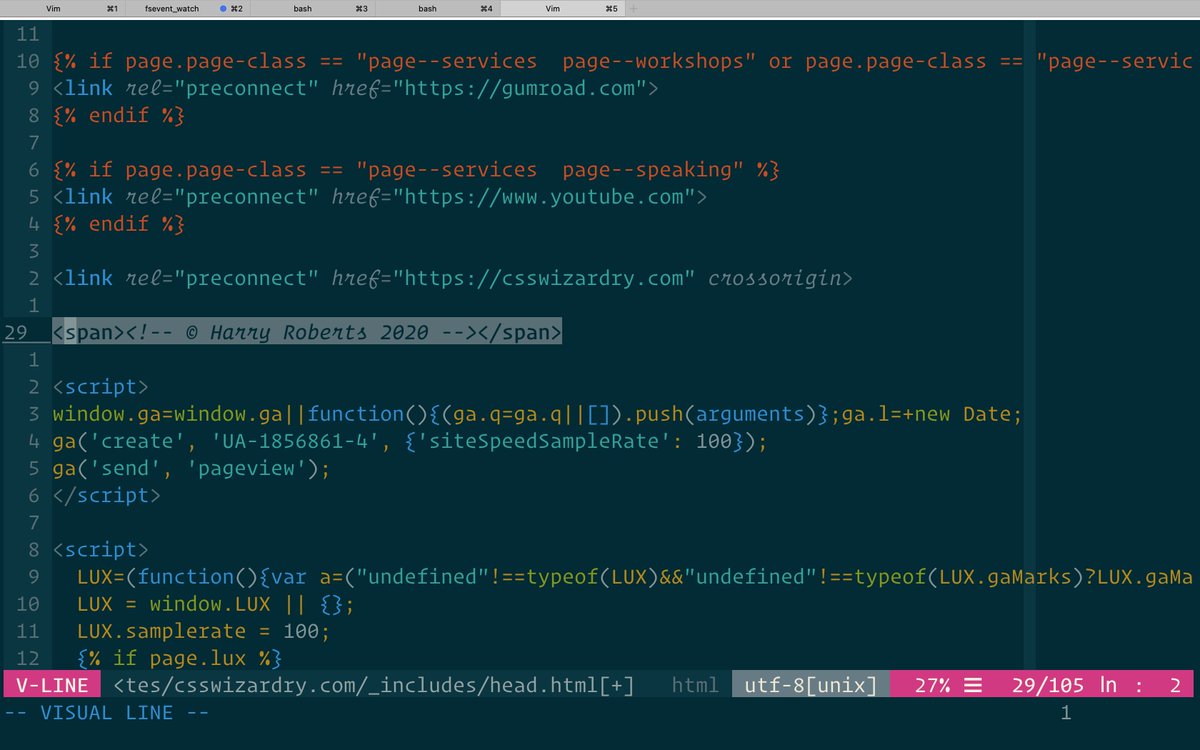
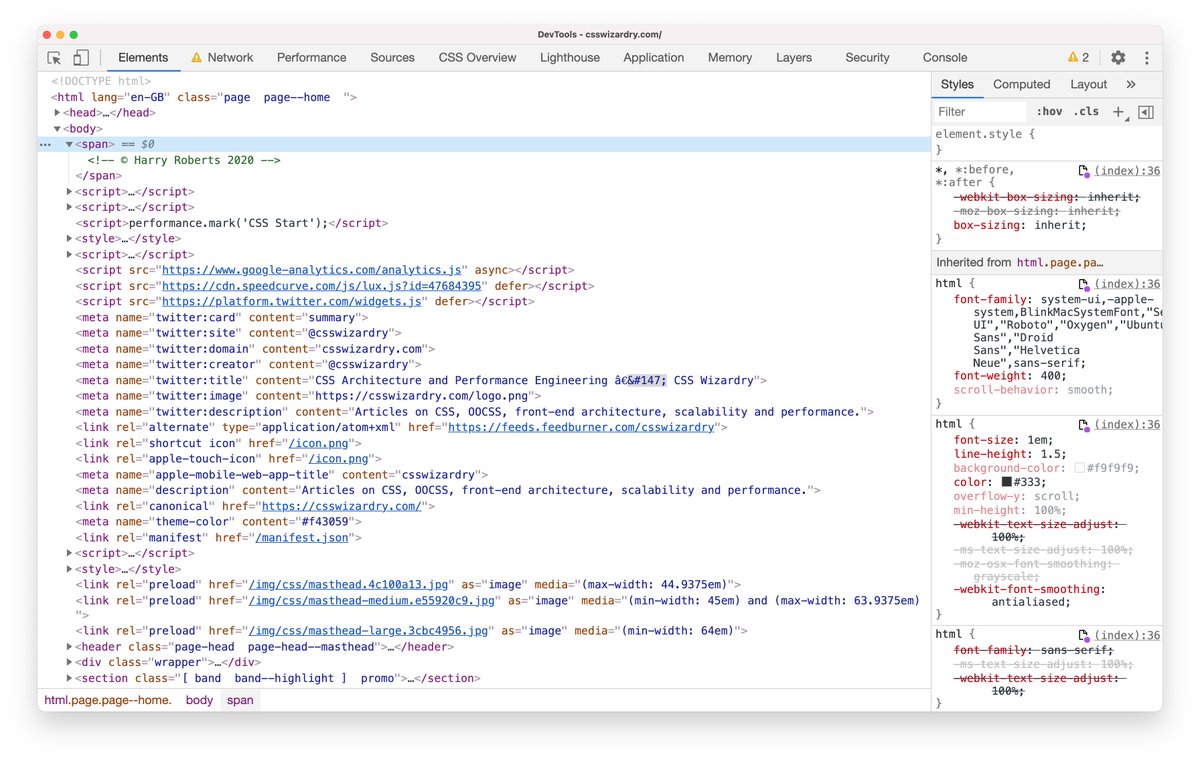
Validate HTML? Yep. We haven’t really cared about ‘valid HTML’ for valid HTML’s sake for about a decade, but certain errors can actually be pretty significant. What’s wrong with this picture?
It’s this lil’ fella right here. isn’t allowed in the , so when the browser encounters the , it assumes the should have been closed already.
This is a feature. This is what allows us to omit certain closing tags like

, , , and—you guessed it!—. The appearance of certain opening tags implies the closing of certain preceding ones.
The practical upshot of which is that non- elements early-terminate the tags, pushing all of your important resources into the . Oops!
Disable JavaScript? I think building sites for people who’ve turned JS off is an expensive waste of time: they’ve turned it off! Leave them to it. But! I do feel it’s vital that we can fail reasonably elegantly when JS fails (and it will).
I strongly hold @adactio and @jaffathecake’s respective (and paraphrased) opinions about JS: ‘How well does it fail?’ and ‘All your users are non-JS until your JS is downloaded and run’.
From a performance perspective, I don’t want to see your core content buried away in JS. JS is slower than HTML. If you need JS to display core content, you’re on the slow path. The quickest way for me to ascertain whether content is coming out of JS? Disable it!
Do I care that CNN doesn’t work with JS disabled? Not necessarily. But immediately I can see that their content is reliant on the successful download and execution of JS. This is always going to be slower than having it in the HTML—the first (and successful) response.

More from Tech

These past few days I've been experimenting with something new that I want to use by myself.

Interestingly, this thread below has been written by that.

Let me show you how it looks like. 👇🏻


When you see localhost up there, you should know that it's truly an experiment! 😀


It's a dead-simple thread writer that will post a series of tweets a.k.a tweetstorm. ⚡️

I've been personally wanting it myself since few months ago, but neglected it intentionally to make sure it's something that I genuinely need.

So why is that important for me? 🙂

I've been a believer of a story. I tell stories all the time, whether it's in the real world or online like this. Our society has moved by that.

If you're interested by stories that move us, read Sapiens!

One of the stories that I've told was from the launch of Poster.

It's been launched multiple times this year, and Twitter has been my go-to place to tell the world about that.

Here comes my frustration.. 😤
A brief analysis and comparison of the CSS for Twitter's PWA vs Twitter's legacy desktop website. The difference is dramatic and I'll touch on some reasons why.

Legacy site *downloads* ~630 KB CSS per theme and writing direction.

6,769 rules
9,252 selectors
16.7k declarations
3,370 unique declarations
44 media queries
36 unique colors
50 unique background colors
46 unique font sizes
39 unique z-indices

https://t.co/qyl4Bt1i5x


PWA *incrementally generates* ~30 KB CSS that handles all themes and writing directions.

735 rules
740 selectors
757 declarations
730 unique declarations
0 media queries
11 unique colors
32 unique background colors
15 unique font sizes
7 unique z-indices

https://t.co/w7oNG5KUkJ


The legacy site's CSS is what happens when hundreds of people directly write CSS over many years. Specificity wars, redundancy, a house of cards that can't be fixed. The result is extremely inefficient and error-prone styling that punishes users and developers.

The PWA's CSS is generated on-demand by a JS framework that manages styles and outputs "atomic CSS". The framework can enforce strict constraints and perform optimisations, which is why the CSS is so much smaller and safer. Style conflicts and unbounded CSS growth are avoided.
Thought I'd put a thread together of some resources & people I consider really valuable & insightful for anyone considering or just starting out on their @SorareHQ journey. It's by no means comprehensive, this community is super helpful so no offence to anyone I've missed off...

1) Get yourself on the official Sorare Discord group
https://t.co/1CWeyglJhu, the forum is always full of interesting debate. Got a question? Put it on the relevant thread & it's usually answered in minutes. This is also a great place to engage directly with the @SorareHQ team.

2) Bury your head in @HGLeitch's @SorareData & get to grips with all the collated information you have to hand FOR FREE! IMO it's vital for price-checking, scouting & S05 team building plus they are hosts to the forward thinking SO11 and SorareData Cups 🏆

3) Get on YouTube 📺, subscribe to @Qu_Tang_Clan's channel https://t.co/1ZxMsQR1kq & engross yourself in hours of Sorare tutorials & videos. There's a good crowd that log in to the live Gameweek shows where you get to see Quinny scratching his head/ beard over team selection.

4) Make sure to follow & give a listen to the @Sorare_Podcast on the streaming service of your choice 🔊, weekly shows are always insightful with great guests. Worth listening to the old episodes too as there's loads of information you'll take from them.

You May Also Like

@franciscodeasis https://t.co/OuQaBRFPu7
Unfortunately the "This work includes the identification of viral sequences in bat samples, and has resulted in the isolation of three bat SARS-related coronaviruses that are now used as reagents to test therapeutics and vaccines." were BEFORE the


chimeric infectious clone grants were there.https://t.co/DAArwFkz6v is in 2017, Rs4231.
https://t.co/UgXygDjYbW is in 2016, RsSHC014 and RsWIV16.
https://t.co/krO69CsJ94 is in 2013, RsWIV1. notice that this is before the beginning of the project

starting in 2016. Also remember that they told about only 3 isolates/live viruses. RsSHC014 is a live infectious clone that is just as alive as those other "Isolates".

P.D. somehow is able to use funds that he have yet recieved yet, and send results and sequences from late 2019 back in time into 2015,2013 and 2016!

https://t.co/4wC7k1Lh54 Ref 3: Why ALL your pangolin samples were PCR negative? to avoid deep sequencing and accidentally reveal Paguma Larvata and Oryctolagus Cuniculus?