0/ I’m tired of hearing about observability replacing monitoring. It’s not going to, and that’s because it shouldn’t.

Observability will not _replace_ monitoring, it will _augment_ monitoring.

Here’s a thread about observability, and how monitoring can evolve to fit in: 👇

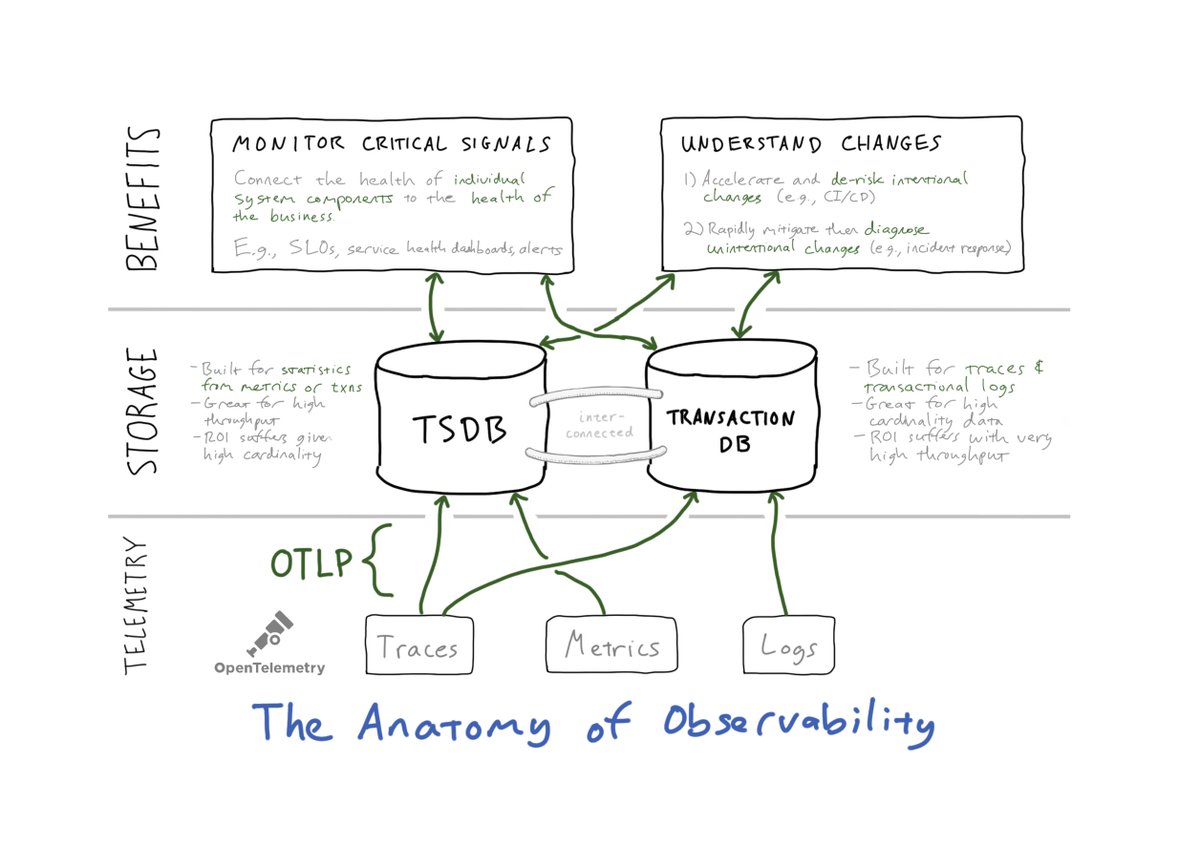
1/ Let’s start with the diagram (above) illustrating the anatomy of observability. There are three layers:

I. (Open)Telemetry: acquire high-quality data with minimal effort
II. Storage: “Stats over time” and “Transactions over time”
III. Benefits: *solve actual problems*
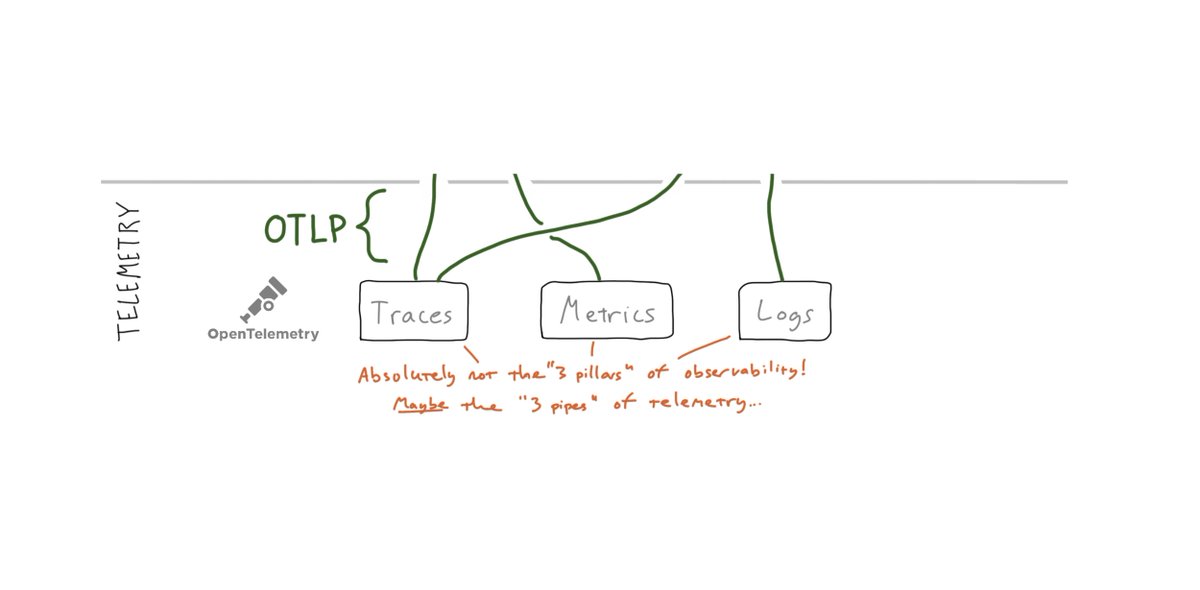
2/ The direction for “Telemetry” is simple: @opentelemetry.

(This is the (only) place where the so-called "three pillars” come in, by the way. If you think you’ve solved the observability problem by collecting traces, metrics, and logs, you’re about to be disappointed. :-/ )
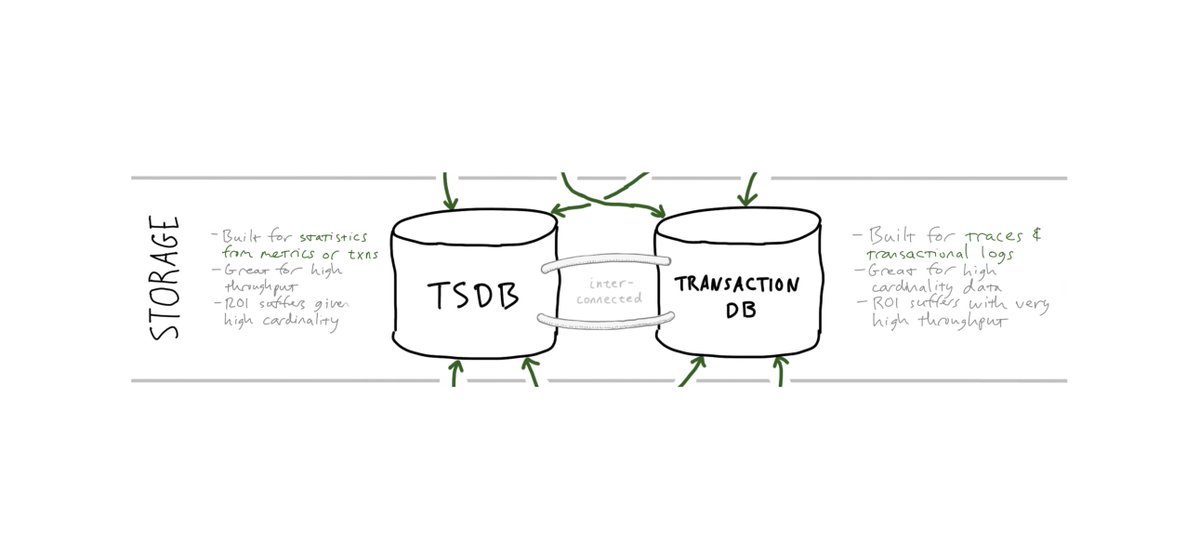
3/ The answer for “Storage” depends on your workload, but we’ve learned that it’s glib to expect a data platform to support observability with *just* a TSDB or *just* a transaction/trace/logging DB. And also that “cost profiling and control” is a core platform feature.
4/ But what about “Benefits”? There’s all of that business about Control Theory (too academic) and “unknown unknowns” (too abstract). And “three pillars” which is complete BS, per the above (it’s just “the three pillars of telemetry,” at best).
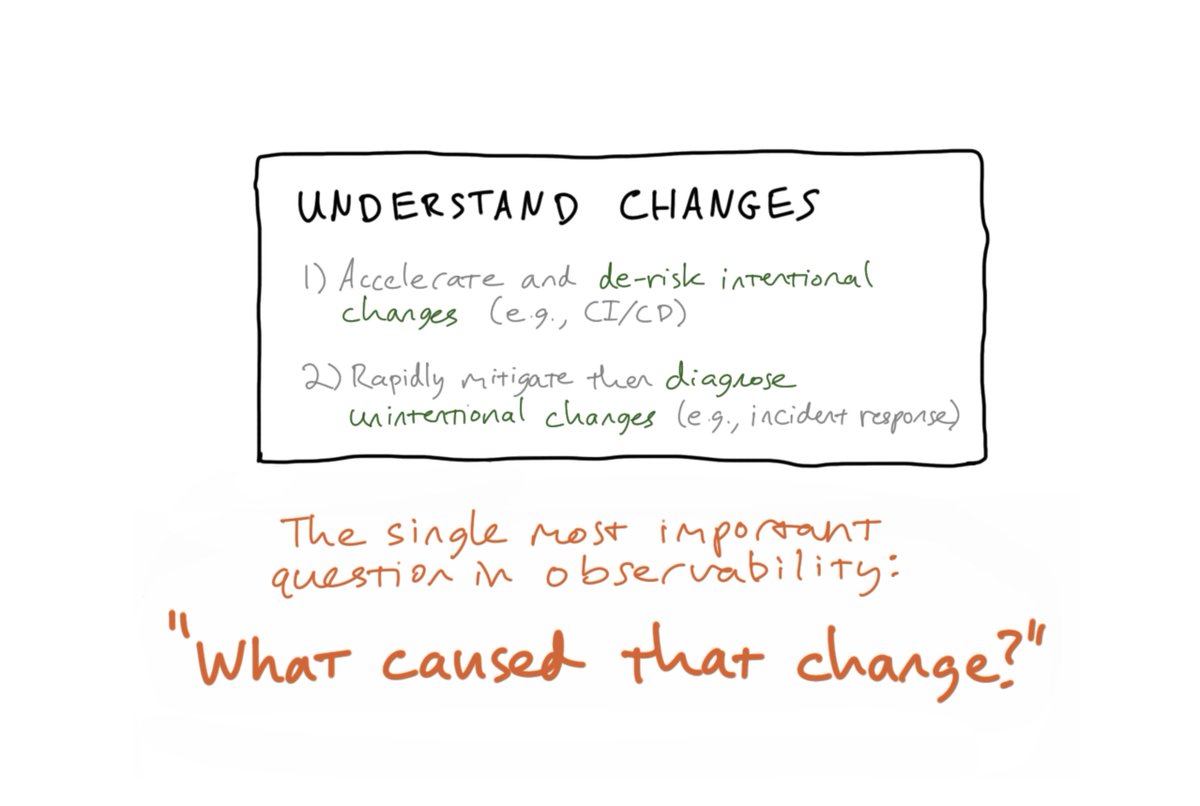
5/ Really, Observability *Benefits* divide neatly into two categories: understanding *health* (i.e., monitoring) and understanding *change* (i.e., finding and exposing signals and statistical insights hidden within the firehose of telemetry).
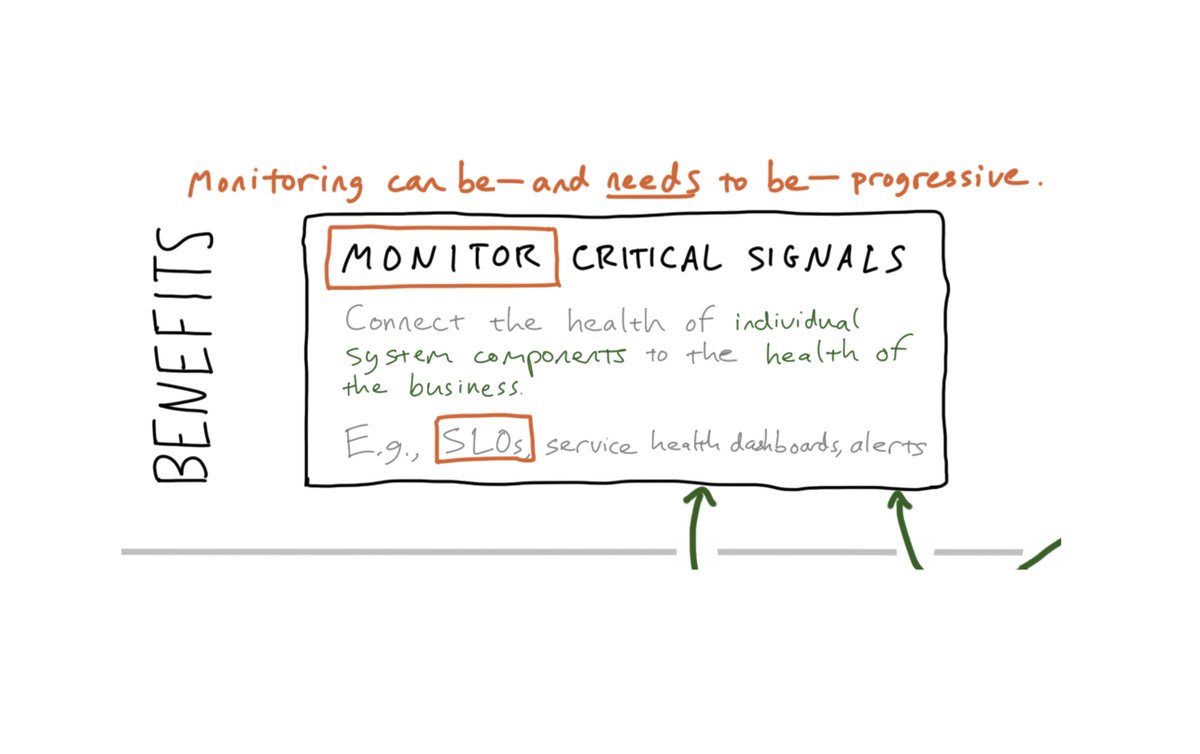
6/ Somewhere along the way, “monitoring” was thrown under a bus, which is unfortunate. If we define monitoring as *an effort to connect the health of a system component to the health of the business* – it’s actually quite vital. And ripe for innovation! E.g., SLOs.
7/ “Monitoring” got a bad name because operators were *trying to monitor every possible failure mode of a distributed system.* That doesn’t work because there are too many of them.

(And that’s why you have too many dashboards at your company.)
8/ Monitoring doesn’t have to be that way. It can actually be quite clarifying, and there’s still ample room for innovation. I’d argue that SLOs, done properly, are what monitoring can and should be (or become).
9/ So what if we do things differently? What if we do things *right*? We treat Monitoring as a first-class citizen, albeit only one aspect of observability, and we closely track the signals that best express and predict the health of each component in our systems.
10/ … And then we need a new kind of observability value that’s purpose-built to manage *changes* in those signals. More on that part in a future post. :) But the idea is to facilitate intentional change (e.g., CI/CD) while mitigating unintentional change (Incident Response).
11/ Zooming out: Monitoring will never be *replaced* by Observability: it’s not just "part of Observability’s anatomy," it’s a vital organ! Our challenge is to *evolve* Monitoring, and to use it as a scaffold for the patterns and insights in our telemetry that explain change.

More from Tech

On Wednesday, The New York Times published a blockbuster report on the failures of Facebook’s management team during the past three years. It's.... not flattering, to say the least. Here are six follow-up questions that merit more investigation. 1/

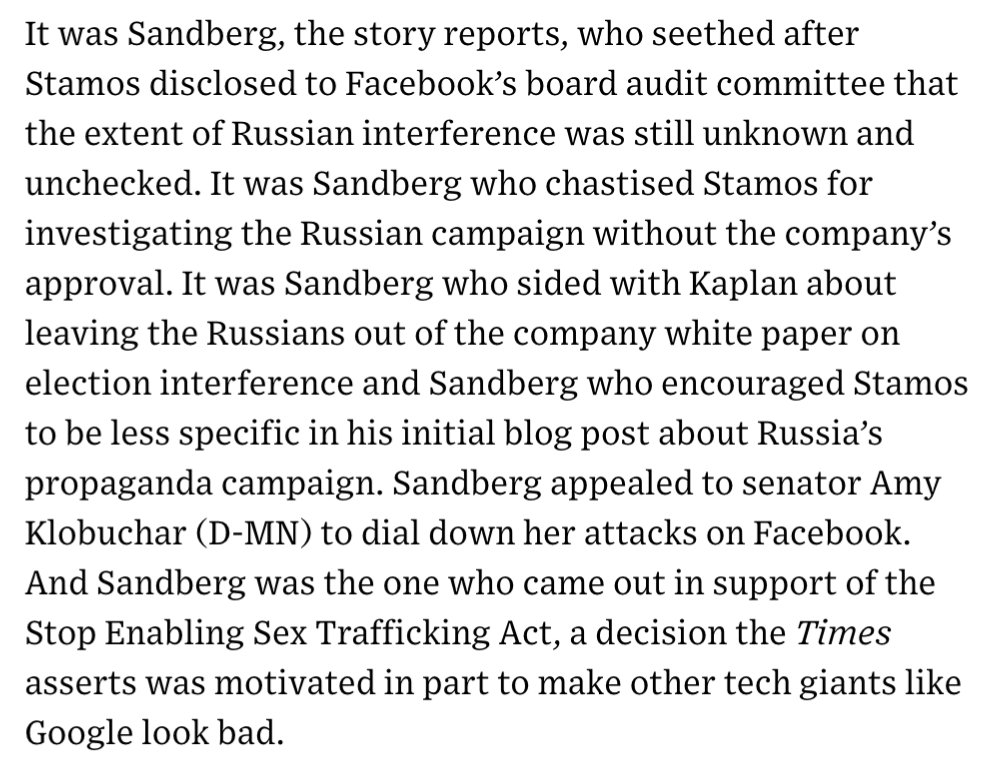
1) During the past year, most of the anger at Facebook has been directed at Mark Zuckerberg. The question now is whether Sheryl Sandberg, the executive charged with solving Facebook’s hardest problems, has caused a few too many of her own. 2/
https://t.co/DTsc3g0hQf


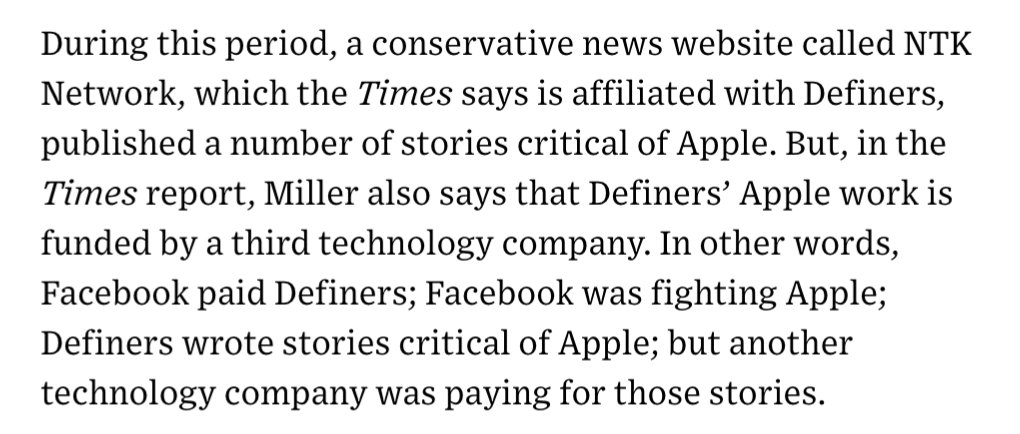
2) One of the juiciest sentences in @nytimes’ piece involves a research group called Definers Public Affairs, which Facebook hired to look into the funding of the company’s opposition. What other tech company was paying Definers to smear Apple? 3/ https://t.co/DTsc3g0hQf


3) The leadership of the Democratic Party has, generally, supported Facebook over the years. But as public opinion turns against the company, prominent Democrats have started to turn, too. What will that relationship look like now? 4/

4) According to the @nytimes, Facebook worked to paint its critics as anti-Semitic, while simultaneously working to spread the idea that George Soros was supporting its critics—a classic tactic of anti-Semitic conspiracy theorists. What exactly were they trying to do there? 5/
I think about this a lot, both in IT and civil infrastructure. It looks so trivial to “fix” from the outside. In fact, it is incredibly draining to do the entirely crushing work of real policy changes internally. It’s harder than drafting a blank page of how the world should be.


I’m at a sort of career crisis point. In my job before, three people could contain the entire complexity of a nation-wide company’s IT infrastructure in their head.

Once you move above that mark, it becomes exponentially, far and away beyond anything I dreamed, more difficult.

And I look at candidates and know-everything’s who think it’s all so easy. Or, people who think we could burn it down with no losses and start over.

God I wish I lived in that world of triviality. In moments, I find myself regretting leaving that place of self-directed autonomy.

For ten years I knew I could build something and see results that same day. Now I’m adjusting to building something in my mind in one day, and it taking a year to do the due-diligence and edge cases and documentation and familiarization and roll-out.

That’s the hard work. It’s not technical. It’s not becoming a rockstar to peers.
These people look at me and just see another self-important idiot in Security who thinks they understand the system others live. Who thinks “bad” designs were made for no reason.
Who wasn’t there.
Next.js has taken the web dev world by storm

It’s the @reactjs framework devs rave about praising its power, flexibility, and dev experience

Don't feel like you're missing out!

Here's everything you need to know in 10 tweets

Let’s dive in 🧵


Next.js is a @reactjs framework from @vercel

It couples a great dev experience with an opinionated feature set to make it easy to spin up new performant, dynamic web apps

It's used by many high-profile teams like @hulu, @apple, @Nike, & more

https://t.co/whCdm5ytuk


@vercel @hulu @Apple @Nike The team at @vercel, formerly Zeit, originally and launched v1 of the framework on Oct 26, 2016 in the pursuit of universal JavaScript apps

Since then, the team & community has grown expotentially, including contributions from giants like @Google

https://t.co/xPPTOtHoKW


@vercel @hulu @Apple @Nike @Google In the #jamstack world, Next.js pulled a hefty 58.6% share of framework adoption in 2020

Compared to other popular @reactjs frameworks like Gatsby, which pulled in 12%

*The Next.js stats likely include some SSR, arguably not Jamstack

https://t.co/acNawfcM4z


@vercel @hulu @Apple @Nike @Google The easiest way to get started with a new Next.js app is with Create Next App

Simply run:

yarn create next-app

or

npx create-next-app

You can even start from a git-based template with the -e flag

yarn create next-app -e https://t.co/JMQ87gi1ue

https://t.co/rwKhp7zlys

You May Also Like