
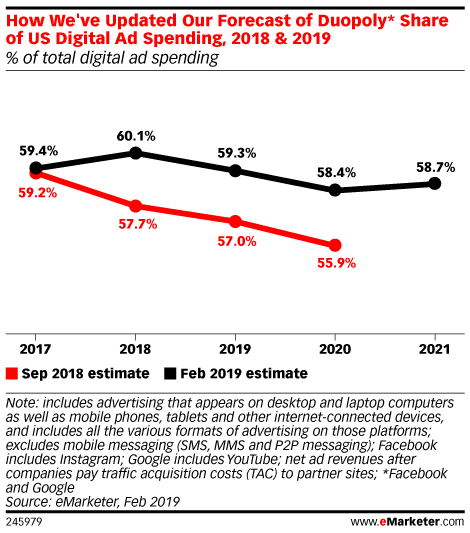
Here's the thing, as someone who sees themself both in ad tech & as a privacy advocate: Advertisers who seek personalized targeting will focus on platforms with the most personal data: Facebook & Google. But I don't believe the status quo of ad targeting is the only future of it.
So the loss of audience targeting is another major negative for the open web as opposed to walled gardens who are mostly not affected - silence from privacy advocates. 6/
— Paul Bannister (@pbannist) January 5, 2021
The biggest story in tech no one\u2019s talking about is Uber discovering they\u2019d been defrauded out of $100M - or 2/3 of their ad spend.
— Nandini Jammi (@nandoodles) January 3, 2021
And all bc Sleeping Giants kept bugging them to block their ads on Breitbart. pic.twitter.com/SiS3MndewS
Do Ads Work? An Inquiry.
— Nandini Jammi (@nandoodles) January 4, 2021
In March 2017, @sapna reported that @chase was running ads across 400k sites when they were alerted they were running on hate speech. So they hand-picked 5k sites & deleted the other 395k.
They found NO change in performance. https://t.co/MzSIxjX7y3 pic.twitter.com/0AlKAOVbcF
A Moz author crunchs numbers: while more ads could have been seen by humans we can only be absolutely sure of 8%. https://t.co/8QPBiNaCwg
— Aram Zucker-Scharff (@Chronotope) January 11, 2017
When you try and purchase inventory 70% or more ends up going to these fraudsters, bullshit artists and bad ad tech vendors - https://t.co/1ir5OONMFT, https://t.co/t9JVj1axyb
— Aram Zucker-Scharff (@Chronotope) December 26, 2018
At the end of the day you can't both believe in our current form of capitalism and not believe in Facebook...
— Aram Zucker-Scharff (@Chronotope) August 4, 2020
So I guess I am one of the few people out there who will tell you this but: understanding ad tech has made me a socialist! There's more to society than cheap ads!
More from Tech


The first area to focus on is diversity. This has become a dogma in the tech world, and despite the fact that tech is one of the most meritocratic industries in the world, there are constant efforts to promote diversity at the expense of fairness, merit and competency. Examples:
USC's Interactive Media & Games Division cancels all-star panel that included top-tier game developers who were invited to share their experiences with students. Why? Because there were no women on the
ElectronConf is a conf which chooses presenters based on blind auditions; the identity, gender, and race of the speaker is not known to the selection team. The results of that merit-based approach was an all-male panel. So they cancelled the conference.
Apple's head of diversity (a black woman) got in trouble for promoting a vision of diversity that is at odds with contemporary progressive dogma. (She left the company shortly after this
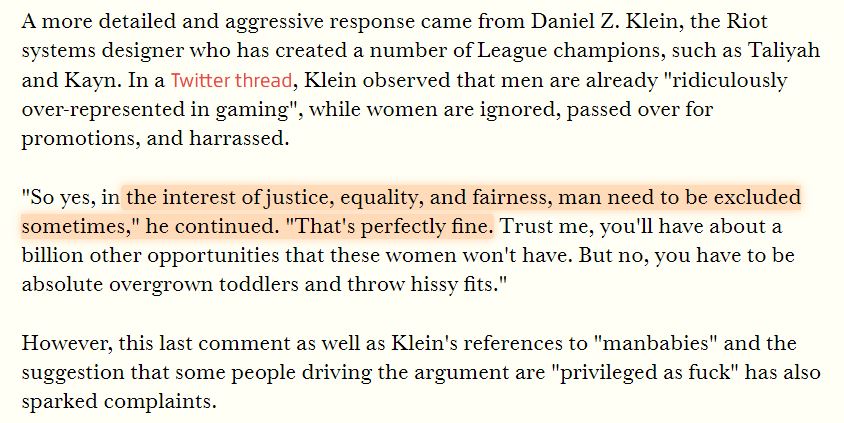
Also in the name of diversity, there is unabashed discrimination against men (especially white men) in tech, in both hiring policies and in other arenas. One such example is this, a developer workshop that specifically excluded men: https://t.co/N0SkH4hR35
USC's Interactive Media & Games Division cancels all-star panel that included top-tier game developers who were invited to share their experiences with students. Why? Because there were no women on the
ElectronConf is a conf which chooses presenters based on blind auditions; the identity, gender, and race of the speaker is not known to the selection team. The results of that merit-based approach was an all-male panel. So they cancelled the conference.
Apple's head of diversity (a black woman) got in trouble for promoting a vision of diversity that is at odds with contemporary progressive dogma. (She left the company shortly after this
Also in the name of diversity, there is unabashed discrimination against men (especially white men) in tech, in both hiring policies and in other arenas. One such example is this, a developer workshop that specifically excluded men: https://t.co/N0SkH4hR35


Machine translation can be a wonderful translation tool, but its uses are widely misunderstood.
Let's talk about Google Translate, its current state in the professional translation industry, and why robots are terrible at interpreting culture and context.
Straight to the point: machine translation (MT) is an incredibly helpful tool for translation! But just like any tool, there are specific times and places for it.
You wouldn't use a jackhammer to nail a painting to the wall.
Two factors are at play when determining how useful MT is: language pair and context.
Certain language pairs are better suited for MT. Typically, the more similar the grammar structure, the better the MT will be. Think Spanish <> Portuguese vs. Spanish <> Japanese.
No two MT engines are the same, though! Check out how human professionals ranked their choice of MT engine in a Phrase survey:
https://t.co/yiVPmHnjKv

When it comes to context, the first thing to look at is the type of text you want to translate. Typically, the more technical and straightforward the text, the better a machine will be at working on it.
Let's talk about Google Translate, its current state in the professional translation industry, and why robots are terrible at interpreting culture and context.
Straight to the point: machine translation (MT) is an incredibly helpful tool for translation! But just like any tool, there are specific times and places for it.
You wouldn't use a jackhammer to nail a painting to the wall.
Two factors are at play when determining how useful MT is: language pair and context.
Certain language pairs are better suited for MT. Typically, the more similar the grammar structure, the better the MT will be. Think Spanish <> Portuguese vs. Spanish <> Japanese.
No two MT engines are the same, though! Check out how human professionals ranked their choice of MT engine in a Phrase survey:
https://t.co/yiVPmHnjKv
When it comes to context, the first thing to look at is the type of text you want to translate. Typically, the more technical and straightforward the text, the better a machine will be at working on it.

You May Also Like











Tip from the Monkey
Pangolins, September 2019 and PLA are the key to this mystery
Stay Tuned!

1. Yang
2. A jacobin capuchin dangling a flagellin pangolin on a javelin while playing a mandolin and strangling a mannequin on a paladin's palanquin, said Saladin
More to come tomorrow!

3. Yigang Tong
https://t.co/CYtqYorhzH
Archived: https://t.co/ncz5ruwE2W

4. YT Interview
Some bats & pangolins carry viruses related with SARS-CoV-2, found in SE Asia and in Yunnan, & the pangolins carrying SARS-CoV-2 related viruses were smuggled from SE Asia, so there is a possibility that SARS-CoV-2 were coming from
Pangolins, September 2019 and PLA are the key to this mystery
Stay Tuned!
1. Yang
Meet Yang Ruifu, CCP's biological weapons expert https://t.co/JjB9TLEO95 via @Gnews202064
— Billy Bostickson \U0001f3f4\U0001f441&\U0001f441 \U0001f193 (@BillyBostickson) October 11, 2020
Interesting expose of China's top bioweapons expert who oversaw fake pangolin research
Paper 1: https://t.co/TrXESKLYmJ
Paper 2:https://t.co/9LSJTNCn3l
Pangolinhttps://t.co/2FUAzWyOcv pic.twitter.com/I2QMXgnkBJ
2. A jacobin capuchin dangling a flagellin pangolin on a javelin while playing a mandolin and strangling a mannequin on a paladin's palanquin, said Saladin
More to come tomorrow!
3. Yigang Tong
https://t.co/CYtqYorhzH
Archived: https://t.co/ncz5ruwE2W
4. YT Interview
Some bats & pangolins carry viruses related with SARS-CoV-2, found in SE Asia and in Yunnan, & the pangolins carrying SARS-CoV-2 related viruses were smuggled from SE Asia, so there is a possibility that SARS-CoV-2 were coming from