Please don’t get jacked up on cheap SBA money and go tag the 14th thing you look at.
This is a valuable thread and @XavierHelgesen has excellent intentions. If you were planning to buy a SMB using the SBA, the deal got sweeter.
That said, there are caution flags I'd like to raise:
1) It's brutally hard. I outline the steps here https://t.co/MZ0beEl0UU
Please don’t get jacked up on cheap SBA money and go tag the 14th thing you look at.
If things turn against you, you’ll declare bankruptcy. Seen it happen. Not pretty.
The idea of cashing checks and “allocating capital” is a joke. Someone somewhere has done it, but I’ve never seen it.
It’s going to be a challenging 7/365 grind to hopefully make very good money. That’s the best you can hope for.
You’ll often have top employees getting more cash out of the business than the owner.
There's a chasm between the world of finance and operations. If this is surprising, be worried.
Cash is like oxygen. You only pay attention to it when it's in short supply and that's often too late.
More from Tech

"I really want to break into Product Management"
make products.
"If only someone would tell me how I can get a startup to notice me."
Make Products.
"I guess it's impossible and I'll never break into the industry."
MAKE PRODUCTS.
Courtesy of @edbrisson's wonderful thread on breaking into comics – https://t.co/TgNblNSCBj – here is why the same applies to Product Management, too.
There is no better way of learning the craft of product, or proving your potential to employers, than just doing it.
You do not need anybody's permission. We don't have diplomas, nor doctorates. We can barely agree on a single standard of what a Product Manager is supposed to do.
But – there is at least one blindingly obvious industry consensus – a Product Manager makes Products.
And they don't need to be kept at the exact right temperature, given endless resource, or carefully protected in order to do this.
They find their own way.
make products.
"If only someone would tell me how I can get a startup to notice me."
Make Products.
"I guess it's impossible and I'll never break into the industry."
MAKE PRODUCTS.
Courtesy of @edbrisson's wonderful thread on breaking into comics – https://t.co/TgNblNSCBj – here is why the same applies to Product Management, too.
"I really want to break into comics"
— Ed Brisson (@edbrisson) December 4, 2018
make comics.
"If only someone would tell me how I can get an editor to notice me."
Make Comics.
"I guess it's impossible and I'll never break into the industry."
MAKE COMICS.
There is no better way of learning the craft of product, or proving your potential to employers, than just doing it.
You do not need anybody's permission. We don't have diplomas, nor doctorates. We can barely agree on a single standard of what a Product Manager is supposed to do.
But – there is at least one blindingly obvious industry consensus – a Product Manager makes Products.
And they don't need to be kept at the exact right temperature, given endless resource, or carefully protected in order to do this.
They find their own way.


The 12 most important pieces of information and concepts I wish I knew about equity, as a software engineer.
A thread.
1. Equity is something Big Tech and high-growth companies award to software engineers at all levels. The more senior you are, the bigger the ratio can be:

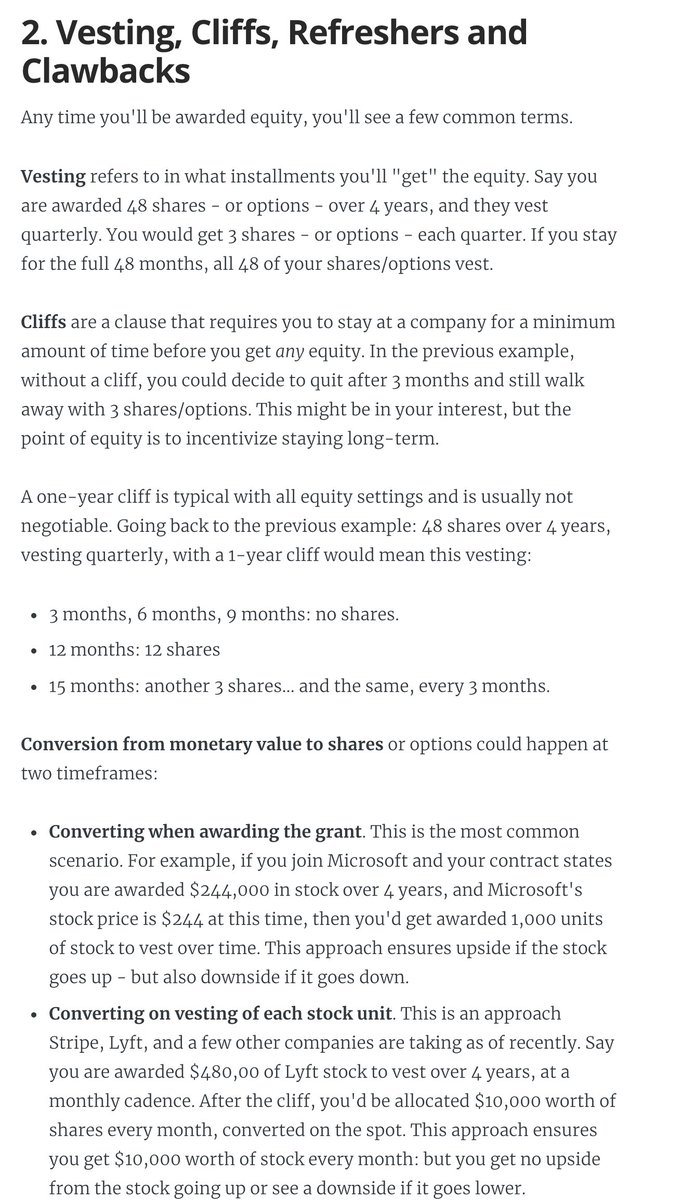
2. Vesting, cliffs, refreshers, and sign-on clawbacks.
If you get awarded equity, you'll want to understand vesting and cliffs. A 1-year cliff is pretty common in most places that award equity.
Read more in this blog post I wrote: https://t.co/WxQ9pQh2mY
3. Stock options / ESOPs.
The most common form of equity compensation at early-stage startups that are high-growth.
And there are *so* many pitfalls you'll want to be aware of. You need to do your research on this: I can't do justice in a tweet.
https://t.co/cudLn3ngqi
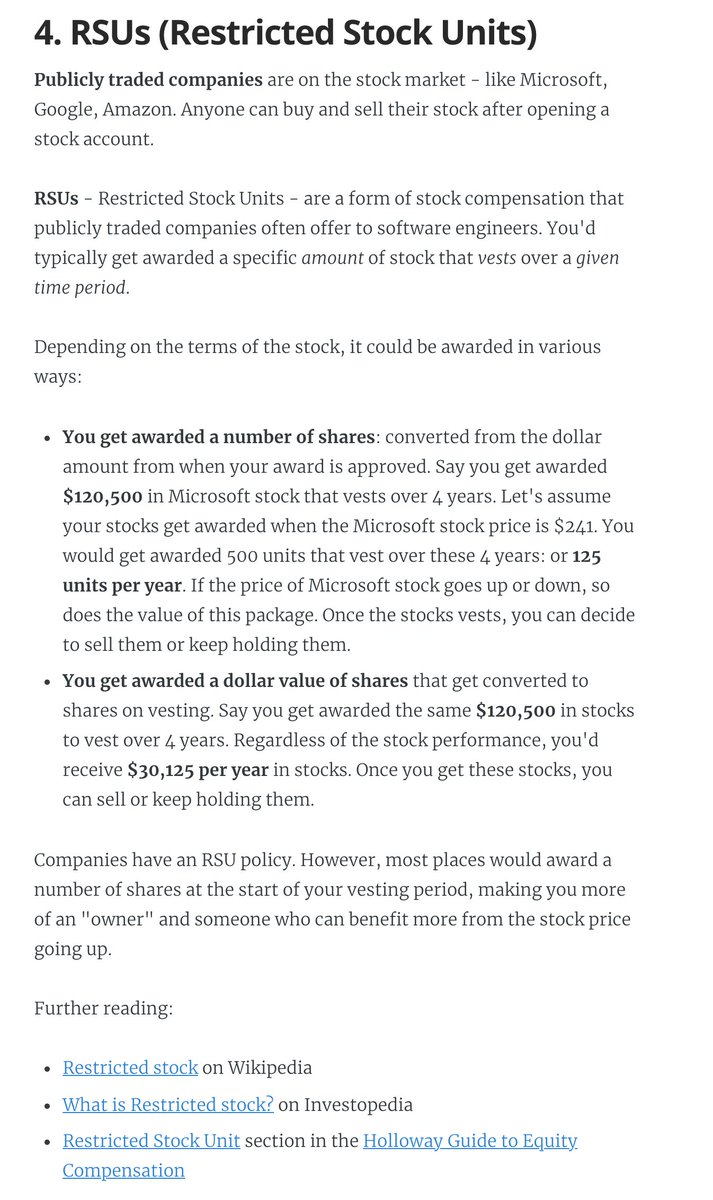
4. RSUs (Restricted Stock Units)
A common form of equity compensation for publicly traded companies and Big Tech. One of the easier types of equity to understand: https://t.co/a5xU1H9IHP
5. Double-trigger RSUs. Typically RSUs for pre-IPO companies. I got these at Uber.
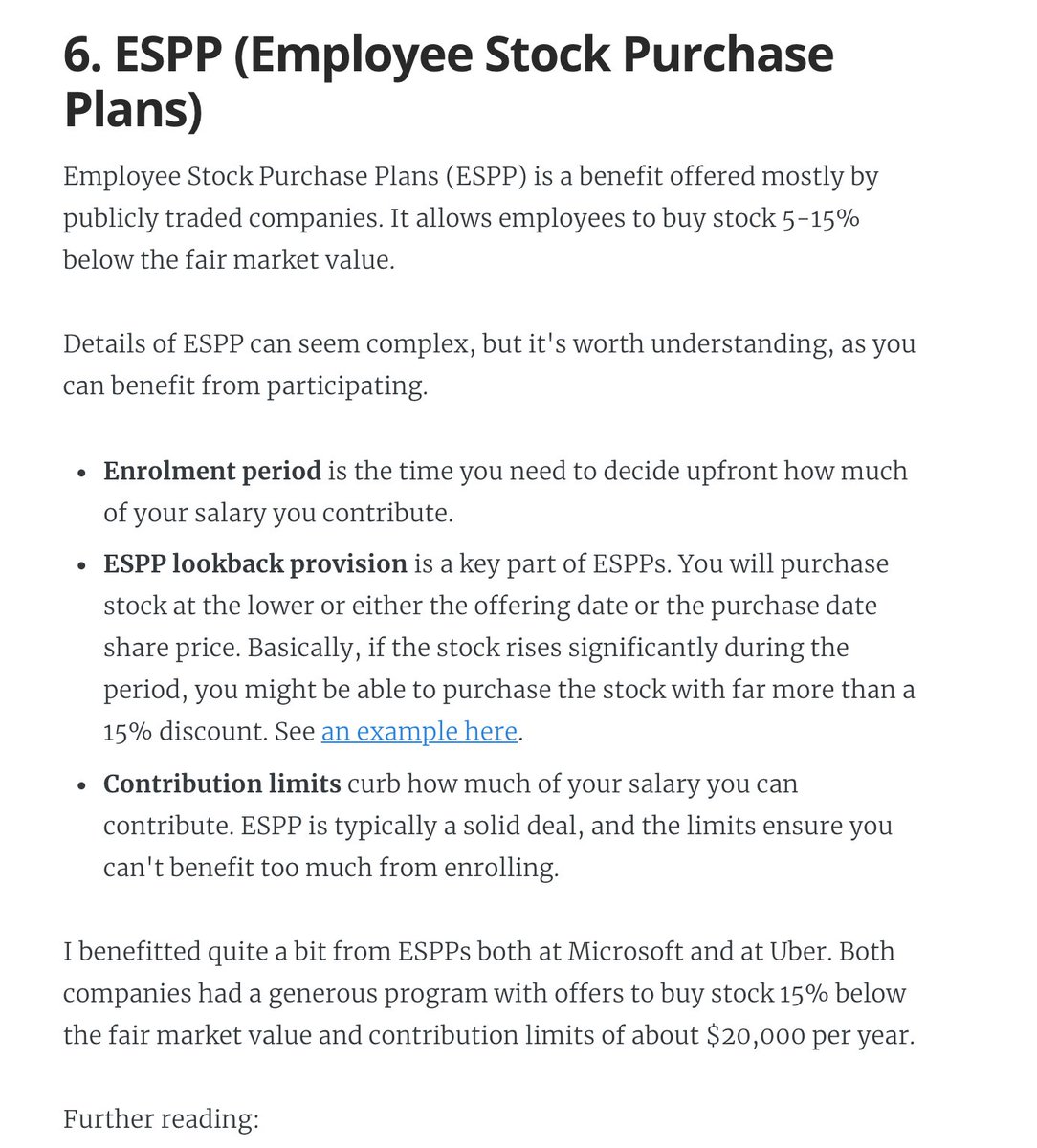
6. ESPP: a (typically) amazing employee perk at publicly traded companies. There's always risk, but this plan can typically offer good upsides.
7. Phantom shares. An interesting setup similar to RSUs... but you don't own stocks. Not frequent, but e.g. Adyen goes with this plan.
A thread.
1. Equity is something Big Tech and high-growth companies award to software engineers at all levels. The more senior you are, the bigger the ratio can be:
2. Vesting, cliffs, refreshers, and sign-on clawbacks.
If you get awarded equity, you'll want to understand vesting and cliffs. A 1-year cliff is pretty common in most places that award equity.
Read more in this blog post I wrote: https://t.co/WxQ9pQh2mY
3. Stock options / ESOPs.
The most common form of equity compensation at early-stage startups that are high-growth.
And there are *so* many pitfalls you'll want to be aware of. You need to do your research on this: I can't do justice in a tweet.
https://t.co/cudLn3ngqi
4. RSUs (Restricted Stock Units)
A common form of equity compensation for publicly traded companies and Big Tech. One of the easier types of equity to understand: https://t.co/a5xU1H9IHP
5. Double-trigger RSUs. Typically RSUs for pre-IPO companies. I got these at Uber.
6. ESPP: a (typically) amazing employee perk at publicly traded companies. There's always risk, but this plan can typically offer good upsides.
7. Phantom shares. An interesting setup similar to RSUs... but you don't own stocks. Not frequent, but e.g. Adyen goes with this plan.