
Subtle real advantage nobody talks about: if founders can access deeper pools of capital early/quickly, they can get bigger faster without spawning lots of competitors.
If your startup is real, pitching Sand Hill is sometimes like giving away copies of your treasure map
More from Startups

There are a *lot* of software shops in the world that would far rather have one more technical dependency than they'd like to pay for one of their 20 engineers to become the company's SPOF expert on the joys of e.g. HTTP file uploads, CSV parsing bugs, PDF generation, etc.
Every year at MicroConf I get surprised-not-surprised by the number of people I meet who are running "Does one thing reasonably well, ranks well for it, pulls down a full-time dev salary" out of a fun side project which obviates a frequent 1~5 engineer-day sprint horizontally.
"Who is the prototypical client here?"
A consulting shop delivering a $X00k engagement for an internal system, a SaaS company doing something custom for a large client or internally facing or deeply non-core to their business, etc.
(I feel like many of these businesses are good answers to the "how would you monetize OSS to make it sustainable?" fashion, since they often wrap a core OSS offering in the assorted infrastructure which makes it easily consumable.)
"But don't the customers get subscription fatigue?"
I think subscription fatigue is far more reported by people who are embarrassed to charge money for software than it is experienced by for-profit businesses, who don't seem to have gotten pay-biweekly-for-services fatigue.
On a serious note, it's interesting to observe that you can build a decent business charging $20 - $50 per month for something that any good developer can set up. This is one of those micro-saas sweet spots between "easy for me to build" and "tedious for others to build"
— Jon Yongfook (@yongfook) September 5, 2019
Every year at MicroConf I get surprised-not-surprised by the number of people I meet who are running "Does one thing reasonably well, ranks well for it, pulls down a full-time dev salary" out of a fun side project which obviates a frequent 1~5 engineer-day sprint horizontally.
"Who is the prototypical client here?"
A consulting shop delivering a $X00k engagement for an internal system, a SaaS company doing something custom for a large client or internally facing or deeply non-core to their business, etc.
(I feel like many of these businesses are good answers to the "how would you monetize OSS to make it sustainable?" fashion, since they often wrap a core OSS offering in the assorted infrastructure which makes it easily consumable.)
"But don't the customers get subscription fatigue?"
I think subscription fatigue is far more reported by people who are embarrassed to charge money for software than it is experienced by for-profit businesses, who don't seem to have gotten pay-biweekly-for-services fatigue.





1/ Tuesday was my last day as CEO of @CircleUp. I’ve been CEO since starting the co. in 2011 with my co-founder @roryeakin.
This is a thread about what happened, why and my emotions about it. For more detail:
https://t.co/vYImcm1bTM
Much of this I have never talked about.
2/ My goals: I hope it helps founders feel less lonely than I did. Little public content about the challenges of transitioning exists, but I longed for it. I’m not here to provide a playbook- just to share my experience. Hope it might build greater empathy.
Here goes….
3/ Why: When I tell people that I’m transitioning to an Exec Chairman role their first question is always: “why?” Short answer: co. pivot + fertility issues + health issues + a false sense that grit was always the answer = burnout. Long answer: is longer so hang in there with me
4/ Over a 12-18 month period that ended in late 2017 I ran my tank far beyond empty for far too long. You know that sound your car makes when it’s sputtering for more gas? It was like that. Worst year of my life. Since then it has felt like bone on bone.
5/ Here is what happened:
Professionally: pivoting a Series C company was a living hell in and of itself, as I’ve talked about before.
This is a thread about what happened, why and my emotions about it. For more detail:
https://t.co/vYImcm1bTM
Much of this I have never talked about.
2/ My goals: I hope it helps founders feel less lonely than I did. Little public content about the challenges of transitioning exists, but I longed for it. I’m not here to provide a playbook- just to share my experience. Hope it might build greater empathy.
Here goes….
3/ Why: When I tell people that I’m transitioning to an Exec Chairman role their first question is always: “why?” Short answer: co. pivot + fertility issues + health issues + a false sense that grit was always the answer = burnout. Long answer: is longer so hang in there with me
4/ Over a 12-18 month period that ended in late 2017 I ran my tank far beyond empty for far too long. You know that sound your car makes when it’s sputtering for more gas? It was like that. Worst year of my life. Since then it has felt like bone on bone.
5/ Here is what happened:
Professionally: pivoting a Series C company was a living hell in and of itself, as I’ve talked about before.
1/ We Pivoted a few yrs ago. This is the story- mostly my feelings. It has never been told publicly.
— Ryan Caldbeck (@ryan_caldbeck) April 16, 2019
This will be rambly and represents the chaos in my head at the time. There is [hopefully] no advice here. I don\u2019t know if we did it right.


You May Also Like


Margatha Natarajar murthi - Uthirakosamangai temple near Ramanathapuram,TN
#ArudraDarisanam
Unique Natarajar made of emerlad is abt 6 feet tall.
It is always covered with sandal paste.Only on Thriuvadhirai Star in month Margazhi-Nataraja can be worshipped without sandal paste.

After removing the sandal paste,day long rituals & various abhishekam will be https://t.co/e1Ye8DrNWb day Maragatha Nataraja sannandhi will be closed after anointing the murthi with fresh sandal paste.Maragatha Natarajar is covered with sandal paste throughout the year
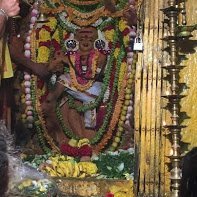
as Emerald has scientific property of its molecules getting disturbed when exposed to light/water/sound.This is an ancient Shiva temple considered to be 3000 years old -believed to be where Bhagwan Shiva gave Veda gyaana to Parvati Devi.This temple has some stunning sculptures.

#ArudraDarisanam
Unique Natarajar made of emerlad is abt 6 feet tall.
It is always covered with sandal paste.Only on Thriuvadhirai Star in month Margazhi-Nataraja can be worshipped without sandal paste.
After removing the sandal paste,day long rituals & various abhishekam will be https://t.co/e1Ye8DrNWb day Maragatha Nataraja sannandhi will be closed after anointing the murthi with fresh sandal paste.Maragatha Natarajar is covered with sandal paste throughout the year
as Emerald has scientific property of its molecules getting disturbed when exposed to light/water/sound.This is an ancient Shiva temple considered to be 3000 years old -believed to be where Bhagwan Shiva gave Veda gyaana to Parvati Devi.This temple has some stunning sculptures.


I just finished Eric Adler's The Battle of the Classics, and wanted to say something about Joel Christiansen's review linked below. I am not sure what motivates the review (I speculate a bit below), but it gives a very misleading impression of the book. 1/x
The meat of the criticism is that the history Adler gives is insufficiently critical. Adler describes a few figures who had a great influence on how the modern US university was formed. It's certainly critical: it focuses on the social Darwinism of these figures. 2/x
Other insinuations and suggestions in the review seem wildly off the mark, distorted, or inappropriate-- for example, that the book is clickbaity (it is scholarly) or conservative (hardly) or connected to the events at the Capitol (give me a break). 3/x
The core question: in what sense is classics inherently racist? Classics is old. On Adler's account, it begins in ancient Rome and is revived in the Renaissance. Slavery (Christiansen's primary concern) is also very old. Let's say classics is an education for slaveowners. 4/x
It's worth remembering that literacy itself is elite throughout most of this history. Literacy is, then, also the education of slaveowners. We can honor oral and musical traditions without denying that literacy is, generally, good. 5/x
As someone\u2019s who\u2019s read the book, this review strikes me as tremendously unfair. It mostly faults Adler for not writing the book the reviewer wishes he had! https://t.co/pqpt5Ziivj
— Teresa M. Bejan (@tmbejan) January 12, 2021
The meat of the criticism is that the history Adler gives is insufficiently critical. Adler describes a few figures who had a great influence on how the modern US university was formed. It's certainly critical: it focuses on the social Darwinism of these figures. 2/x
Other insinuations and suggestions in the review seem wildly off the mark, distorted, or inappropriate-- for example, that the book is clickbaity (it is scholarly) or conservative (hardly) or connected to the events at the Capitol (give me a break). 3/x
The core question: in what sense is classics inherently racist? Classics is old. On Adler's account, it begins in ancient Rome and is revived in the Renaissance. Slavery (Christiansen's primary concern) is also very old. Let's say classics is an education for slaveowners. 4/x
It's worth remembering that literacy itself is elite throughout most of this history. Literacy is, then, also the education of slaveowners. We can honor oral and musical traditions without denying that literacy is, generally, good. 5/x
