The main focus in this round is to see your thought process and whether you'll be able to design a minimal system keeping future scale in mind and by following the standard principles.
How should one approach System Design questions during an interview?
Here's the step by step guide:
🧵👇🏻
The main focus in this round is to see your thought process and whether you'll be able to design a minimal system keeping future scale in mind and by following the standard principles.
You cannot possibly design a complex system in 1-2 hours which engineers usually take months to years to design, develop and build.
So this is how you should approach this round:
Example: "Design an application like Twitter"
- Post tweet
- Home timeline
- Profile timeline
- Analytics
- Likes
- Retweets
- Following
- Bookmark
- Trending etc
You get the idea!
Ask a lot of specific questions in this step and make sure both of you are on the same page.
- consistency
- availability
- durability
- scalability etc
In this step you can assume the traffic your service gets and estimate how much data you need to store in your tables so that your system works for the next 5 - 10 years without running into any problems.
- Read / Write ratio (ex: Twitter)
- Each file size (ex: Dropbox)
- Average photo size (ex: Instagram)
- Total active users (Ex: Facebook) etc
Based on the assumptions, you can calculate how much data you need to store in your tables.
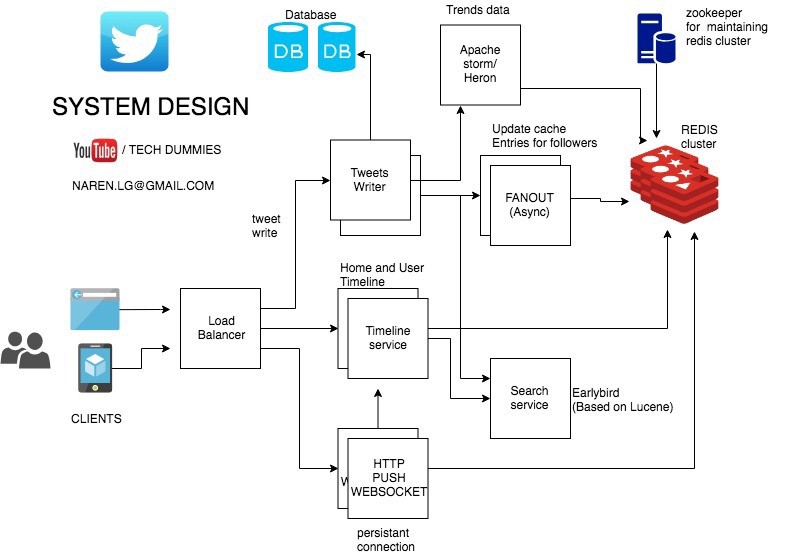
Ex: In case of Twitter:
- Clients
- Timeline Svc
- Search Svc
- DB Storage
- Cache
etc
Come up with different tables, their schema and relations between them to store the data for your application.
Based on the columns and the data type of each of the column you can compute how much data you may need to store for the next 5-10 years.
For example if your data schema constantly changes and scalability is a requirement, you can go with a NoSQL db.
If transactions are important then go with SQL.
For example:
- in case of URL Shortener service they may ask you how you would generate the shortened url for every given long url.
In this case you may want to precompute the timeline for users because of the huge data volume and the realtime behaviour we need.
Since this is a spatial search problem, you may want to store the data in a quad tree.
Depending on the requirements, discuss about how you would do partitioning & sharding.
Cache allows you to store the frequently used data and access it much faster which improves the overall response time of your APIs.
In this case you may want to cache that 20% of the data. You can estimate how much cache storage is needed based on each entity data size and your total traffic.
Note that the interviewer may ask you to discuss all of the above step by step at high level as discussed or any one in detail.
More from Sunil Kumar
Are you a web developer?
Here's a list of websites that offer free & beautiful website templates:
🧵👇🏻
1. HTML5UP: Very modern, unique responsive HTML5/CSS3 themes
https://t.co/VmAFs2xEUO
2. Templatemo: Minimal, resume, gallery themes and more
https://t.co/hCVsSqg3dx
3. Templated .co: Tons of minimalistic HTML5/CSS3
4. FreeHTML5: Free & premium HTML5 and Bootstrap themes
https://t.co/HqCj21RVry
5. StyleShout: Brilliantly crafted free website templates
https://t.co/AeNAAvmiYx
6. Start Bootstrap: Bootstrap starter
7. Zerotheme: HTML5, Bootstrap, Prestashop templates
https://t.co/WZtbW1gZzv
8. HTML5xCSS3: Collection of wonderful templates in different categories
https://t.co/g47dzRhSnW
9. Colorlib: Almost any category of theme you can think
10: Free CSS: Huge collection of free templates
https://t.co/JzQgKmBBGJ
11. Hubspot: Templates, infographics, banners and much more
https://t.co/T2jAlXYH8E
12. Mobirise: Great looking HTML5/CSS3
Here's a list of websites that offer free & beautiful website templates:
🧵👇🏻
1. HTML5UP: Very modern, unique responsive HTML5/CSS3 themes
https://t.co/VmAFs2xEUO
2. Templatemo: Minimal, resume, gallery themes and more
https://t.co/hCVsSqg3dx
3. Templated .co: Tons of minimalistic HTML5/CSS3
4. FreeHTML5: Free & premium HTML5 and Bootstrap themes
https://t.co/HqCj21RVry
5. StyleShout: Brilliantly crafted free website templates
https://t.co/AeNAAvmiYx
6. Start Bootstrap: Bootstrap starter
7. Zerotheme: HTML5, Bootstrap, Prestashop templates
https://t.co/WZtbW1gZzv
8. HTML5xCSS3: Collection of wonderful templates in different categories
https://t.co/g47dzRhSnW
9. Colorlib: Almost any category of theme you can think
10: Free CSS: Huge collection of free templates
https://t.co/JzQgKmBBGJ
11. Hubspot: Templates, infographics, banners and much more
https://t.co/T2jAlXYH8E
12. Mobirise: Great looking HTML5/CSS3

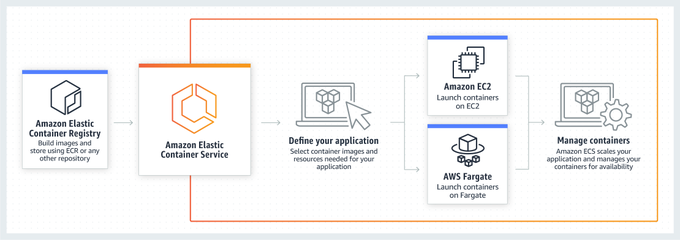
Are you a web developer or a designer?
These websites will help you create professional mockups for your applications:
🧵👇🏻
1. Shot Snap:
Create beautiful device mockup images for your app or website
2. Smart Mockups:
Create stunning product mockups (free & premium)
https://t.co/1RmIQhAreS

3. Screely:
Instantly turn your screenshot into a mockup
https://t.co/riAzf7CioH
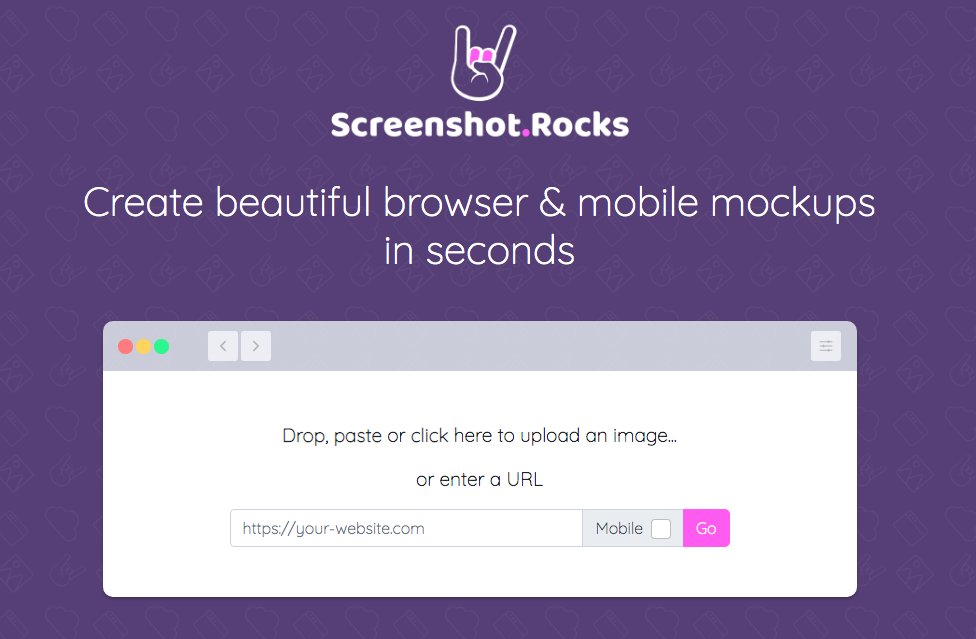
4. Screenshot .rocks:
Create beautiful browser & mobile mockups in seconds.
https://t.co/EpxLukHg8T

These websites will help you create professional mockups for your applications:
🧵👇🏻
1. Shot Snap:
Create beautiful device mockup images for your app or website
2. Smart Mockups:
Create stunning product mockups (free & premium)
https://t.co/1RmIQhAreS
3. Screely:
Instantly turn your screenshot into a mockup
https://t.co/riAzf7CioH
4. Screenshot .rocks:
Create beautiful browser & mobile mockups in seconds.
https://t.co/EpxLukHg8T
Are you a web developer?
Here's a list of websites that offer free & beautiful website templates:
🧵👇🏻
1. HTML5UP: Very modern, unique responsive HTML5/CSS3 themes
https://t.co/Nx1IWM7Kho
2. Templatemo: Minimal, resume, gallery themes and more
https://t.co/IRtOxrujUh
3. Templated .co: Tons of minimalistic HTML5/CSS3
4. FreeHTML5: Free & premium HTML5 and Bootstrap themes
https://t.co/YFVkiDM3Th
5. StyleShout: Brilliantly crafted free website templates
https://t.co/AaGAkGlLTV
6. Start Bootstrap: Bootstrap starter
7. Zerotheme: HTML5, Bootstrap, Prestashop templates
https://t.co/UtlaNxGh6Q
8. HTML5xCSS3: Collection of wonderful templates in different categories
https://t.co/fm4AOthUdR
9. Colorlib: Almost any category of theme you can think
10: Free CSS: Huge collection of free templates
https://t.co/S5yQrkp1eq
11. Hubspot: Templates, infographics, banners and much more
https://t.co/T10zTgkIzp
12. Mobirise: Great looking HTML5/CSS3
Here's a list of websites that offer free & beautiful website templates:
🧵👇🏻
1. HTML5UP: Very modern, unique responsive HTML5/CSS3 themes
https://t.co/Nx1IWM7Kho
2. Templatemo: Minimal, resume, gallery themes and more
https://t.co/IRtOxrujUh
3. Templated .co: Tons of minimalistic HTML5/CSS3
4. FreeHTML5: Free & premium HTML5 and Bootstrap themes
https://t.co/YFVkiDM3Th
5. StyleShout: Brilliantly crafted free website templates
https://t.co/AaGAkGlLTV
6. Start Bootstrap: Bootstrap starter
7. Zerotheme: HTML5, Bootstrap, Prestashop templates
https://t.co/UtlaNxGh6Q
8. HTML5xCSS3: Collection of wonderful templates in different categories
https://t.co/fm4AOthUdR
9. Colorlib: Almost any category of theme you can think
10: Free CSS: Huge collection of free templates
https://t.co/S5yQrkp1eq
11. Hubspot: Templates, infographics, banners and much more
https://t.co/T10zTgkIzp
12. Mobirise: Great looking HTML5/CSS3
Are you a front-end developer or a designer?
Here's a list of websites to get inspiration for design and building UI:
🧵👇🏻
1. Behance
https://t.co/eNm9PHPwiv
2. Dribbble
https://t.co/79Zq4AISuB
3. Httpster
https://t.co/U7xXszEdRU
4.
5. Design Notes
https://t.co/io8DVOLWSv
6. Land Book
https://t.co/KsNQxWxmqh
7. Frontend Mentor
https://t.co/NfvVVgEsOE
8.
9. Codrops
https://t.co/hfmwzhG0bk
10. SaaS Landing Page
https://t.co/NYXxCvFDTj
11. Pages .xyz
https://t.co/ilxtaHQ7j5
12. UI
13. lapa ninja
https://t.co/nmhJ6wgSfl
14. Freefrontend
https://t.co/FrDYMKfnPO
15. Webframe
https://t.co/GhVhkWFg5f
16. Collect
Here's a list of websites to get inspiration for design and building UI:
🧵👇🏻
1. Behance
https://t.co/eNm9PHPwiv
2. Dribbble
https://t.co/79Zq4AISuB
3. Httpster
https://t.co/U7xXszEdRU
4.
5. Design Notes
https://t.co/io8DVOLWSv
6. Land Book
https://t.co/KsNQxWxmqh
7. Frontend Mentor
https://t.co/NfvVVgEsOE
8.
9. Codrops
https://t.co/hfmwzhG0bk
10. SaaS Landing Page
https://t.co/NYXxCvFDTj
11. Pages .xyz
https://t.co/ilxtaHQ7j5
12. UI
13. lapa ninja
https://t.co/nmhJ6wgSfl
14. Freefrontend
https://t.co/FrDYMKfnPO
15. Webframe
https://t.co/GhVhkWFg5f
16. Collect
More from Software

buffalo uses dominion scoreboard software so not really
DEAD PEOPLE SCORED FOR BUFFALO!
A truck delivered off a suitcase full of points at halftime from Canada for Buffalo.
#StopTheSteel !!!!
I’ll be submitting sworn affidavits from Steelers fans than they saw the Buffalo rigging the game but I want to emphasize that I’m not under oath.
Sports Minute: Bills improve to 10-3 with 26-15 win over sloppy Steelers https://t.co/lg0isTiE92
— Erie News Now (@ErieNewsNow) December 14, 2020
DEAD PEOPLE SCORED FOR BUFFALO!
A truck delivered off a suitcase full of points at halftime from Canada for Buffalo.
#StopTheSteel !!!!
I’ll be submitting sworn affidavits from Steelers fans than they saw the Buffalo rigging the game but I want to emphasize that I’m not under oath.

@JuliaLMarcus @Iplaywithgerms This paper gives documentation on software (with causal reasoning, assumptions reviewed in appendix) for a parametric approach to estimating either "total effects" or "controlled direct effects" with competing events and time-varying
@Iplaywithgerms Total effects capture paths by which treatment affects competing event (e.g. protective total effect of lifesaving treatment on dementia may be wholly/partially due to effect on survival). Controlled direct effects do not capture these paths
@Iplaywithgerms More detailed reasoning on the difference and tradeoffs between total and controlled direct effects and causal reasoning in the point treatment context provided here along with description of some estimators and
@Iplaywithgerms If you are familiar with more robust approaches like IPW or even better TMLE for time-varying treatment, these are trivially adapted to go after the controlled direct effect by simply treating competing events like loss to follow-up (censoring). e.g.
@Iplaywithgerms Examples of IPW estimation of the total effect of a time-varying treatment described in Appendix D of this paper:
https://t.co/RNhcgTBMkb
And here
https://t.co/rMWmwFBWwV
Others in reference lists of above papers.
@Iplaywithgerms Total effects capture paths by which treatment affects competing event (e.g. protective total effect of lifesaving treatment on dementia may be wholly/partially due to effect on survival). Controlled direct effects do not capture these paths
@Iplaywithgerms More detailed reasoning on the difference and tradeoffs between total and controlled direct effects and causal reasoning in the point treatment context provided here along with description of some estimators and
@Iplaywithgerms If you are familiar with more robust approaches like IPW or even better TMLE for time-varying treatment, these are trivially adapted to go after the controlled direct effect by simply treating competing events like loss to follow-up (censoring). e.g.
@Iplaywithgerms Examples of IPW estimation of the total effect of a time-varying treatment described in Appendix D of this paper:
https://t.co/RNhcgTBMkb
And here
https://t.co/rMWmwFBWwV
Others in reference lists of above papers.


As the year wrap's up, let's run through some of the worst public security mistakes and delays in fixes by AWS in 2020. A thread.
First, that time when an AWS employee posted confidential AWS customer information including including AWS access keys for those customer accounts to
Discovery by @SpenGietz that you can disable CloudTrail without triggering GuardDuty by using cloudtrail:PutEventSelectors to filter all events.
Amazon launched their bug bounty, but specifically excluded AWS, which has no bug bounty.
Repeated, over and over again examples of AWS having no change control over their Managed IAM policies, including the mistaken release of CheesepuffsServiceRolePolicy, AWSServiceRoleForThorInternalDevPolicy, AWSCodeArtifactReadOnlyAccess.json, AmazonCirrusGammaRoleForInstaller.
First, that time when an AWS employee posted confidential AWS customer information including including AWS access keys for those customer accounts to
Fresh data breach news-
— Chris Vickery (@VickerySec) January 23, 2020
Amazon AWS engineer exposes work-related keys, passwords, and documents marked "Amazon Confidential" via public Github repository: https://t.co/7gkIegnslx
Discovered within 30 minutes of exposure by my team at @UpGuard.
Discovery by @SpenGietz that you can disable CloudTrail without triggering GuardDuty by using cloudtrail:PutEventSelectors to filter all events.
"Disable" most #AWS #CloudTrail logging without triggering #GuardDuty:https://t.co/zVe4uSHog9
— Rhino Security Labs (@RhinoSecurity) April 23, 2020
Reported to AWS Security and it is not a bug.
Amazon launched their bug bounty, but specifically excluded AWS, which has no bug bounty.
Amazon Vulnerability Research Program - Doesn't include AWS D:https://t.co/stJHDG68pj#BugBounty #AWS
— Spencer Gietzen (@SpenGietz) April 22, 2020
Repeated, over and over again examples of AWS having no change control over their Managed IAM policies, including the mistaken release of CheesepuffsServiceRolePolicy, AWSServiceRoleForThorInternalDevPolicy, AWSCodeArtifactReadOnlyAccess.json, AmazonCirrusGammaRoleForInstaller.






You May Also Like


"I lied about my basic beliefs in order to keep a prestigious job. Now that it will be zero-cost to me, I have a few things to say."
We know that elite institutions like the one Flier was in (partial) charge of rely on irrelevant status markers like private school education, whiteness, legacy, and ability to charm an old white guy at an interview.
Harvard's discriminatory policies are becoming increasingly well known, across the political spectrum (see, e.g., the recent lawsuit on discrimination against East Asian applications.)
It's refreshing to hear a senior administrator admits to personally opposing policies that attempt to remedy these basic flaws. These are flaws that harm his institution's ability to do cutting-edge research and to serve the public.
Harvard is being eclipsed by institutions that have different ideas about how to run a 21st Century institution. Stanford, for one; the UC system; the "public Ivys".
As a dean of a major academic institution, I could not have said this. But I will now. Requiring such statements in applications for appointments and promotions is an affront to academic freedom, and diminishes the true value of diversity, equity of inclusion by trivializing it. https://t.co/NfcI5VLODi
— Jeffrey Flier (@jflier) November 10, 2018
We know that elite institutions like the one Flier was in (partial) charge of rely on irrelevant status markers like private school education, whiteness, legacy, and ability to charm an old white guy at an interview.
Harvard's discriminatory policies are becoming increasingly well known, across the political spectrum (see, e.g., the recent lawsuit on discrimination against East Asian applications.)
It's refreshing to hear a senior administrator admits to personally opposing policies that attempt to remedy these basic flaws. These are flaws that harm his institution's ability to do cutting-edge research and to serve the public.
Harvard is being eclipsed by institutions that have different ideas about how to run a 21st Century institution. Stanford, for one; the UC system; the "public Ivys".