It’s funny how, when Black people leave toxic church spaces we are the ones called “divisive.” We always have to bear the weight of judgment and have to explain ourselves.

When you see Black people leaving a predominantly white church space en masse, you should be asking...

Why are so many people walking away? Why are their stories all similar or exactly the same? Why is this not being addressed by leadership? Why does it feel like it’s being swept under the rug? Why is Black folks’ departure deemed as their issue or fault?
Why does the leadership of my church or organization only take the slightest of responsibility (if any at all)? Why do the sermons end teaching in my church seem to change for a season directly after departures? Why are the Black folks who remain given promotions or visibility?
I have observed a pattern of behavior around Black folks leaving white Christian institutions.

There’s a lot of folks who leave who won’t make public (or private) comment about their departure. Often it’s out of fear of what opportunities that it could cost them.
This allows the institution to shape the narrative around the departure and make it seem more amicable than it actually was. I’ve seen this pattern multiple times.
Another pattern of behavior that I’ve observed is when people are vocal about their departure, they are cast as being bitter or not willing to “play ball” in the institution’s effort. They are cast as being a problem and seen as being destructive.
The institution is able to blame shift and make it about the person’s tone and to cast them as angry and unwilling to cooperate and appreciate all that the institution is “done.”
Occasionally and institution might do a soft mea culpa. They might talk about all the work that they “have to do,” but still continue to lay the blame squarely on Black people for leaving the toxic place.

More from Society

This is a piece I've been thinking about for a long time. One of the most dominant policy ideas in Washington is that policy should, always and everywhere, move parents into paid labor. But what if that's wrong?

My reporting here convinced me that there's no large effect in either direction on labor force participation from child allowances. Canada has a bigger one than either Romney or Biden are considering, and more labor force participation among women.

But what if that wasn't true?

Forcing parents into low-wage, often exploitative, jobs by threatening them and their children with poverty may be counted as a success by some policymakers, but it’s a sign of a society that doesn’t value the most essential forms of labor.

The problem is in the very language we use. If I left my job as a New York Times columnist to care for my 2-year-old son, I’d be described as leaving the labor force. But as much as I adore him, there is no doubt I’d be working harder. I wouldn't have stopped working!

I tried to render conservative objections here fairly. I appreciate that @swinshi talked with me, and I'm sorry I couldn't include everything he said. I'll say I believe I used his strongest arguments, not more speculative ones, in the piece.
It is simply not correct to point fingers at wind & solar energy as we try to understand the situation in TX. The system (almost) had a plan for weather (almost) like this. 1/x


It relied on very little wind energy - that was the plan. It relied on a lot of natural gas - that was the plan. It relied on all of its nuclear energy - that was the plan. 2/x

There was enough natural gas, coal and nuclear capacity installed to survive this event - it was NOT "forced out" by the wind energy expansion. It was there. 3/x

Wind, natural gas, coal and nuclear plants all failed to deliver on their expectations for long periods of time. The biggest gap was in natural gas! The generators were there, but they were not able to deliver. 4/x

It may be fair to ask why there is so much wind energy in ERCOT if we do NOT expect it to deliver during weather events like this, but that is an entirely different question - and one with a lot of great answers!! 5/x

You May Also Like

First thread of the year because I have time during MCO. As requested, a thread on the gods and spirits of Malay folk religion. Some are indigenous, some are of Indian origin, some have Islamic


Before I begin, it might be worth explaining the Malay conception of the spirit world. At its deepest level, Malay religious belief is animist. All living beings and even certain objects are said to have a soul. Natural phenomena are either controlled by or personified as spirits

Although these beings had to be respected, not all of them were powerful enough to be considered gods. Offerings would be made to the spirits that had greater influence on human life. Spells and incantations would invoke their


Two known examples of such elemental spirits that had god-like status are Raja Angin (king of the wind) and Mambang Tali Arus (spirit of river currents). There were undoubtedly many more which have been lost to time

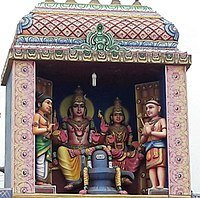
Contact with ancient India brought the influence of Hinduism and Buddhism to SEA. What we now call Hinduism similarly developed in India out of native animism and the more formal Vedic tradition. This can be seen in the multitude of sacred animals and location-specific Hindu gods