1/

It’s often claimed that “The Concept of Autogynephilia and the Typology of Male Gender Dysphoria” by @BlanchardPhD has been debunked.

I thought it would be interesting to see, at a basic level, how the concept and typology compares to the DSM-5.

A. The definition of AGP.

2/

B. Transvestism is often accompanied by AGP.

C. The presence of AGP in transvestism increases the likelihood of [developing] Gender Dysphoria.
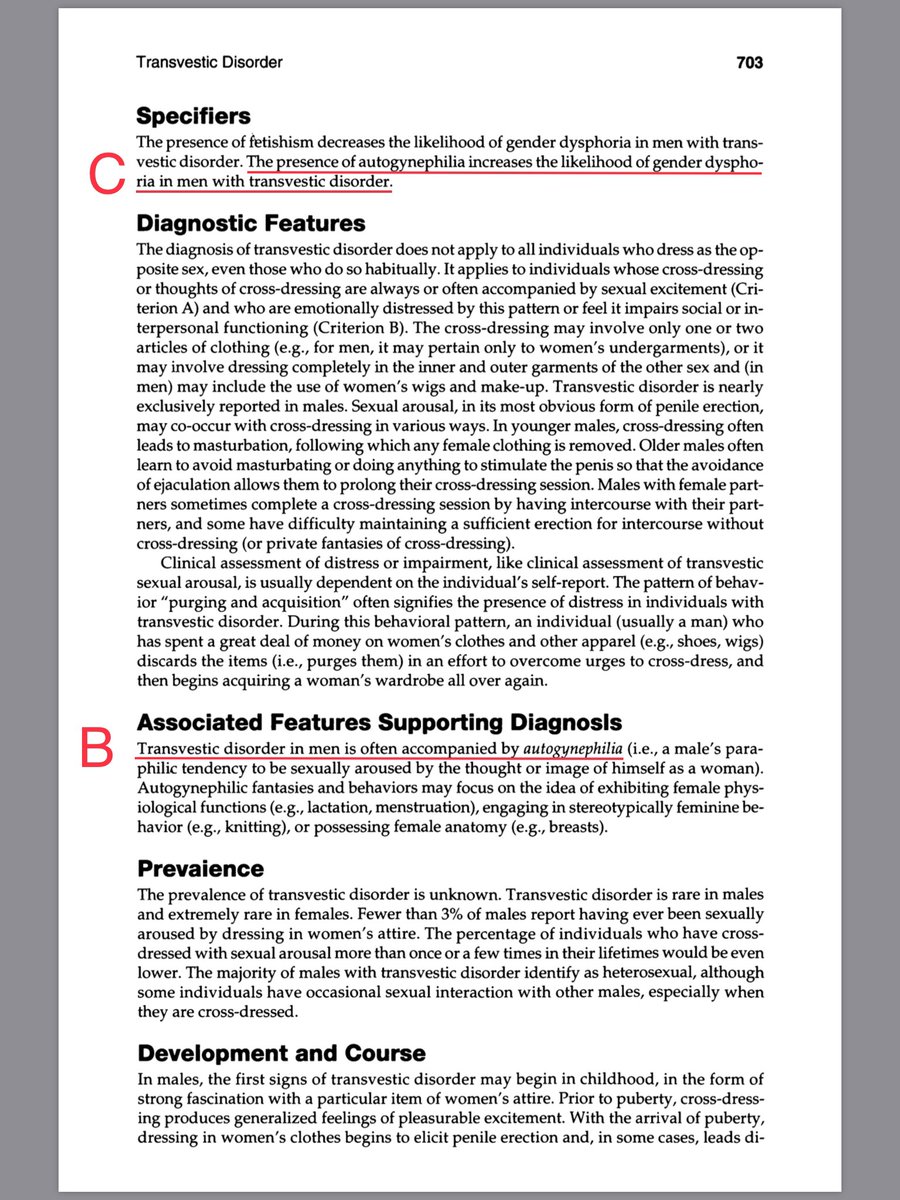
3/

D. Gender Dysphoria (GD) in natal males is categorized as either early-onset or late-onset.
4/

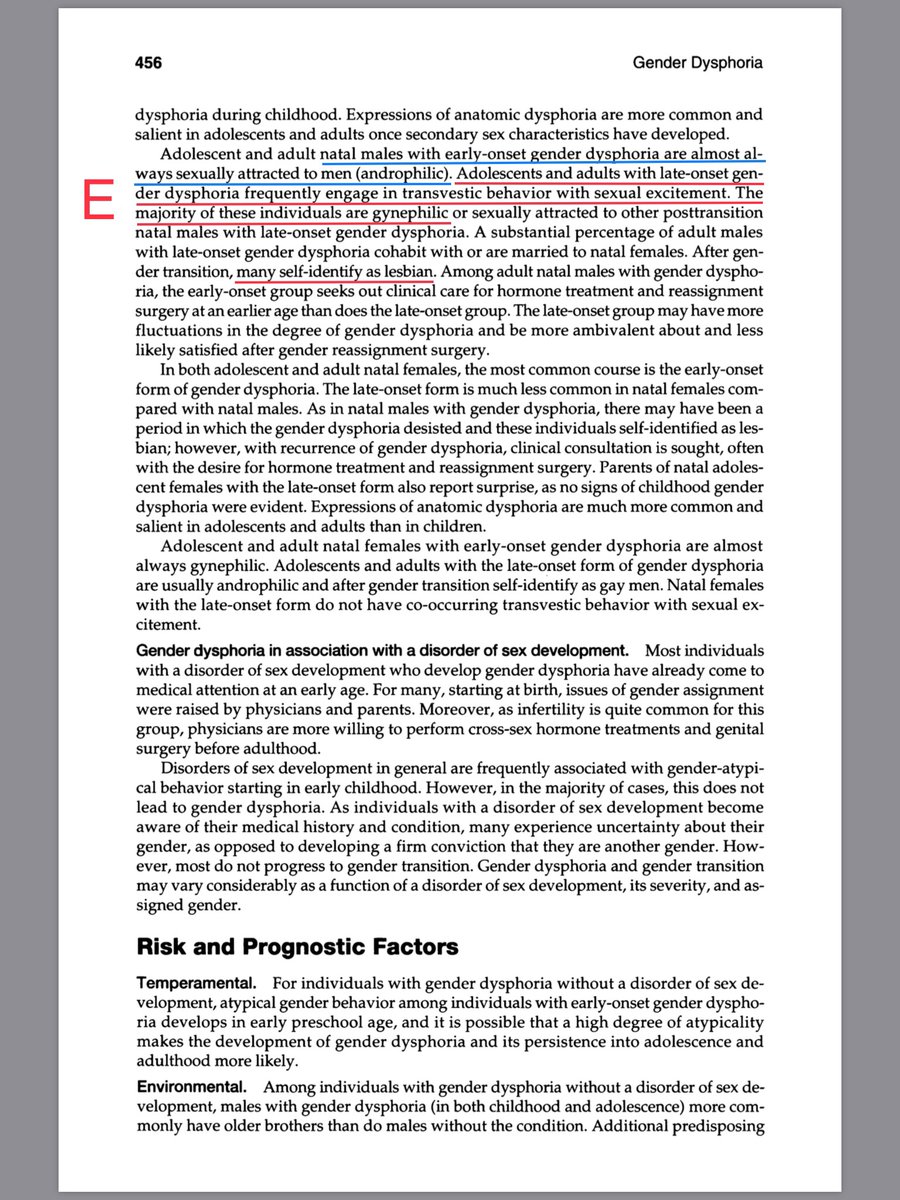
E. Natal males with early-onset GD are almost always androphilic. The majority of natal males with late-onset GD are gynephilic; additionally, they frequently [have histories of] engaging in transvestic behavior with sexual excitement.
5/

F. In many cases of natal males with late-onset GD, transvestic behavior with sexual excitement is a precursor to their GD.
6/

Observation 1:
There appears to be a strong correlation between the “early-onset GD” group in the DSM-5 and the “homosexual transsexual” (HSTS) group in the Blanchard typology.
7/

Observation 2:
There appears to be a strong correlation between the “late-onset GD” group in the DSM-5 and the “nonhomosexual transsexual” (autogynephilic/AGP) group in the Blanchard typology.
8/

Observation 3:
The DSM-5 categorizes its GD groups based on age of onset, while the Blanchard typology categorizes its groups
based on sexual orientation.
9/

Although this creates room for incongruence between the DSM-5 groups and the Blanchard typology groups, it also demonstrates a strong resemblance, given that the DSM-5 indicates such a strong relationship between age of GD onset and sexual orientation.
10/

Observation 4:
The DSM-5 draws a clear link between transvestic AGP and the late-onset GD group.

The other subtypes of AGP (anatomic, behavioral and physiologic) aren’t really covered, but it seems plausible that they are similarly linked to the late-onset GD group.
11/

Summary:
There is a strong resemblance between the DSM-5 and the Blanchard typology. One would not expect to see such a strong resemblance if the Blanchard typology had truly been debunked.

On a final note:

More from Society

You May Also Like

So the cryptocurrency industry has basically two products, one which is relatively benign and doesn't have product market fit, and one which is malignant and does. The industry has a weird superposition of understanding this fact and (strategically?) not understanding it.


The benign product is sovereign programmable money, which is historically a niche interest of folks with a relatively clustered set of beliefs about the state, the literary merit of Snow Crash, and the utility of gold to the modern economy.

This product has narrow appeal and, accordingly, is worth about as much as everything else on a 486 sitting in someone's basement is worth.

The other product is investment scams, which have approximately the best product market fit of anything produced by humans. In no age, in no country, in no city, at no level of sophistication do people consistently say "Actually I would prefer not to get money for nothing."

This product needs the exchanges like they need oxygen, because the value of it is directly tied to having payment rails to move real currency into the ecosystem and some jurisdictional and regulatory legerdemain to stay one step ahead of the banhammer.
I think a plausible explanation is that whatever Corbyn says or does, his critics will denounce - no matter how much hypocrisy it necessitates.


Corbyn opposes the exploitation of foreign sweatshop-workers - Labour MPs complain he's like Nigel

He speaks up in defence of migrants - Labour MPs whinge that he's not listening to the public's very real concerns about immigration:

He's wrong to prioritise Labour Party members over the public:

He's wrong to prioritise the public over Labour Party