Unless we pass laws which support people to enable them to self-isolate properly, any improvements to test & trace will have marginal impact and cases will simply spiral out of control once again as we ease lockdown in December.

A short thread on what we can do and why 👇
1/

Improving the currently poor rates of self-isolation is actually the key point, which many scientists, politicians, & commentators do still seem to be missing.

This requires good public health communication, proper support for those who need to self-isolate, & trust.
2/
Massive testing and tracing will only significantly reduce
transmission if positive cases isolate effectively. Yet
currently fewer than 20% of those who should isolate are fully adherent.

I don't think I need to explain why it's so critical to improve these rates.

3/
Survey data shows intention to adhere to test/trace/isolate behaviours is higher than self-reported adherence: whilst 76% of people intend to share contacts, only 50% of people correctly recognise symptoms &
just 12% get a test, 18% isolate, & 11% of contacts isolate properly.
4
Self-reported ability to self-isolate
is three times lower in those who earn less than £20,000 per year or have less than £100 saved.

5/
The UK has one of the lowest proportions of pay covered by statutory sick pay in Europe (29% compared to 100% in Germany), and millions do not qualify.

6/
An OECD review showed paid sick leave is important well beyond its
core function to protect sick workers during a health pandemic and subsequent economic crisis.

7/
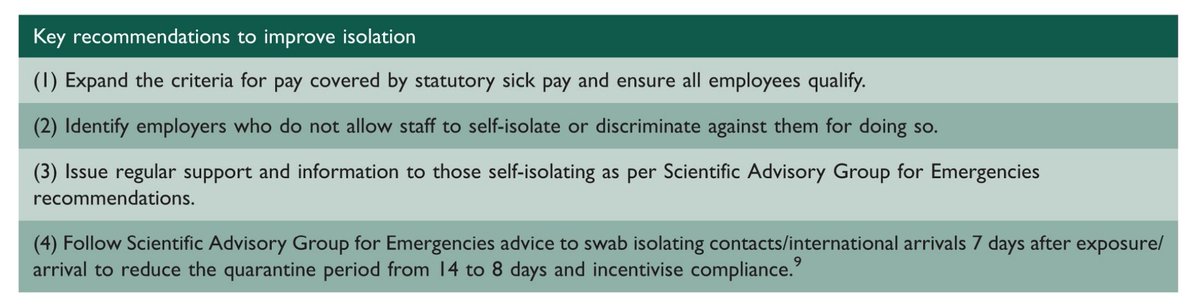
SAGE and iSAGE agree that
individuals need to be supported properly for them to isolate, advising a daily text or phone call, with provision of food supplies, essential goods and employment
protection, stressing solidarity and togetherness.

8/
In Senegal (& China & elsewhere), they offer isolated accommodation to anyone who needs it. https://t.co/Reopwtvizn
We could do this too (hotels), & it would go a long way to preventing spread within multigenerational households, where transmission often occurs.
9/
It is *over three months* since the ONS found that a lack of proper sick pay was highly correlated with care home outbreaks and *over three months later* we have still done absolutely nothing about this in England. https://t.co/q4phFlXALW

In the most vulnerable of settings.

10/
https://t.co/7lkzrHx7DB
Wales has acted to change this in care homes, when will England? And when will we then follow SAGE, iSAGE and OECD advice and apply that across the board to improve self - isolation rates and therefore reduce rates of community transmission?

11/
Existing test-and-trace policies have deviated from advice provided by SAGE and, without improving basic public health communication and giving support to self-isolate, any
improvements to the test-and-trace system will have only marginal impact.

END
https://t.co/h60nM1TMsM

More from Society

This is a piece I've been thinking about for a long time. One of the most dominant policy ideas in Washington is that policy should, always and everywhere, move parents into paid labor. But what if that's wrong?

My reporting here convinced me that there's no large effect in either direction on labor force participation from child allowances. Canada has a bigger one than either Romney or Biden are considering, and more labor force participation among women.

But what if that wasn't true?

Forcing parents into low-wage, often exploitative, jobs by threatening them and their children with poverty may be counted as a success by some policymakers, but it’s a sign of a society that doesn’t value the most essential forms of labor.

The problem is in the very language we use. If I left my job as a New York Times columnist to care for my 2-year-old son, I’d be described as leaving the labor force. But as much as I adore him, there is no doubt I’d be working harder. I wouldn't have stopped working!

I tried to render conservative objections here fairly. I appreciate that @swinshi talked with me, and I'm sorry I couldn't include everything he said. I'll say I believe I used his strongest arguments, not more speculative ones, in the piece.

You May Also Like