1/n
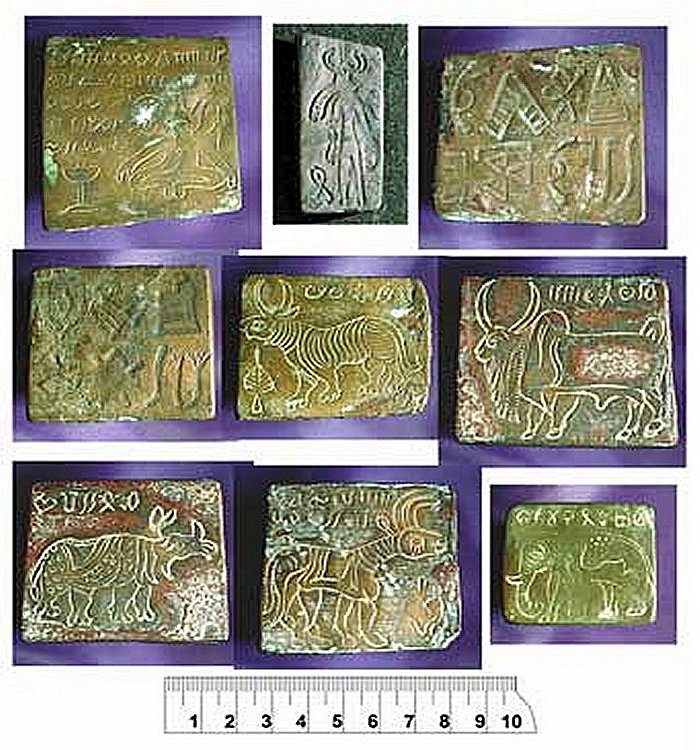
In 2014, a group of 9 Indus copper plates ( 2600 BCE), discovered in a private collection in Pakistan, revealed an incredible secret. The plates proved that printing was first invented in India more than 1500 years before the first known printing, in China around 700 BCE.

2/n
Authors Vasant Shinde & Rick J Willis wrote a detailed scientific paper discussing the discovery & its implications. The plates are larger and stronger than known copper plates or tablets, but the most significant detail is that they are inscribed with mirrored characters.
3/n
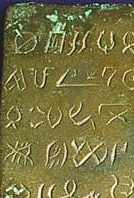
One of the plates bears 34 characters, which is the longest known single Indus script inscription. A thorough examination revealed the copper plates were not used as seal but as templates for copper plate printing. This makes them the earliest known printing devices, by far.
4/n
In their paper,  Shinde &  Willis write:
"They are quite different from other metal plates or tablets recovered from Mohenjo-daro & Harappa, as they are larger and much thicker, but most significantly they bear inscriptions only on one surface and the script is reversed. “
5/n
“Data from all tests, including x-ray fluorescence metal analyses, conventional and scanning electron microscopy, and metallographic analysis are totally consistent with metal artifacts from Indus Valley (Harappan) civilization, c. 2600–2000 BC.”
6/n
“The plates have all attributes of printing plates: fine engraving & reversed writing. They are the earliest printed form of art, possibly printed on silk, leather or bark, as paper did not exist then. We have produced quite acceptable images onto native silk cloth..."
7/n
"Thus it is suggested that these unique copper plates are the world’s earliest known printing plates, & moreover, would have provided the world’s earliest printed works of art."
The plates show imagery & details similar to seals/tablets excavated from Indus Valley sites.
8/n
The most unusual copper plate depicts a deity with a horned head-dress, seated in yogic position, bearing a gem on his chest like the Kaustubha jewel of Vishnu. To the right, is a small Tulsi plant. This may be the earliest depiction of Shree Vishnu.
9/n
The scientists worked with a master printer to validate their theory. All nine plates were trialled in a cylinder printing press using 2 types of ink which could simulate inks available millennia ago: carbon black pigment and ferric oxide pigment.
10/n
Prints were first trialled by being printed on Tussar silk cloth & parchment, materials for which evidence of native silk fibres was found at Indus Valley. Tussar silk is still manufactured from cocoons of the wild silk moth 'Antherea paphia' in India.
11/n
This ancient tradition continues to this day in many parts of modern India, where special handcrafted wooden & metal templates are used to hand block beautiful designs on Silk. Over time specific patterns and designs have come to signify cultural traditions.
12/n
The results of printing were remarkable. That these plates were designed for printing was further corroborated by their unusual thickness & strength to take the pressure required. The plates were used with simple pressure from a heavy object to press the ink onto the medium.
12/n
This extraordinary discovery provides strong evidence that printing was first invented in India’s Saraswati Sindhu civilization more than 1500 years before China. We are sure to discover many more such facts about our heritage as technology enables path breaking research.
13/n
Images & data were sourced from the Shinde & Willis research paper which you can read here:

https://t.co/T5IwuR40RD

More from Savitri Mumukshu - सावित्री मुमुक्षु

You May Also Like

I hate when I learn something new (to me) & stunning about the Jeff Epstein network (h/t MoodyKnowsNada.)

Where to begin?

So our new Secretary of State Anthony Blinken's stepfather, Samuel Pisar, was "longtime lawyer and confidant of...Robert Maxwell," Ghislaine Maxwell's Dad.


"Pisar was one of the last people to speak to Maxwell, by phone, probably an hour before the chairman of Mirror Group Newspapers fell off his luxury yacht the Lady Ghislaine on 5 November, 1991."
https://t.co/DAEgchNyTP


OK, so that's just a coincidence. Moving on, Anthony Blinken "attended the prestigious Dalton School in New York City"...wait, what? https://t.co/DnE6AvHmJg

Dalton School...Dalton School...rings a

Oh that's right.

The dad of the U.S. Attorney General under both George W. Bush & Donald Trump, William Barr, was headmaster of the Dalton School.

Donald Barr was also quite a


I'm not going to even mention that Blinken's stepdad Sam Pisar's name was in Epstein's "black book."

Lots of names in that book. I mean, for example, Cuomo, Trump, Clinton, Prince Andrew, Bill Cosby, Woody Allen - all in that book, and their reputations are spotless.
THREAD: 12 Things Everyone Should Know About IQ

1. IQ is one of the most heritable psychological traits – that is, individual differences in IQ are strongly associated with individual differences in genes (at least in fairly typical modern environments). https://t.co/3XxzW9bxLE


2. The heritability of IQ *increases* from childhood to adulthood. Meanwhile, the effect of the shared environment largely fades away. In other words, when it comes to IQ, nature becomes more important as we get older, nurture less.
https://t.co/UqtS1lpw3n


3. IQ scores have been increasing for the last century or so, a phenomenon known as the Flynn effect. https://t.co/sCZvCst3hw (N ≈ 4 million)

(Note that the Flynn effect shows that IQ isn't 100% genetic; it doesn't show that it's 100% environmental.)


4. IQ predicts many important real world outcomes.

For example, though far from perfect, IQ is the single-best predictor of job performance we have – much better than Emotional Intelligence, the Big Five, Grit, etc. https://t.co/rKUgKDAAVx https://t.co/DWbVI8QSU3


5. Higher IQ is associated with a lower risk of death from most causes, including cardiovascular disease, respiratory disease, most forms of cancer, homicide, suicide, and accident. https://t.co/PJjGNyeQRA (N = 728,160)