1
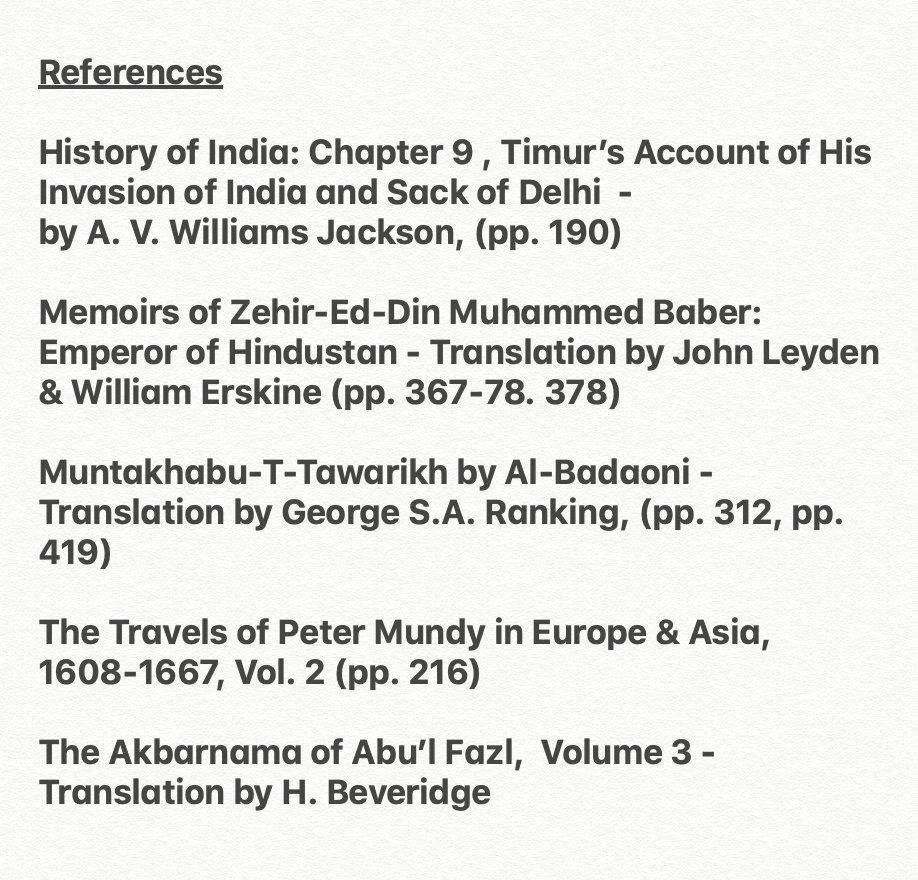
Since so many Twitter friends of Salman Nizami are turning red asking me for proof, I thought I would oblige. This short thread cites evidence from trusted sources (mostly Islamic) to prove how Mughals built Minars of Hindu heads as a sign of Islam’s victory over infidel Kafirs

2
When Timur first came to Hindustan, he attacked the Hindu kingdom of Kator extending from Kashmir to Kabul. In his autobiography “Tuzak-I-Timuri” Timur describes building a tower of skulls of “obstinate unbelievers” after enslaving women & kids & looting booty (May, 1398 CE).
3
The Zafarnama of Sharafuddin Ali Yazdi (Iran) is an illustrated book on Timurid dynasty (1425 CE). A painting in the Zafarnama shows Timur getting tribute from soldiers, while an Islamic Minaret representing the might of Islam built out of dead Kafir’s heads looms behind him.
4
The next Mughal, Babur, practically salivated with delight at the prospect of killing Hindus & scattering them like “teased wool & broken bubbles on wine”. He built several Minars out of Hindu heads, during battles with Rajputs, in the Doab, near Agra & Chanderi to name a few.
5
So overjoyed was Babur with the gore that he waxed eloquent poetry about killing Hindus in praise of God. After creating Minars out of Hindu heads, he proudly declared himself a “Ghazi” as his official imperial title - a term which means “Victorious over the enemies of Islam”
6
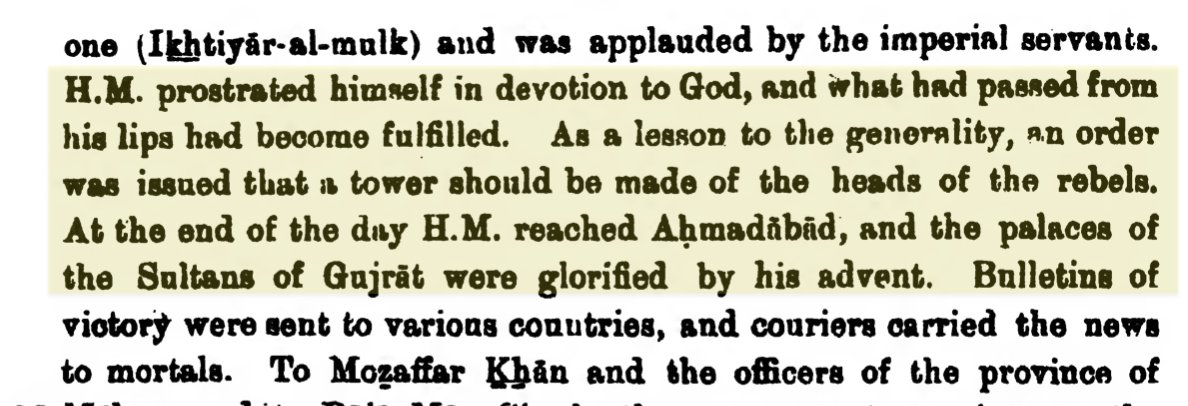
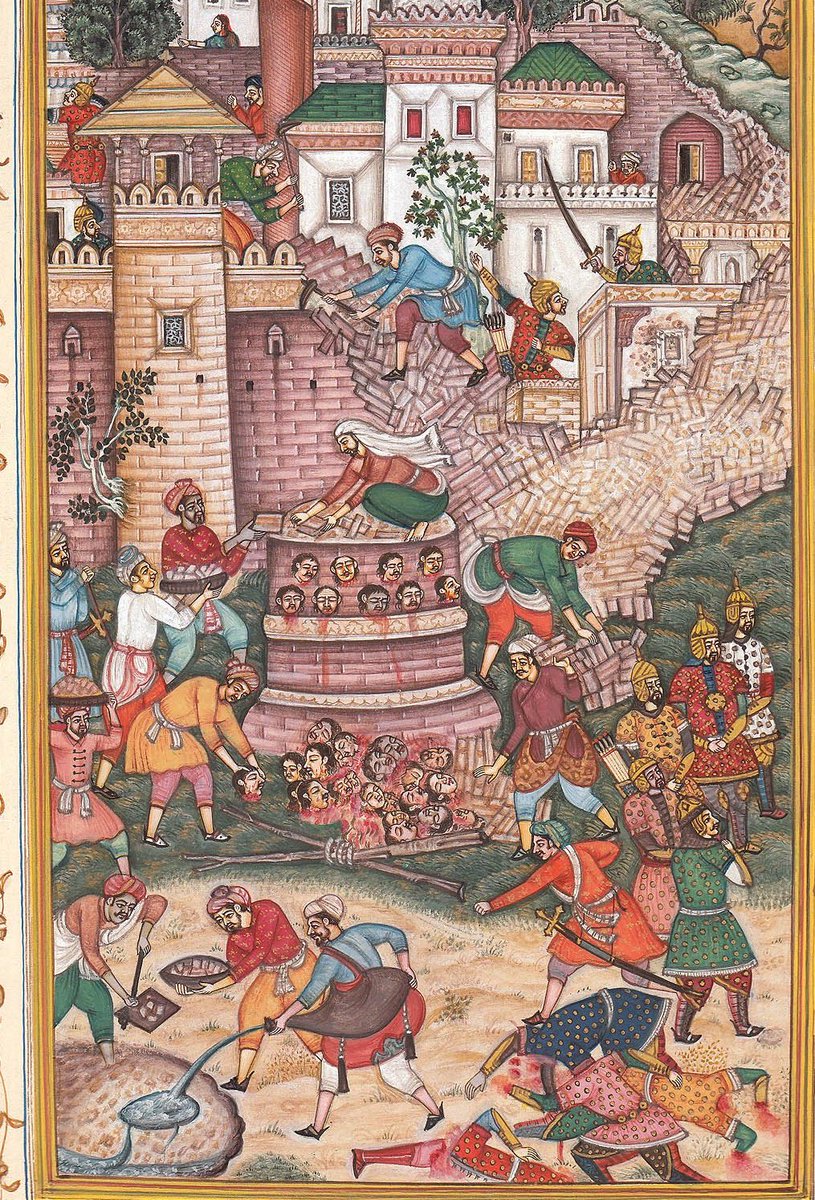
The Great “secular” Akbar, occupied Delhi & Agra in true Mughal tradition by building a tower with Hindu heads. He did the same in his conquest of Ahmedabad. He rewarded his commander Khan-i-Khanan (Bairam Khan), for building “8 sky high Minarets of Hindu heads” in Bengal.
7
A painting in the illustrated Akbarnama showed Akbar at the 2nd battle of Panipat, in 1526 CE, where Bairam Khan & Akbar colluded to behead Hemu. It depicted “Ghazi” Akbar & his army stacking up heads of Hemu's Hindu soldiers into a tower/Minar of victory over Islam’s enemies.
8
The great Mughal romantic, Shah Jahan was nothing less. In 1628 CE, British merchant Peter Mundy traveled to his court & wrote a detailed account of all that he saw. Mundy describes Shah Jahan’s army officers such as Abdullah Khan building towers/Minars of Hindu skulls.
9
He describes over 60 such towers each made of 35-40 heads. He also saw head towers that were created to warn off criminals. At that time, definition of criminal included any Hindu worshipping their gods, or refusing to convert to Islam. Mundy made a drawing of these towers.
10
Slaughtering Hindus & stacking up their heads into Minars was a hallowed tradition of the Mughals. They celebrated violent carnage as Ghazis, who won victory against Kafir Hindus for Islam. Minars of horror were one of the foremost building achievement of Mughals in India.
11

More from Savitri Mumukshu - सावित्री मुमुक्षु

More from All

You May Also Like

1/ Some initial thoughts on personal moats:

Like company moats, your personal moat should be a competitive advantage that is not only durable—it should also compound over time.

Characteristics of a personal moat below:


2/ Like a company moat, you want to build career capital while you sleep.

As Andrew Chen noted:


3/ You don’t want to build a competitive advantage that is fleeting or that will get commoditized

Things that might get commoditized over time (some longer than


4/ Before the arrival of recorded music, what used to be scarce was the actual music itself — required an in-person artist.

After recorded music, the music itself became abundant and what became scarce was curation, distribution, and self space.

5/ Similarly, in careers, what used to be (more) scarce were things like ideas, money, and exclusive relationships.

In the internet economy, what has become scarce are things like specific knowledge, rare & valuable skills, and great reputations.