There were five prominent dominions of the Kalinga Ganga family in initial days: Kalinganagara (Srikakulam), Svetaka Mandala (Ganjam), Giri Kalinga (Simhapur), Ambabadi Mandala (Gunupur, Rayagada) and Vartanni Mandala (Hinjilikatu, Ganjam).
Eastern Ganga Dynasty

ThenTriKalinga defination was different.
In the he heartland of the Eastern Ganga Dynasty had3 parts of Kalinga namely, Daksina Kalinga (Pithapura), Madhya Kalinga (Yellamanchili Kalinga or Visakhapatnam), Uttara Kalinga (districts of Srikakulam, Ganjam, Gajapati and Rayagada).
During the rule of Vajrahasta V from 1038-1070 A.D the Gangas started playing a prominent role from the southern horizon of the already weakening later Somavanshi kingdom.
Eastern Ganga Dynasty
He introduced the Anka year of calculation system for the regnal years of the kings and this continued as a standard norm for future kings of ancient Odisha.
Eastern Ganga Dynasty
One of his predecessors had tried to unite the Ganga dominions in the Kalinga Dandapat area unsuccessfully. Vajrahasta V had not only united the Ganga domain but also had defeated the Somavanshis in his northern frontiers.
Eastern Ganga Dynasty
He established firm diplomatic and military relations with the Kalachuris (enemies of the Somavanshi) by marrying a princess from their family. He was also married to a princess of Ceylonese royal descent.
Eastern Ganga Dynasty
Rajaraja Deva I expanded his succesor expanded the kigndom over the united Ganga dominions. He ascended the throne in 1070 A.D, the same as the year of ascension of the Chola Kulottunga I (later crowned as Chola emperor).
Eastern Ganga Dynasty
One of his Ganga Prasasti inscriptions clearly says that he fought the Chola king over the territories of Vengi in the south, which means he invaded the opponent to be certain. he was married to Chola princess Rajasundari.
Eastern Ganga Dynasty
Despite ruling for only eight years, Rajaraja I was able to defeat the Somavanshi ruler ‘Mahasivagupta’ Janmenjaya II at the time of its pinnacle of achievements taking into consideration the completion of architectural marvels like the Lingaraja Temple.
Eastern Ganga Dynasty
The Southern portion of the Somavanshi territory became a Ganga domain. The Dirghasi temple inscription of Rajaraja I mentions his Brahmin commander in chief called Vanapati had assisted him in conquests.
Eastern Ganga Dynasty
He succeeded in defeating all the enemies on multiple fronts like the Chola, Utkala (Somavanshis), Gidrisingi, Khemidi, Dakshina Koshala (Kalachuris) and Vengi (Eastern Chalukyas).
Eastern Ganga Dynasty
Chodaganga Deva: he lost, his father Rajaraja Deva I at the age of five while his younger brother Parmardi was only three years. He was heir to the expanding Ganga dominion, which was directly in conflict with the Cholas and Somavanshis
Eastern Ganga Dynasty
The territory of Vengi became a fierce contest for the Gangas though ruled by the Cholas directly after defeating the Eastern Chalukiyas.
Eastern Ganga Dynasty
The relations between Chola Dynasty and Esatern Ganga Dynasty were strong due to Marital and trade ties. However, during the rule of the third governor Vikramchoda Chola, hostilities began again.
The Tamil classic Kalingattuparani says that due to non-payment of tributes (in defiance to Chola authority) Kulotunga sent the Chola army who defeated the Ganga kingdom and returned to his master collecting lots of wealth.
Eastern Ganga Dynasty
Historical estimation says that Chodaganga was married to Chodadevi, a Chola princess as per Daksarama inscription. Virachoda the former governor of Vengi had married off his daughter to him and settled in Kalinga acting as a guardian to him.
Eastern Ganga Dynasty
Chodaganga was, invited by the Somavanshi Brahmin minister and general, Vasudeva Ratha to oust the incompetent Somavanshi king. According to folklores, Chodaganga Deva reached Bhubaneswar with his army and dressed as a performer at the Somavanshi court..
..in Jajpur, he sneaked into their defenses with some of his companions. The overthrowing of the Somavanshi rule was an internal coup, which reinstated Chodaganga as king.
Eastern Ganga Dynasty
Dagoba inscription says that he fought with the Pala king of Bengal, Ramapala with the help his rival Sena chief, Vijaya Sena and defeated him at Aramayinagar.
Eastern Ganga Dynasty.
After many other conquests and reclamations, Chodaganga Deva unified most of the ancient Kalingan geography except the western regions and an imperial era began. He was the undisputed ruler of a landmass stretching from the river Ganga to Godavari.
Eastern Ganga Dynasty
Stone panel at a temple in Puri depicting Gangeswara Anantavarman Chodaganga Deba
Eastern Ganga Dynasty
Thread Source: https://t.co/TcoGs7SUBi
Eastern Ganga Dynasty

More from Religion

🌿𝑻𝒉𝒆 𝒔𝒕𝒐𝒓𝒚 𝒐𝒇 𝒂 𝑺𝒕𝒂𝒓 : 𝑫𝒉𝒓𝒖𝒗𝒂 & 𝑽𝒊𝒔𝒉𝒏𝒖

Once upon a time there was a Raja named Uttānapāda born of Svayambhuva Manu,1st man on earth.He had 2 beautiful wives - Suniti & Suruchi & two sons were born of them Dhruva & Uttama respectively.
#talesofkrishna https://t.co/E85MTPkF9W


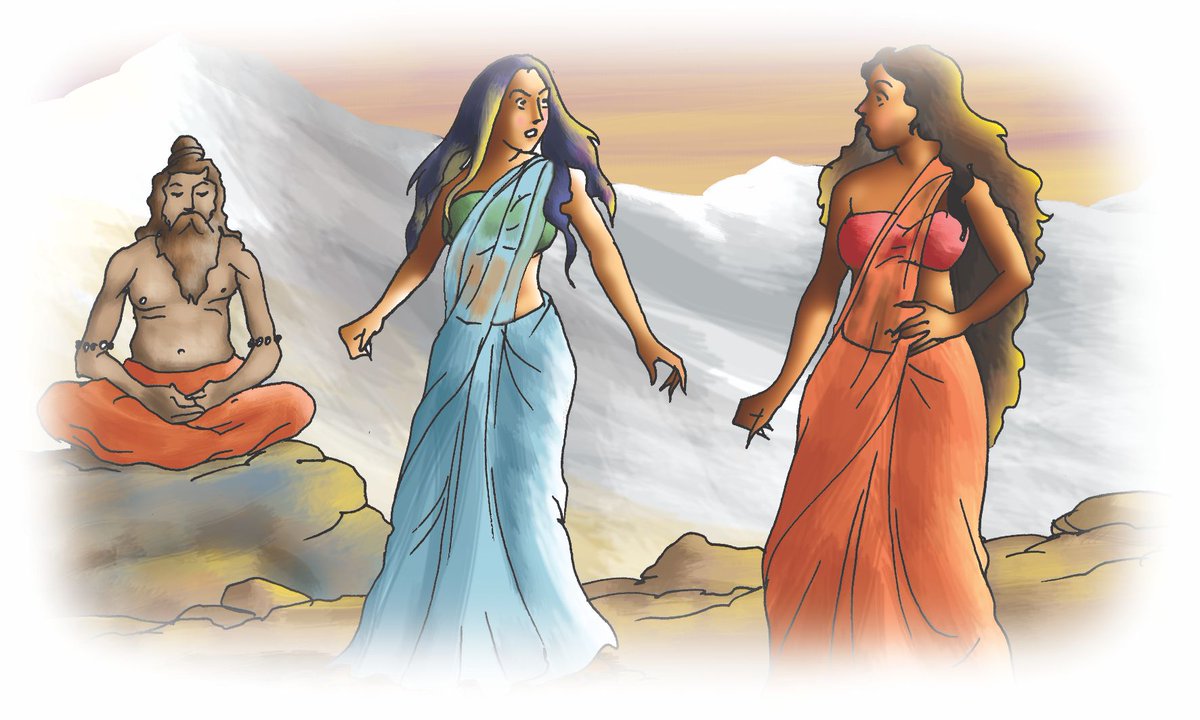
Now Suniti was the daughter of a tribal chief while Suruchi was the daughter of a rich king. Hence Suruchi was always favored the most by Raja while Suniti was ignored. But while Suniti was gentle & kind hearted by nature Suruchi was venomous inside.
#KrishnaLeela


The story is of a time when ideally the eldest son of the king becomes the heir to the throne. Hence the sinhasan of the Raja belonged to Dhruva.This is why Suruchi who was the 2nd wife nourished poison in her heart for Dhruva as she knew her son will never get the throne.


One day when Dhruva was just 5 years old he went on to sit on his father's lap. Suruchi, the jealous queen, got enraged and shoved him away from Raja as she never wanted Raja to shower Dhruva with his fatherly affection.


Dhruva protested questioning his step mother "why can't i sit on my own father's lap?" A furious Suruchi berated him saying "only God can allow him that privilege. Go ask him"
#BookExcerpts #Venkateshwara #Balaji

I will write a 3 part thread series with some interesting points from this book.

Part-1 : History of Tirumala & Venkateshwara Swamy
Part-2: Rituals & Prasada Procedure
Part-3: Historical records

Part-1 thread below

1/


Venkatachala Hill

Maha Vishnu wished for the mountain Krida / Krida Parvatham / Kridhachalam from Vaikunta to be brought to the earth for his avataram.

This was brought to earth by Garuda and Ananta & placed it on banks of river Swarna Mukhi

2/


This is where current Tirumala temple is located. The fact that this was transported from Vaikunta is apparently a scientifically proven fact.

The scientific dating of the sedimentary rocks have confirmed the date to be around 120 million years ago..

3/

This timeline coincides with Swayambhu Manu manvanthara of the Sweta Varaha Kalpa which is the time when Swamy descended on earth in the form of Venkateshwara Swamy.

From a survey of flora and fauna, they have found rare species of plants & animals like golden gecko..

4/

that are exclusive to this hill range only and not found anywhere else in the world.

Tirumala hills are a range of 7 hills
1. Seshachala
2. Vedachala
3. Garudachala
4. Anjanachala
5. Vrishabhachala
6. Narayanachala
7. Venkatachala --> Where temple is present

5/
@Kate_SdE @PriyamvadaGopal @ChathamHouse @AdomGetachew Hindu nationalism should not have a negative connotation. It’s not exclusivist because Hinduism isn’t a religion - rather, it’s a way of life, and the term “Hindu” refer broadly to the people around and east of the Sindhu. This transcends the modern construct of religions.

@PriyamvadaGopal @ChathamHouse @AdomGetachew For “Hindus” - a broad-brush stroke for a people whose culture is underpinned by a knowledge system that provides logical structure for adopters of a plethora of philosophies, “Hindu nationalism” by definition, is inclusive and pluralistic. It gives space to everyone.

@PriyamvadaGopal @ChathamHouse @AdomGetachew If Nyaya, Vaisheshika, Samkhya, Yoga, Purva-Mimamsa, Buddhist and Jain philosophies are studied in comparison with Abrahamic faiths, India’s unique Carl Popper Paradox comes to light. The imposition of a western matrix of secularism on a pluralistic culture has done much harm.

@PriyamvadaGopal @ChathamHouse @AdomGetachew Because the traditions are rooted in universalist philosophies, India gladly hosts followers of non-proselytizing faiths. Supremacist theocratic ideologies find little resonance with the people of the land. To understand “Hindu nationalism,” one has to study Indic philosophy.

@PriyamvadaGopal @ChathamHouse @AdomGetachew Equally, it is important to view history objectively, know the excesses of supremacist invaders/colonizers, and importantly, understand the asymmetries created by the “secular” state which structurally disadvantage the vastly heterogeneous so-called “Hindu” majority.

You May Also Like