Do you want to see if your Representative failed to vote in favor of a resolution calling for the global repeal of blasphemy, heresy, and apostasy laws? Look below. ⬇️

I think we deserve an explanation as to why they don't value basic global human

Louisiana Representative Ralph Abraham (R) "Not Voting." @RepAbraham

Alabama Representative Robert Aderholt (R) "Not Voting." @Robert_Aderholt

Georgia Representative Rick Allen (R) "Not Voting." @RepRickAllen

Michigan Representative Justin Amash (L) "Present." @justinamash
Arizona Representative Andy Biggs (R) "Nay." @RepAndyBiggsAZ

Georgia Representative Sanford Bishop Jr (D) "Not Voting." @SanfordBishop

Texas Representative Kevin Brady (R) "Not Voting." @RepKevinBrady

Florida Representative Vern Buchanan (R) "Not Voting." @VernBuchanan
Colorado Representative Ken Buck (R) "Not Voting." @BuckForColorado

Alabama Representative Bradley Byrne (R) "Not Voting." @RepByrne

California Representative Ken Calvert (R) "Not Voting." @KenCalvert

Texas Representative John Carter (R) "Not Voting." @JudgeCarter
Georgia Representative Doug Collins (R) "Not Voting." @RepDougCollins

Florida Representative Neal Dunn (R) "Not Voting." @DunnCampaign

Hawaii Representative Tulsi Gabbard (D) "Not Voting." @TulsiGabbard

Florida Representative Matt Gaetz (R) "Not Voting." @RepMattGaetz
Arizona Representative Ruben Gallego (D) "Not Voting." @RubenGallego

Montana Representative Greg Gianforte (R) "Not Voting." @gianforte

Ohio Representative Bob Gibbs (R) "Not Voting." @RepBobGibbs

Arizona Representative Paul Gosar (R) "Not Voting." @RepGosar
Louisiana Representative Garret Graves (R) "Not Voting." @garretgraves

Louisiana Representative Clay Higgins (R) "Not Voting." @CaptClayHiggins

Michigan Representative Bill Huizenga (R) "Not Voting." @billhuizenga
Iowa Representative Steve King (R) "Not Voting." @SteveKingIA

Connecticut Representative John Larson (D) "Not Voting." @JohnLarsonCT

Texas Representative Kenny Marchant (R) "Not Voting." @RepKenMarchant

Kentucky Representative Thomas Massie (R) "Nay." @RepThomasMassie
California Representative Tom McClintock (R) "Not Voting." @RepMcClintock

North Carolina Representative Patrick McHenry (R) "Not Voting." @McHenryCampaign

Michigan Representative Paul Mitchell (R) "Not Voting." @RepPaulMitchell
Colorado Representative Joe Neguse (D) "Not Voting." @JoeNeguse

Pennsylvania Representative Guy (R) Reschenthaler "Not Voting." @GReschenthaler

Louisiana Representative Cedric Richmond (R) "Not Voting." @RepRichmond
Washington Representative Cathy Rodgers (R) "Not Voting." @TeamCMR

Florida Representative Francis Rooney (R) "Not Voting." @RepRooney

Texas Representative Chip Roy (R) "Nay." @chiproytx

Georgia Representative Austin Scott (R) "Not Voting." @AustinScottGA08
Wisconsin Representative Jim Sensenbrenner Jr. (R) "Not Voting." @JimPressOffice

Illinois Representative John Shimkus (R) "Not Voting." @JohnMShimkus

North Carolina Representative Mark Walker (R) "Not Voting." @RepMarkWalker
Indiana Representative Jackie Walorski (R) "Not Voting." @RepWalorski

Texas Representative Ron Wright (R) "Not Voting." @RepRonWright

More from Politics

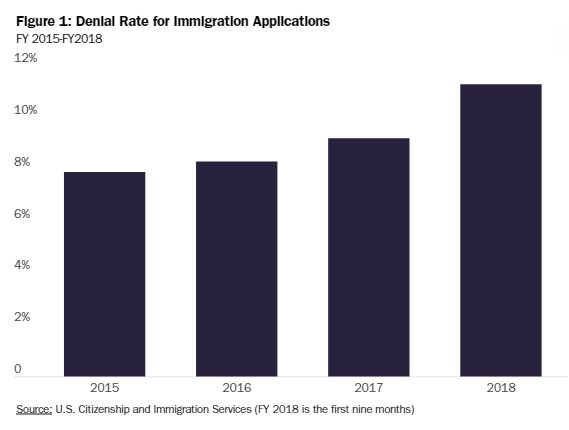
My piece in the NY Times today: "the Trump administration is denying applications submitted to the United States Citizenship and Immigration Services at a rate 37 percent higher than the Obama administration did in 2016."

Based on this analysis: "Denials for immigration benefits—travel documents, work permits, green cards, worker petitions, etc.—increased 37 percent since FY 2016. On an absolute basis, FY 2018 will see more than about 155,000 more denials than FY 2016."
https://t.co/Bl0naOO0sh


"This increase in denials cannot be credited to an overall rise in applications. In fact, the total number of applications so far this year is 2 percent lower than in 2016. It could be that the higher denial rate is also discouraging some people from applying at all.."

Thanks to @gsiskind for his insightful comments. The increase in denials, he said, is “significant enough to make one think that Congress must have passed legislation changing the requirements. But we know they have not.”

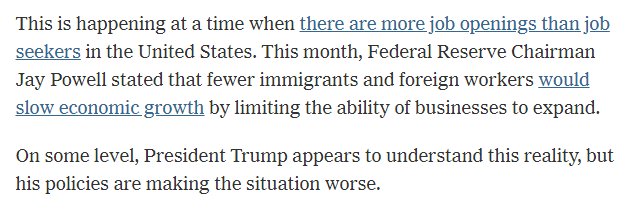
My conclusion:

You May Also Like

1/“What would need to be true for you to….X”

Why is this the most powerful question you can ask when attempting to reach an agreement with another human being or organization?

A thread, co-written by @deanmbrody:


2/ First, “X” could be lots of things. Examples: What would need to be true for you to

- “Feel it's in our best interest for me to be CMO"
- “Feel that we’re in a good place as a company”
- “Feel that we’re on the same page”
- “Feel that we both got what we wanted from this deal

3/ Normally, we aren’t that direct. Example from startup/VC land:

Founders leave VC meetings thinking that every VC will invest, but they rarely do.

Worse over, the founders don’t know what they need to do in order to be fundable.

4/ So why should you ask the magic Q?

To get clarity.

You want to know where you stand, and what it takes to get what you want in a way that also gets them what they want.

It also holds them (mentally) accountable once the thing they need becomes true.

5/ Staying in the context of soliciting investors, the question is “what would need to be true for you to want to invest (or partner with us on this journey, etc)?”

Multiple responses to this question are likely to deliver a positive result.
I just finished Eric Adler's The Battle of the Classics, and wanted to say something about Joel Christiansen's review linked below. I am not sure what motivates the review (I speculate a bit below), but it gives a very misleading impression of the book. 1/x


The meat of the criticism is that the history Adler gives is insufficiently critical. Adler describes a few figures who had a great influence on how the modern US university was formed. It's certainly critical: it focuses on the social Darwinism of these figures. 2/x

Other insinuations and suggestions in the review seem wildly off the mark, distorted, or inappropriate-- for example, that the book is clickbaity (it is scholarly) or conservative (hardly) or connected to the events at the Capitol (give me a break). 3/x

The core question: in what sense is classics inherently racist? Classics is old. On Adler's account, it begins in ancient Rome and is revived in the Renaissance. Slavery (Christiansen's primary concern) is also very old. Let's say classics is an education for slaveowners. 4/x

It's worth remembering that literacy itself is elite throughout most of this history. Literacy is, then, also the education of slaveowners. We can honor oral and musical traditions without denying that literacy is, generally, good. 5/x