(THREAD) The main problem with that @DanDrezner piece in the Post is that it's an international politics prof writing about the field in which I'm a professor—communications. No one in communications would *ever* compare the blogosphere to either Twitter or Substack. Here's why.
I still find that problematic in many ways.
More from Seth Abramson

(THREAD) To understand the second impeachment of Donald Trump, we must understand the words that preceded and augmented his January 6 incitement of insurrection. This thread unpacks four key speeches—Don Jr., Giuliani, Mo Brooks, and Eric Trump. I hope you'll read on and RETWEET.
1/ If you haven't yet seen my analysis of Trump's January 6 "incitement to insurrection" speech, you can find it at the link below. This thread will look at four shorter—but deeply consequential—speeches just before Trump's, all by Trump allies or family.
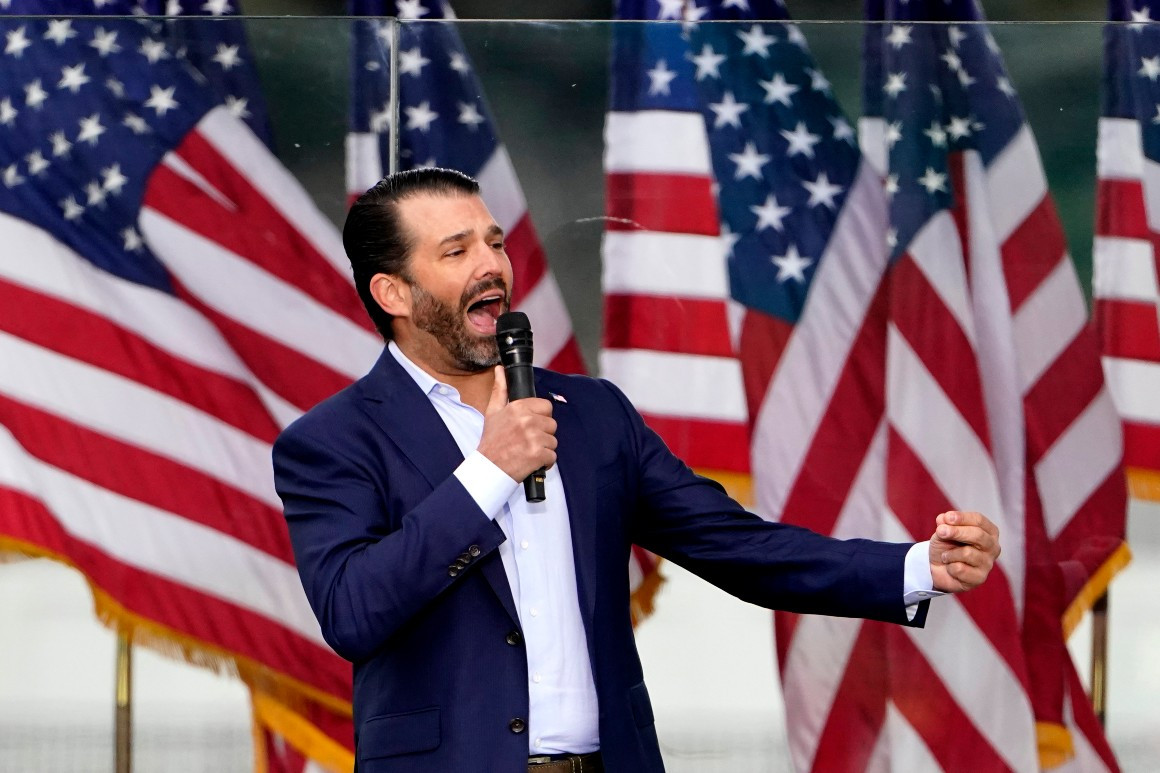
2/ DONALD TRUMP JR.
Trump Jr.'s speech on January 6—which ended less than an hour before his father incited an insurrection—is one of the most inscrutable of the day, because its beginning includes some promisingly responsible rhetoric. Then it descends into madness and chaos.
3/ "I'm looking at the crowd here, and you did it all [congregate here] without burning down buildings! You did it without ripping down churches! Without looting! I didn't know that that was possible!" Within 2 hours of his speech, Don Jr.'s audience would be looting the Capitol.
4/ So obviously Don Jr.'s opening is ironic to a historic degree, but this isn't the first time we've heard this rhetoric from him. He habitually ignores right-wing violence because he knows that his chief rhetorical canard—which marries progressivism and violences—gets applause.
1/ If you haven't yet seen my analysis of Trump's January 6 "incitement to insurrection" speech, you can find it at the link below. This thread will look at four shorter—but deeply consequential—speeches just before Trump's, all by Trump allies or family.
(THREAD) Media has yet to do a deep dive on precisely what Trump *said* in his January 6 speech in DC\u2014a speech now called an "incitement to insurrection," and the basis for an article of impeachment coming Monday. This thread unpacks the speech. I hope you'll read on and RETWEET. pic.twitter.com/ba6eaNScNW
— Seth Abramson (@SethAbramson) January 9, 2021
2/ DONALD TRUMP JR.
Trump Jr.'s speech on January 6—which ended less than an hour before his father incited an insurrection—is one of the most inscrutable of the day, because its beginning includes some promisingly responsible rhetoric. Then it descends into madness and chaos.
3/ "I'm looking at the crowd here, and you did it all [congregate here] without burning down buildings! You did it without ripping down churches! Without looting! I didn't know that that was possible!" Within 2 hours of his speech, Don Jr.'s audience would be looting the Capitol.
4/ So obviously Don Jr.'s opening is ironic to a historic degree, but this isn't the first time we've heard this rhetoric from him. He habitually ignores right-wing violence because he knows that his chief rhetorical canard—which marries progressivism and violences—gets applause.
About a month ago, I said to Jeffrey Toobin that it was Mike Flynn—not Paul Manafort—who had the *most* to offer Robert Mueller on the collusion question, underscoring that Flynn's December 2017 plea deal gave Mueller far more than we ever realized. Now here we are, 10 months on.
2/ Trump had two opportunities to formally name Flynn and his co-conspirator Erik Prince to his NatSec team during the 2016 campaign—he declined to do so *both times*. In the criminal justice system this is evidence of consciousness of guilt. Trump knew what these men were doing.
3/ That Trump sought out Flynn—not the other way around—in August '15, and began using him as his chief NatSec adviser right away, but never put him on his National Security Advisory Committee is critical evidence that Flynn was working on projects that had to be "off the books."
New reports show more and more evidence Michael Flynn ran a collusion channel to Russia for Trump's campaign https://t.co/upgnbTAkAh pic.twitter.com/6LNtrXaSf7
— Jonathan Chait (@jonathanchait) October 20, 2018
2/ Trump had two opportunities to formally name Flynn and his co-conspirator Erik Prince to his NatSec team during the 2016 campaign—he declined to do so *both times*. In the criminal justice system this is evidence of consciousness of guilt. Trump knew what these men were doing.
3/ That Trump sought out Flynn—not the other way around—in August '15, and began using him as his chief NatSec adviser right away, but never put him on his National Security Advisory Committee is critical evidence that Flynn was working on projects that had to be "off the books."
More from Politics


Trump is gonna let the Mueller investigation end all on it's own. It's obvious. All the hysteria of the past 2 weeks about his supposed impending firing of Mueller was a distraction. He was never going to fire Mueller and he's not going to
Mueller's officially end his investigation all on his own and he's gonna say he found no evidence of Trump campaign/Russian collusion during the 2016 election.
Democrats & DNC Media are going to LITERALLY have nothing coherent to say in response to that.
Mueller's team was 100% partisan.
That's why it's brilliant. NOBODY will be able to claim this team of partisan Democrats didn't go the EXTRA 20 MILES looking for ANY evidence they could find of Trump campaign/Russian collusion during the 2016 election
They looked high.
They looked low.
They looked underneath every rock, behind every tree, into every bush.
And they found...NOTHING.
Those saying Mueller will file obstruction charges against Trump: laughable.
What documents did Trump tell the Mueller team it couldn't have? What witnesses were withheld and never interviewed?
THERE WEREN'T ANY.
Mueller got full 100% cooperation as the record will show.
BREAKING: President Donald Trump has submitted his answers to questions from special counsel Robert Mueller
— Ryan Saavedra (@RealSaavedra) November 20, 2018
Mueller's officially end his investigation all on his own and he's gonna say he found no evidence of Trump campaign/Russian collusion during the 2016 election.
Democrats & DNC Media are going to LITERALLY have nothing coherent to say in response to that.
Mueller's team was 100% partisan.
That's why it's brilliant. NOBODY will be able to claim this team of partisan Democrats didn't go the EXTRA 20 MILES looking for ANY evidence they could find of Trump campaign/Russian collusion during the 2016 election
They looked high.
They looked low.
They looked underneath every rock, behind every tree, into every bush.
And they found...NOTHING.
Those saying Mueller will file obstruction charges against Trump: laughable.
What documents did Trump tell the Mueller team it couldn't have? What witnesses were withheld and never interviewed?
THERE WEREN'T ANY.
Mueller got full 100% cooperation as the record will show.


You May Also Like


The first area to focus on is diversity. This has become a dogma in the tech world, and despite the fact that tech is one of the most meritocratic industries in the world, there are constant efforts to promote diversity at the expense of fairness, merit and competency. Examples:
USC's Interactive Media & Games Division cancels all-star panel that included top-tier game developers who were invited to share their experiences with students. Why? Because there were no women on the
ElectronConf is a conf which chooses presenters based on blind auditions; the identity, gender, and race of the speaker is not known to the selection team. The results of that merit-based approach was an all-male panel. So they cancelled the conference.
Apple's head of diversity (a black woman) got in trouble for promoting a vision of diversity that is at odds with contemporary progressive dogma. (She left the company shortly after this
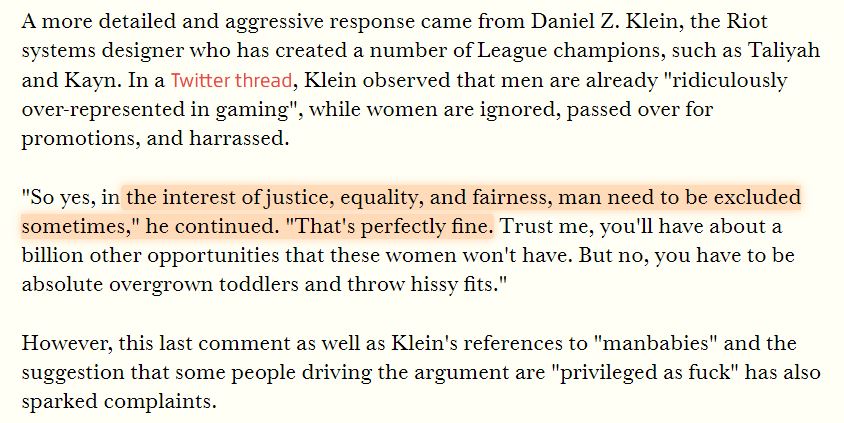
Also in the name of diversity, there is unabashed discrimination against men (especially white men) in tech, in both hiring policies and in other arenas. One such example is this, a developer workshop that specifically excluded men: https://t.co/N0SkH4hR35
USC's Interactive Media & Games Division cancels all-star panel that included top-tier game developers who were invited to share their experiences with students. Why? Because there were no women on the
ElectronConf is a conf which chooses presenters based on blind auditions; the identity, gender, and race of the speaker is not known to the selection team. The results of that merit-based approach was an all-male panel. So they cancelled the conference.
Apple's head of diversity (a black woman) got in trouble for promoting a vision of diversity that is at odds with contemporary progressive dogma. (She left the company shortly after this
Also in the name of diversity, there is unabashed discrimination against men (especially white men) in tech, in both hiring policies and in other arenas. One such example is this, a developer workshop that specifically excluded men: https://t.co/N0SkH4hR35