
I use these resources and they will (hopefully) help you in understanding the theoretical aspects of machine learning very well.
Do you want to learn the maths for machine learning but don't know where to start?
This thread is for you.
🧵👇
I use these resources and they will (hopefully) help you in understanding the theoretical aspects of machine learning very well.
Read this thread for more details👇
https://t.co/sSN3jdxDwK
Are you planning to learn Python for machine learning this year?
— Pratham Prasoon (@PrasoonPratham) February 13, 2021
Here's everything you need to get started.
\U0001f9f5\U0001f447
- Trigonometry & Algebra
These are the main pre-requisites for other topics on this list.
(There are other pre-requites but these are the most common)
To manipulate and represent data.
- Calculus
To train and optimize your machine learning model, this is very important.
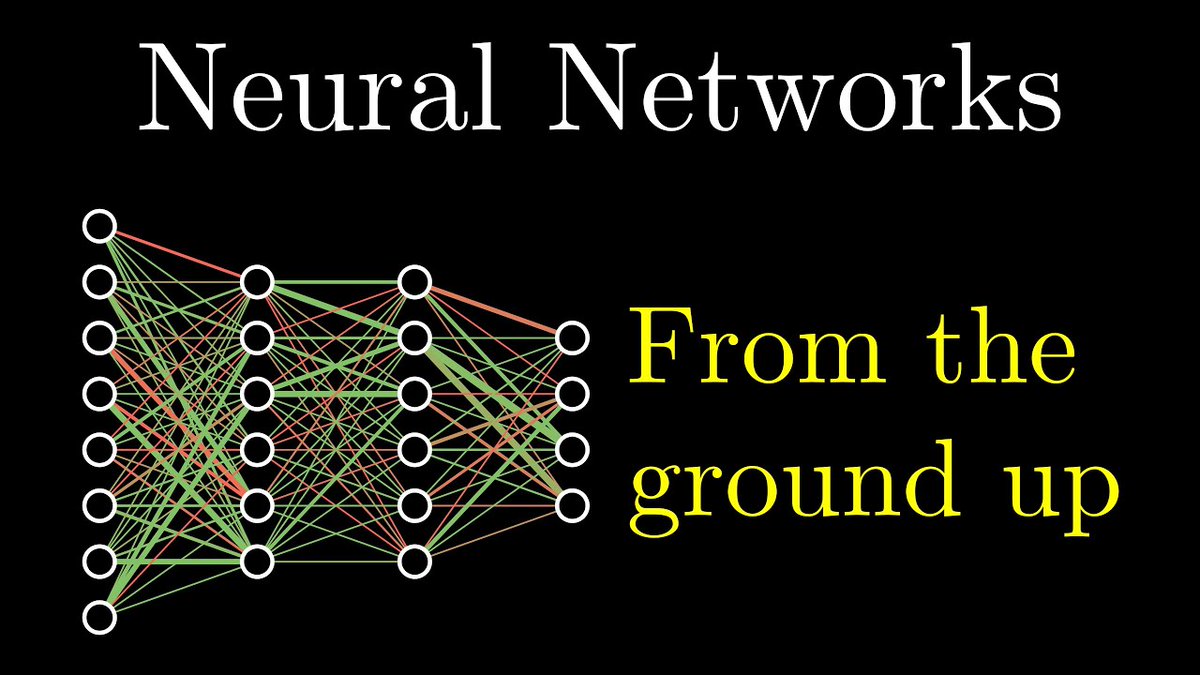
> A series of videos that go over how neural networks work with approach visual, must watch.
🔗youtu.be/aircAruvnKk
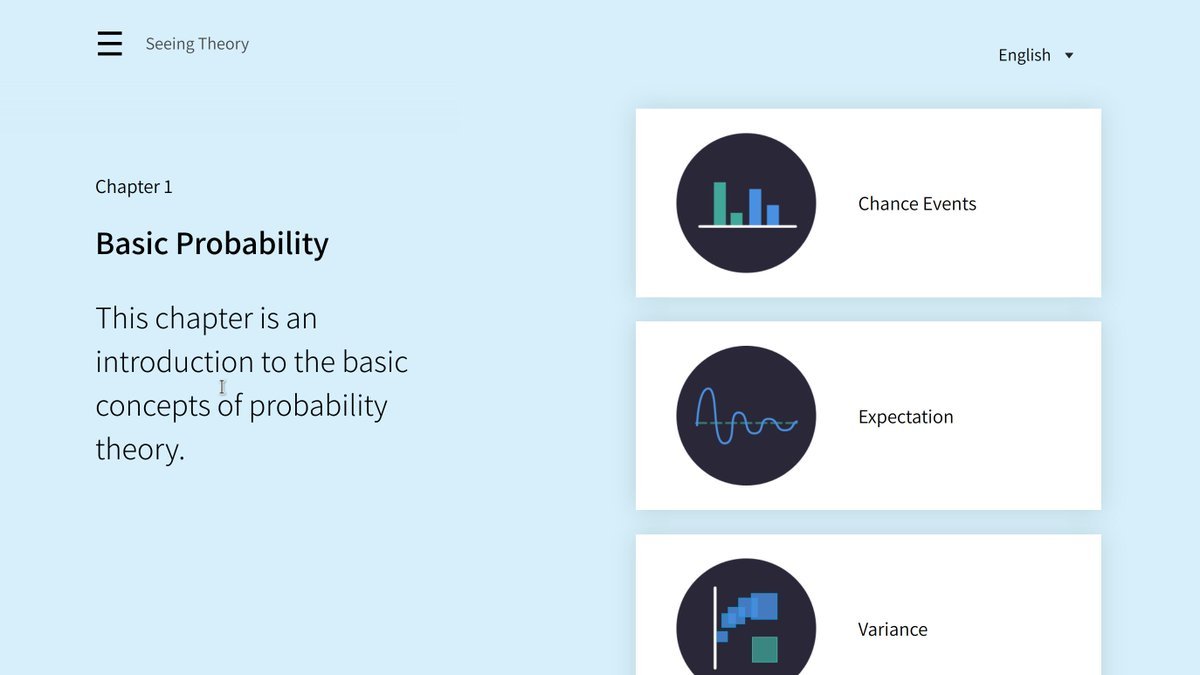
> This website helps you learn statistics and probability in an intuitive way.
🔗seeing-theory.brown.edu/basic-probability/index.html
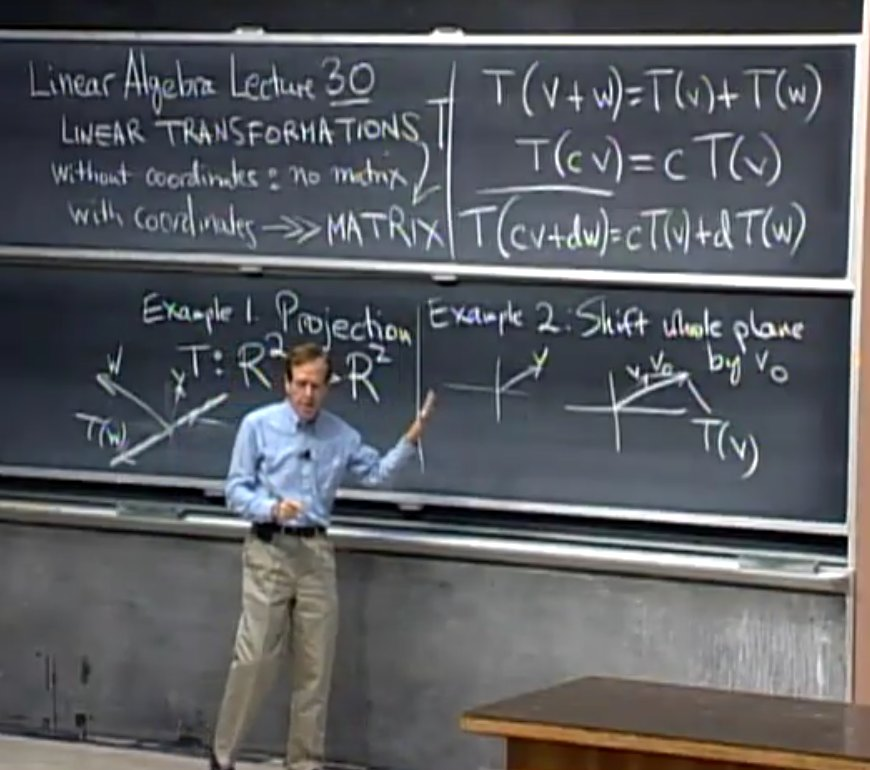
> This is 15 years old but still 100% relevant today!
Despite the fact these lectures are made for freshman college students at MIT, I found it very easy to follow👌
🔗youtube.com/playlist?list=PL49CF3715CB9EF31D
https://t.co/3H7U2HJgTd
This is a beginner-friendly introduction to:
— Pratham Prasoon (@PrasoonPratham) January 24, 2021
Linear Algebra for Machine Learning.
\U0001f9f5\U0001f447
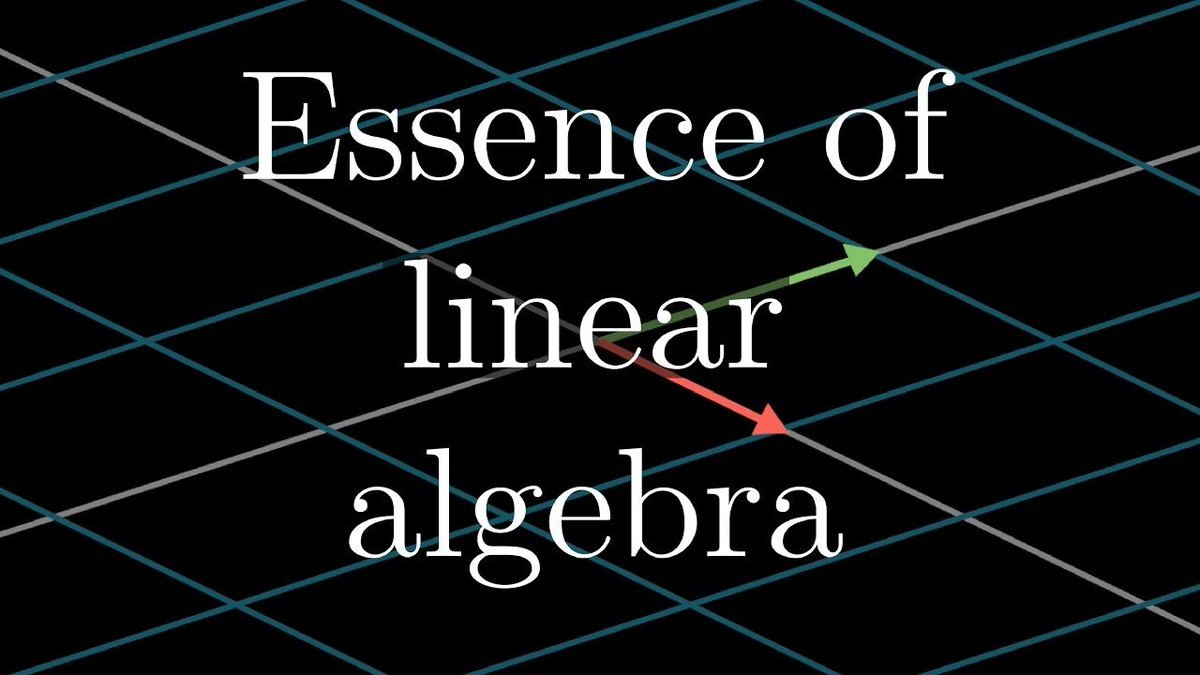
> A beautiful playlist of videos which teach you linear algebra through visualisations in an easy to digest manner.
🔗youtube.com/watch?v=fNk_zzaMoSs&list=PLZHQObOWTQDPD3MizzM2xVFitgF8hE_ab
>You'll find a course on everything here! Khan Academy is the first place I'll go to when I want to learn something.
🔗khanacademy.org/math

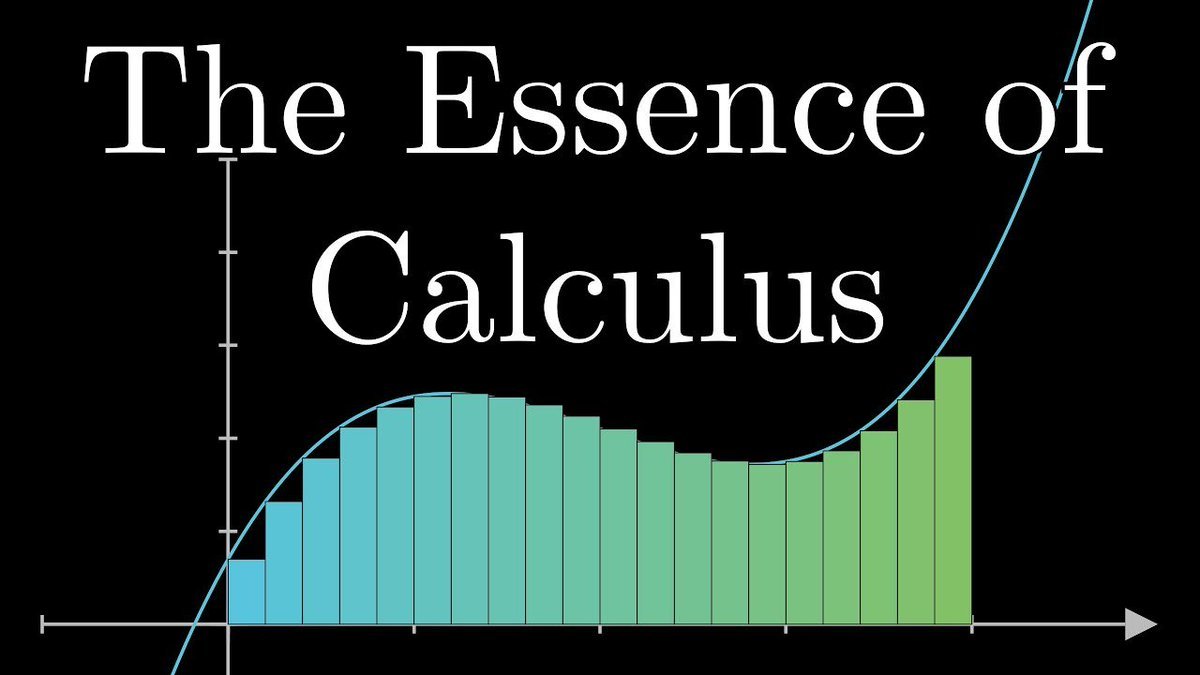
> A beautiful series on calculus, makes everything seem super simple.
🔗youtube.com/watch?v=WUvTyaaNkzM&list=PL0-GT3co4r2wlh6UHTUeQsrf3mlS2lk6x

More from Pratham Prasoon
This is a step-by-step guide on getting started with Python as a total beginner.
(includes free resources and everything else you need to get started)
🧵👇
Before we begin, I want to congratulate you on your decision to learn how to code using Python.
I still remember how I wrote my first piece of code 6 years and all the amazing and cool things I've been able to do with it ever since.
(2 / 24)
Make sure to keep in mind that it is probably best for you to keep your expectations in check.
Don't expect to make AAA games or state of the art machine learning models in a week.
(3 / 24)
Programming is not something that you can learn in a single week, it takes consistent effort and dedication over time to get good at it.
With all that being said, let's dive straight in.
(4 / 24)
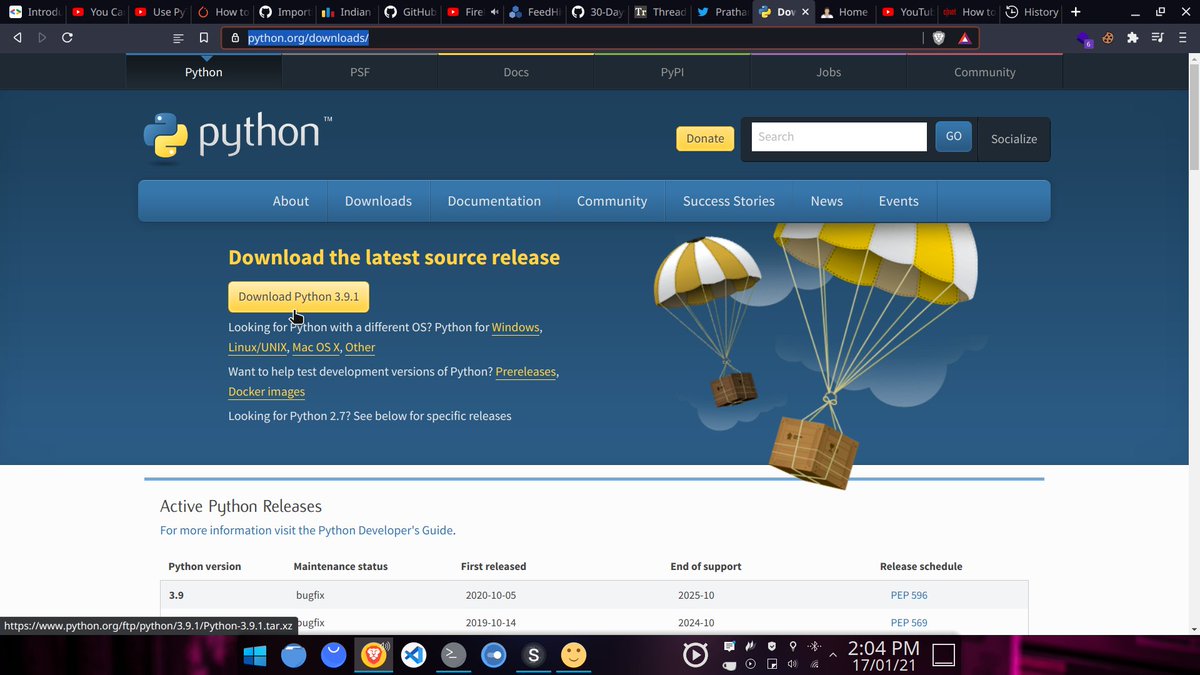
In order to write Python code, you'll need to install Python on your system.
Linux and macOS users can skip this step because they come pre-installed with Python.
Download link: https://t.co/KSZ4Qd6CNk
(5 / 24)
(includes free resources and everything else you need to get started)
🧵👇
Before we begin, I want to congratulate you on your decision to learn how to code using Python.
I still remember how I wrote my first piece of code 6 years and all the amazing and cool things I've been able to do with it ever since.
(2 / 24)
Make sure to keep in mind that it is probably best for you to keep your expectations in check.
Don't expect to make AAA games or state of the art machine learning models in a week.
(3 / 24)
Programming is not something that you can learn in a single week, it takes consistent effort and dedication over time to get good at it.
With all that being said, let's dive straight in.
(4 / 24)
In order to write Python code, you'll need to install Python on your system.
Linux and macOS users can skip this step because they come pre-installed with Python.
Download link: https://t.co/KSZ4Qd6CNk
(5 / 24)
More from Machine learning

Really enjoyed digging into recent innovations in the football analytics industry.
>10 hours of interviews for this w/ a dozen or so of top firms in the game. Really grateful to everyone who gave up time & insights, even those that didnt make final cut 🙇♂️ https://t.co/9YOSrl8TdN
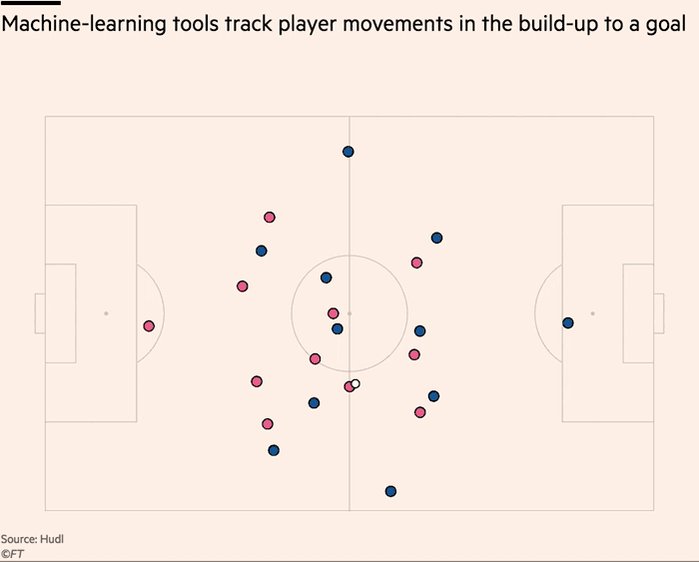
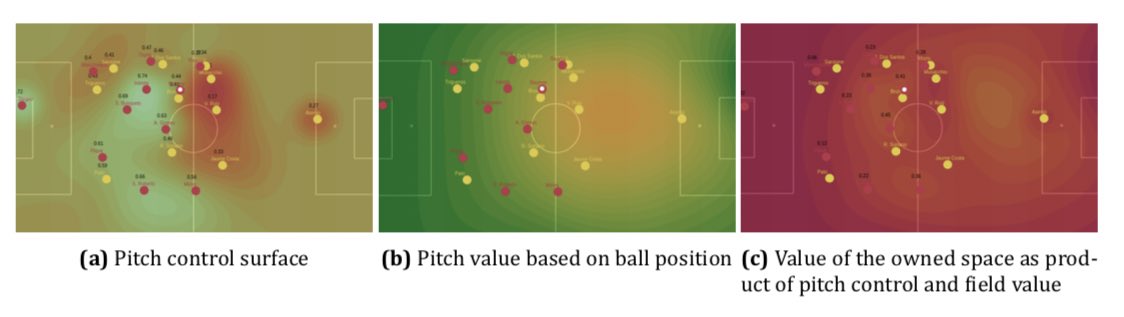
For avoidance of doubt, leading tracking analytics firms are now well beyond voronoi diagrams, using more granular measures to assess control and value of space.
This @JaviOnData & @LukeBornn paper from 2018 referenced in the piece demonstrates one method https://t.co/Hx8XTUMpJ5
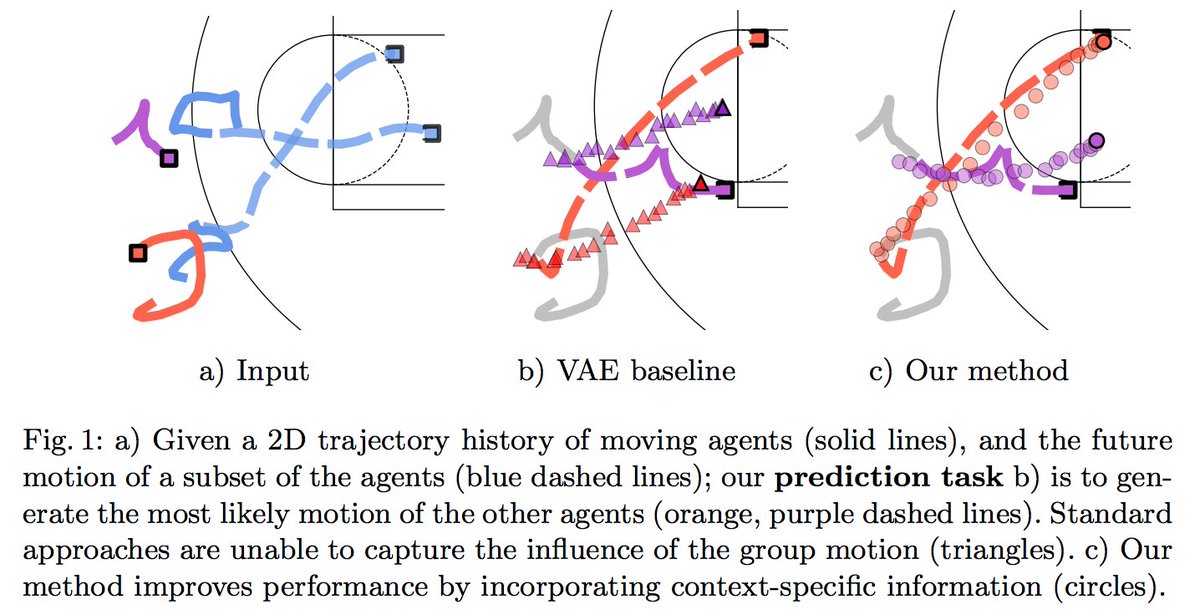
Bit of this that I nerded out on the most is "ghosting" — technique used by @counterattack9 & co @stats_insights, among others.
Deep learning models predict how specific players — operating w/in specific setups — will move & execute actions. A paper here: https://t.co/9qrKvJ70EN
So many use-cases:
1/ Quickly & automatically spot situations where opponent's defence is abnormally vulnerable. Drill those to death in training.
2/ Swap target player B in for current player A, and simulate. How does target player strengthen/weaken team? In specific situations?
>10 hours of interviews for this w/ a dozen or so of top firms in the game. Really grateful to everyone who gave up time & insights, even those that didnt make final cut 🙇♂️ https://t.co/9YOSrl8TdN
For avoidance of doubt, leading tracking analytics firms are now well beyond voronoi diagrams, using more granular measures to assess control and value of space.
This @JaviOnData & @LukeBornn paper from 2018 referenced in the piece demonstrates one method https://t.co/Hx8XTUMpJ5
Bit of this that I nerded out on the most is "ghosting" — technique used by @counterattack9 & co @stats_insights, among others.
Deep learning models predict how specific players — operating w/in specific setups — will move & execute actions. A paper here: https://t.co/9qrKvJ70EN
So many use-cases:
1/ Quickly & automatically spot situations where opponent's defence is abnormally vulnerable. Drill those to death in training.
2/ Swap target player B in for current player A, and simulate. How does target player strengthen/weaken team? In specific situations?


This is a Twitter series on #FoundationsOfML.
❓ Today, I want to start discussing the different types of Machine Learning flavors we can find.
This is a very high-level overview. In later threads, we'll dive deeper into each paradigm... 👇🧵
Last time we talked about how Machine Learning works.
Basically, it's about having some source of experience E for solving a given task T, that allows us to find a program P which is (hopefully) optimal w.r.t. some metric
According to the nature of that experience, we can define different formulations, or flavors, of the learning process.
A useful distinction is whether we have an explicit goal or desired output, which gives rise to the definitions of 1️⃣ Supervised and 2️⃣ Unsupervised Learning 👇
1️⃣ Supervised Learning
In this formulation, the experience E is a collection of input/output pairs, and the task T is defined as a function that produces the right output for any given input.
👉 The underlying assumption is that there is some correlation (or, in general, a computable relation) between the structure of an input and its corresponding output and that it is possible to infer that function or mapping from a sufficiently large number of examples.
❓ Today, I want to start discussing the different types of Machine Learning flavors we can find.
This is a very high-level overview. In later threads, we'll dive deeper into each paradigm... 👇🧵
Last time we talked about how Machine Learning works.
Basically, it's about having some source of experience E for solving a given task T, that allows us to find a program P which is (hopefully) optimal w.r.t. some metric
I'm starting a Twitter series on #FoundationsOfML. Today, I want to answer this simple question.
— Alejandro Piad Morffis (@AlejandroPiad) January 12, 2021
\u2753 What is Machine Learning?
This is my preferred way of explaining it... \U0001f447\U0001f9f5
According to the nature of that experience, we can define different formulations, or flavors, of the learning process.
A useful distinction is whether we have an explicit goal or desired output, which gives rise to the definitions of 1️⃣ Supervised and 2️⃣ Unsupervised Learning 👇
1️⃣ Supervised Learning
In this formulation, the experience E is a collection of input/output pairs, and the task T is defined as a function that produces the right output for any given input.
👉 The underlying assumption is that there is some correlation (or, in general, a computable relation) between the structure of an input and its corresponding output and that it is possible to infer that function or mapping from a sufficiently large number of examples.
You May Also Like


Krugman is, of course, right about this. BUT, note that universities can do a lot to revitalize declining and rural regions.
See this thing that @lymanstoneky wrote:
And see this thing that I wrote:
And see this book that @JamesFallows wrote:
And see this other thing that I wrote:
One thing I've been noticing about responses to today's column is that many people still don't get how strong the forces behind regional divergence are, and how hard to reverse 1/ https://t.co/Ft2aH1NcQt
— Paul Krugman (@paulkrugman) November 20, 2018
See this thing that @lymanstoneky wrote:
And see this thing that I wrote:
And see this book that @JamesFallows wrote:
And see this other thing that I wrote:




Took me 5 years to get the best Chartink scanners for Stock Market, but you’ll get it in 5 mminutes here ⏰
Do Share the above tweet 👆
These are going to be very simple yet effective pure price action based scanners, no fancy indicators nothing - hope you liked it.
https://t.co/JU0MJIbpRV
52 Week High
One of the classic scanners very you will get strong stocks to Bet on.
https://t.co/V69th0jwBr
Hourly Breakout
This scanner will give you short term bet breakouts like hourly or 2Hr breakout
Volume shocker
Volume spurt in a stock with massive X times
Do Share the above tweet 👆
These are going to be very simple yet effective pure price action based scanners, no fancy indicators nothing - hope you liked it.
https://t.co/JU0MJIbpRV
52 Week High
One of the classic scanners very you will get strong stocks to Bet on.
https://t.co/V69th0jwBr
Hourly Breakout
This scanner will give you short term bet breakouts like hourly or 2Hr breakout
Volume shocker
Volume spurt in a stock with massive X times