How to avoid (successful) accusations of defamation on Twitter. A few thoughts from someone who is NOT a libel lawyer, but does say very critical things about named individuals. 1/

1. Facts are different from opinions. But stating an opinion can imply a fact. https://t.co/1PkiI4olib
2. When I tweet I aim to be sure A. I show the *facts* I am basing my *opinion* on. B. I have good reason to believe the *facts* are true. C. My opinion is reasonable based on the facts.
Here I am calling Arron Banks a racist (opinion). Pointing out this is because he called for mosques to be demolished (fact). 4/ https://t.co/mk6g7TeBzE
I can prove this fact - and others - about what Banks has said. And I can justify why in my opinion that shows he’s a racist. 5/
It may be different if I called [person] a racist without indicating why - because that may imply to readers I know [damaging facts] that I can’t prove. 6/
3. When you tweet your facts with your opinion, you help show what you mean by your words. So “corruption” has different meanings - here I’m showing one 7/ https://t.co/jgVVtnsC5D
4. If someone alleges defamation, take it seriously. Think “can I prove the fact I stated / based my opinion on? Is my opinion reasonable?” 8/
5. If you’re in doubt, ask someone you trust to read what you’ve said. And to ask you those same questions - “can you prove the facts? Is your opinion reasonable?” 9/
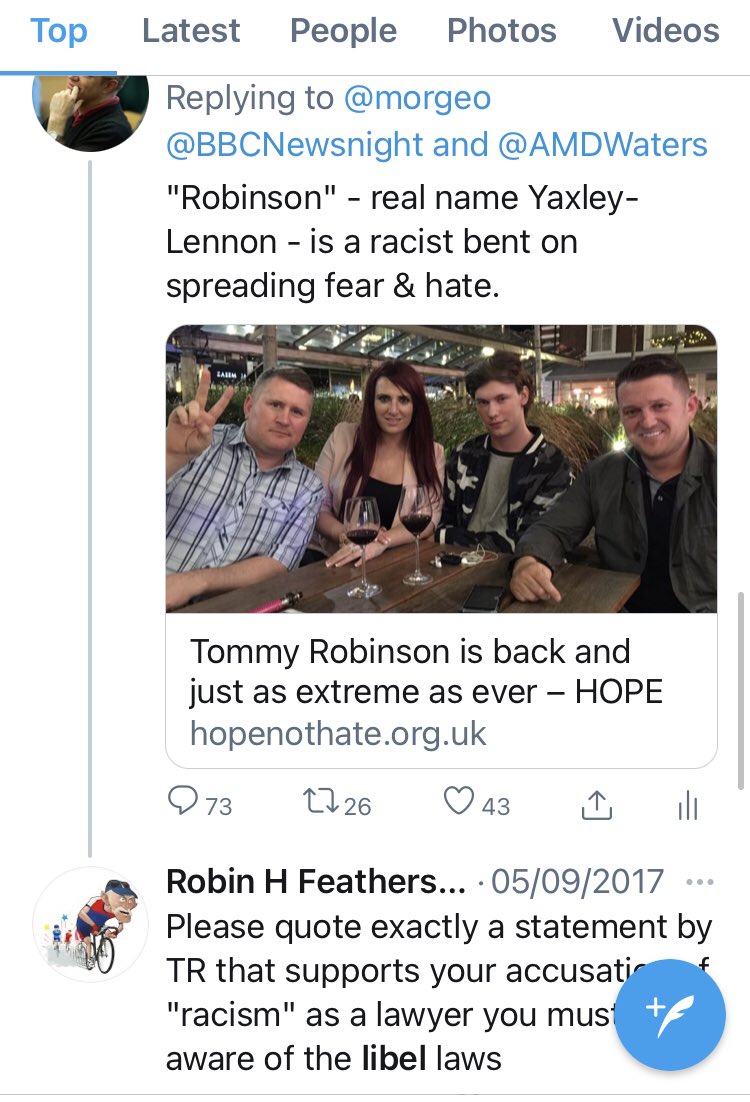
6. Just because someone says “that’s libel” doesn’t mean it is. Yaxley-Lennon *is* a racist. He hasn’t sued me yet. 10/
7. If you think your tweet was wrong, or you don’t think you can show the facts, I’d delete it. You can always tweet it again if you become sure enough. 11/
8. If someone tells you they think you libelled *them* (not someone else), don’t ignore them. Think about how to respond, and respond. 12/
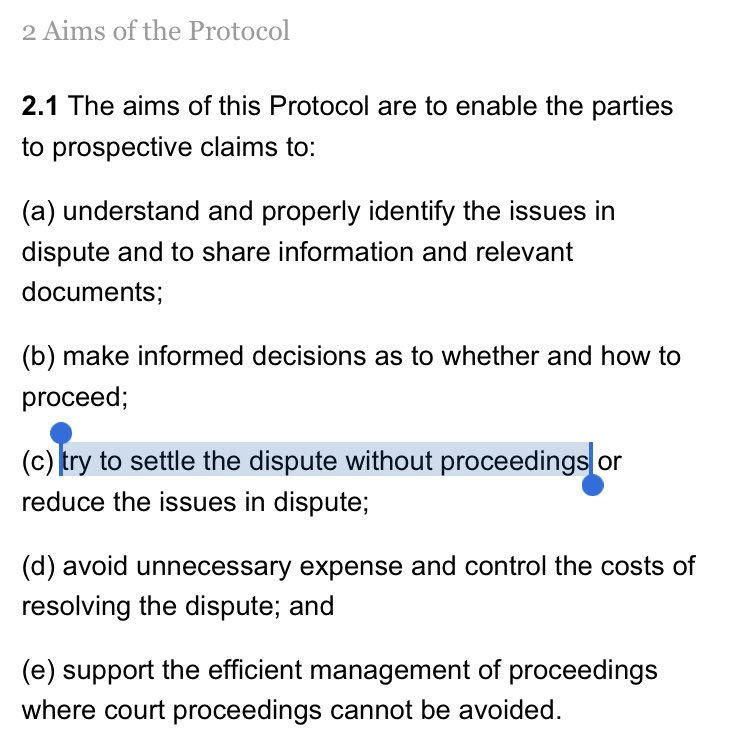
9. A person who may have been libelled is expected by the court to try to settle the dispute without proceedings. https://t.co/Jb9kDB8aT9
10. If someone tweets/DMs that you’ve libelled them but it’s not clear how, you can ask them what it is that you’ve said they disagree with - especially *factually*.

Because you may have it wrong, or they may have misunderstood you. 14/
11. Think before you *re-tweet* and *reply* to a tweet that may be libellous. Treat RTing and agreeing replies as if the tweet was in your name. 15/
Libel law is important protection.

How our friends, colleagues, the world sees us matters to many people. The law isn’t going away.

16/16

More from Law

High crime talk from Fredo


VA curfew


Sen. Grassley - Biden family investigated, potential financial crimes WW including China

Warning


March
1/n How come we still have academics sustaining narratives of #obesity rather than of how real people find value & meaning in everyday lives? Revisit @whatsthepont on @tobyjlowe / @snowded & accept criticising "neoliberal" does not make things

New out 🤯 A review which says lots about the academic context in which it was written - with its embedded behaviorist fixations on just implementing *better* - with complete disregard for the unintended consequences of treating "agency" as a dirty word

In all #becausehuman fields, we see justifiable professional kick-back at reductionist agendas driven by a focus on #obesity & nonsensical CMO guidance of 60 min of moderate-to-vigorous physical activity (MVPA) per day for healthy growth and development


What's fundamentally missing is not just a respect for complexity. It's respect for Homo-Narrans - for the ordinary, everyday story-telling folk all around us whose aspirations & dispositions provide the context in which we find meaning, purpose & value

We don't need spurious arguments against initiatives... but let's consider ethics & unintended consequences - on which, see @snowded (especially around epistemic justice) #becausehuman
https://t.co/gu97xDEamB
https://t.co/E1GzCdCfLA
https://t.co/bKowDAgARQ
https://t.co/evzYMBPwvZ

You May Also Like

I’m torn on how to approach the idea of luck. I’m the first to admit that I am one of the luckiest people on the planet. To be born into a prosperous American family in 1960 with smart parents is to start life on third base. The odds against my very existence are astronomical.


I’ve always felt that the luckiest people I know had a talent for recognizing circumstances, not of their own making, that were conducive to a favorable outcome and their ability to quickly take advantage of them.

In other words, dumb luck was just that, it required no awareness on the person’s part, whereas “smart” luck involved awareness followed by action before the circumstances changed.

So, was I “lucky” to be born when I was—nothing I had any control over—and that I came of age just as huge databases and computers were advancing to the point where I could use those tools to write “What Works on Wall Street?” Absolutely.

Was I lucky to start my stock market investments near the peak of interest rates which allowed me to spend the majority of my adult life in a falling rate environment? Yup.