As the man was just about to knock on Umar’s door,he stopped in his tracks.He heard a voice coming from inside,a woman’s voice. It was Umar’s wife,she was speaking loudly and her voice(2)
ONE night, a man was angry that his wife had raised her voice when speaking with him. How could she disrespect him? How could she be-little him?
This man,convinced that his wife had crossed the line,decided to go and complain about her to a man who had much knowledge about (1)
As the man was just about to knock on Umar’s door,he stopped in his tracks.He heard a voice coming from inside,a woman’s voice. It was Umar’s wife,she was speaking loudly and her voice(2)
That was Umar ibn Al-Khattab in there, the fierce ruler of the Muslim Empire that had stretched East and West, and his wife was freely and confidently voicing her opinion and discussing important matters with him.
The man, feeling ashamed of his own
(3)
The man sheepishly replied, “I came to complain(4)
He said, “She washes my clothes, sweeps the floors,cares for my children, and cleans my house, when Allah has not commanded her to do so, but she(5)
More from Islam

As we know, Rightwing Hindutva is the loudest proponent of the “Caste in Muslims” line.
Gullible Pasmanda activists fall for this charade while willing Quislings perpetuate it.
In this thread I give a rebuttal to each point of fitnāh made by this man.
#Thread #PasmandaPolitics
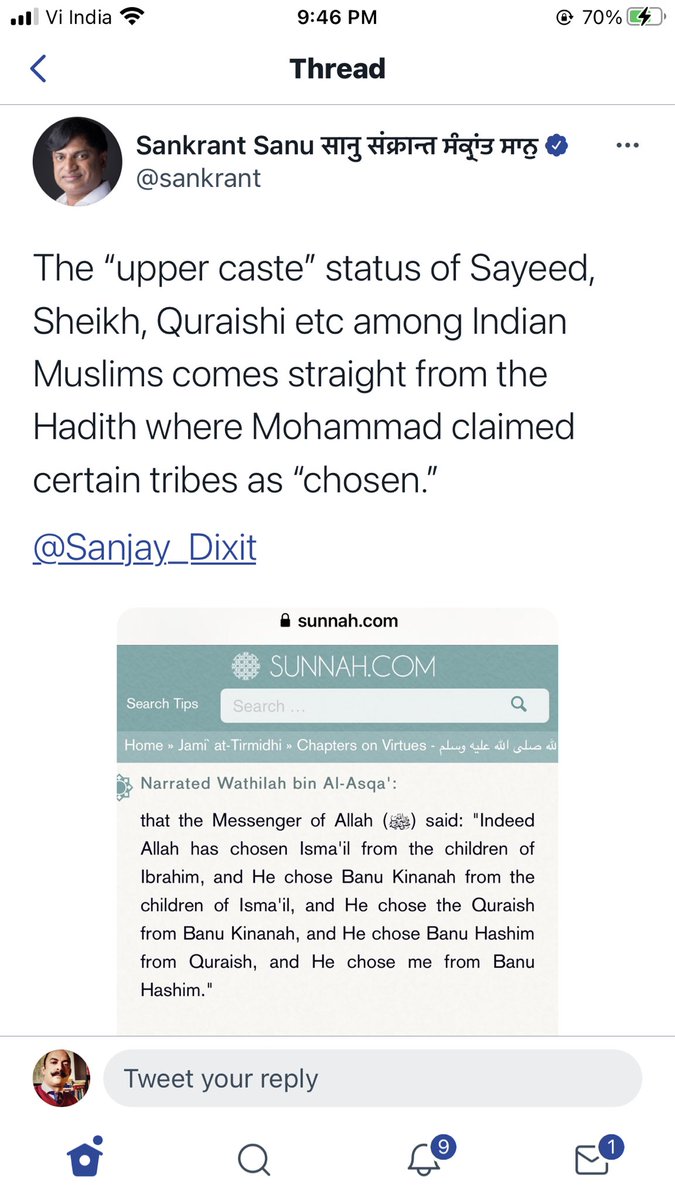
Lie!
This is not an assertion of superiority but a genealogical frame merely tracing descent.
Nor is it comparable to Caste as institutionalised and practised by Vedic Brahminism.
NB: The Prophet (S.A.W.) in fact first took up arms against his own tribe, the Quraish.
The Quran is clear:
“He has ordained for you of religion what He enjoined upon Noah and that which We have revealed to you, [O Muhammad], and what We enjoined upon Abraham and Moses and Jesus - to establish the religion and not be divided therein...”
Surah Ash-Shūrá Quran 42:13
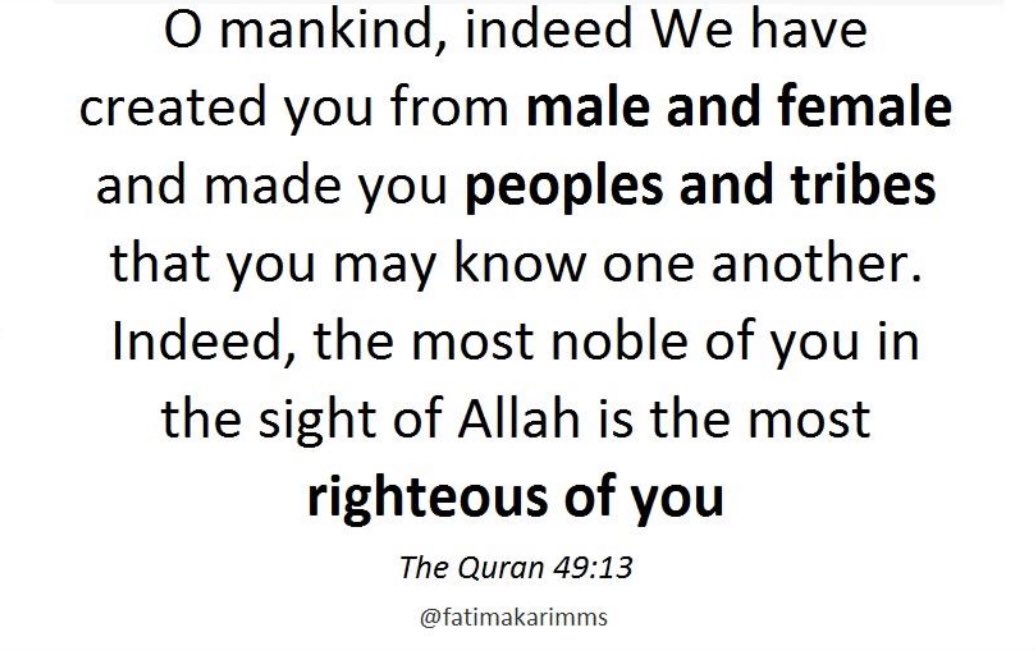
The fact is, the Quran and The Prophet (S.A.W) lay great stress on the characteristics of superiority being righteousness and piety.
Tribal (again, not comparable to the caste system) membership did not denote superiority in religion.
This is a basic difference from Casteism.
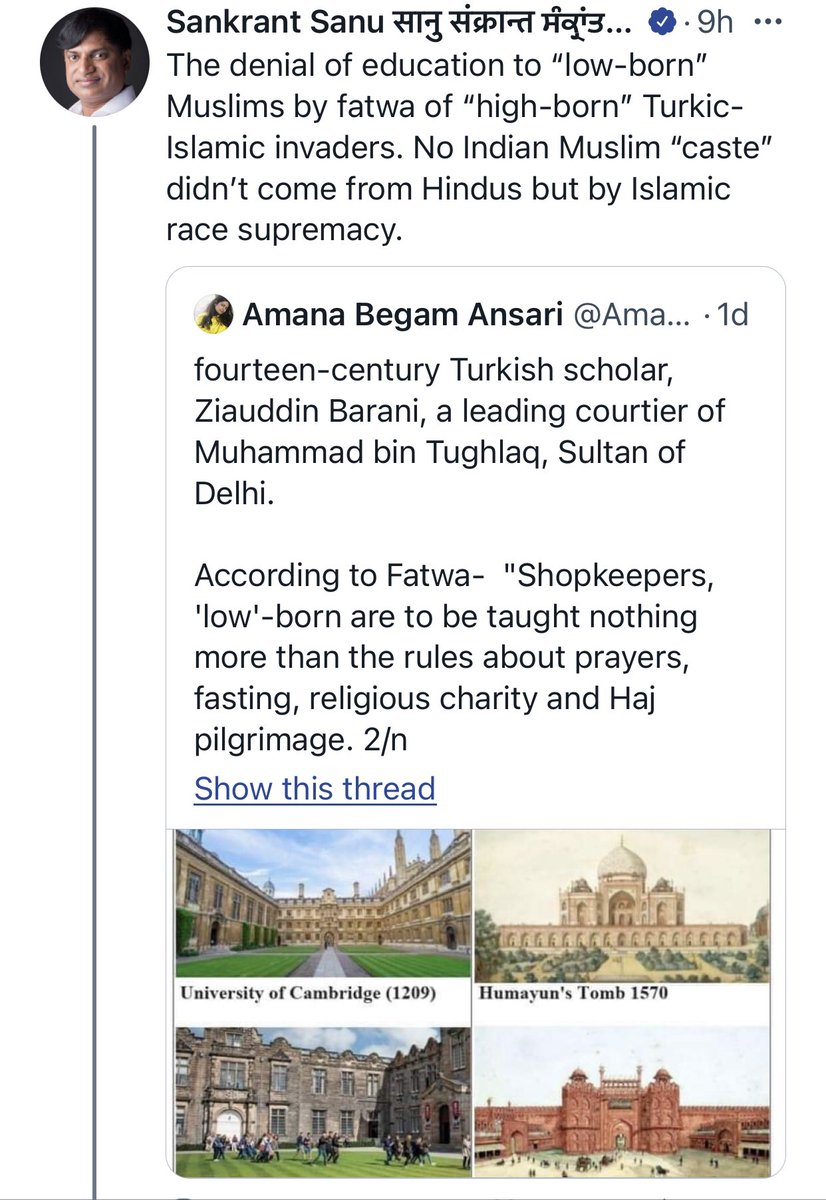
What amateurs!
A fatwa is a non-binding legal opinion.
For more on the subject read this interview of Dr. @rezaaslan:
https://t.co/7CcEv3Up0D
As for Barani let us go on to the next tweet in this thread so I can tear your fabrications to shreds.
Gullible Pasmanda activists fall for this charade while willing Quislings perpetuate it.
In this thread I give a rebuttal to each point of fitnāh made by this man.
#Thread #PasmandaPolitics
The \u201cupper caste\u201d status of Sayeed, Sheikh, Quraishi etc among Indian Muslims comes straight from the Hadith where Mohammad claimed certain tribes as \u201cchosen.\u201d@Sanjay_Dixit https://t.co/MDL17iY9oo pic.twitter.com/LbepG6hlqy
— Sankrant Sanu \u0938\u093e\u0928\u0941 \u0938\u0902\u0915\u094d\u0930\u093e\u0928\u094d\u0924 \u0a38\u0a70\u0a15\u0a4d\u0a30\u0a3e\u0a02\u0a24 \u0a38\u0a3e\u0a28\u0a41 (@sankrant) February 27, 2021
Lie!
This is not an assertion of superiority but a genealogical frame merely tracing descent.
Nor is it comparable to Caste as institutionalised and practised by Vedic Brahminism.
NB: The Prophet (S.A.W.) in fact first took up arms against his own tribe, the Quraish.
The Quran is clear:
“He has ordained for you of religion what He enjoined upon Noah and that which We have revealed to you, [O Muhammad], and what We enjoined upon Abraham and Moses and Jesus - to establish the religion and not be divided therein...”
Surah Ash-Shūrá Quran 42:13
The fact is, the Quran and The Prophet (S.A.W) lay great stress on the characteristics of superiority being righteousness and piety.
Tribal (again, not comparable to the caste system) membership did not denote superiority in religion.
This is a basic difference from Casteism.
What amateurs!
A fatwa is a non-binding legal opinion.
For more on the subject read this interview of Dr. @rezaaslan:
https://t.co/7CcEv3Up0D
As for Barani let us go on to the next tweet in this thread so I can tear your fabrications to shreds.




You May Also Like






First thread of the year because I have time during MCO. As requested, a thread on the gods and spirits of Malay folk religion. Some are indigenous, some are of Indian origin, some have Islamic
Before I begin, it might be worth explaining the Malay conception of the spirit world. At its deepest level, Malay religious belief is animist. All living beings and even certain objects are said to have a soul. Natural phenomena are either controlled by or personified as spirits
Although these beings had to be respected, not all of them were powerful enough to be considered gods. Offerings would be made to the spirits that had greater influence on human life. Spells and incantations would invoke their
Two known examples of such elemental spirits that had god-like status are Raja Angin (king of the wind) and Mambang Tali Arus (spirit of river currents). There were undoubtedly many more which have been lost to time
Contact with ancient India brought the influence of Hinduism and Buddhism to SEA. What we now call Hinduism similarly developed in India out of native animism and the more formal Vedic tradition. This can be seen in the multitude of sacred animals and location-specific Hindu gods
i wonder if you can make a thread bout witchcraft in malaysia.. or list of our own local gods/deites..
— r a y a \U0001f319 (@lcvelylilith) February 20, 2020
Before I begin, it might be worth explaining the Malay conception of the spirit world. At its deepest level, Malay religious belief is animist. All living beings and even certain objects are said to have a soul. Natural phenomena are either controlled by or personified as spirits
Although these beings had to be respected, not all of them were powerful enough to be considered gods. Offerings would be made to the spirits that had greater influence on human life. Spells and incantations would invoke their
Animist ceremonies of a religious or magical nature were normally held for the purpose of divination or making a request. This would either be done at a keramat or at a shrine similar to the Thai spirit houses or Chinese roadside shrines pic.twitter.com/I1hliyi0x3
— \u2745\u1710\u170b\u1713\u170e (@uglyluhan) June 16, 2019
Two known examples of such elemental spirits that had god-like status are Raja Angin (king of the wind) and Mambang Tali Arus (spirit of river currents). There were undoubtedly many more which have been lost to time
Contact with ancient India brought the influence of Hinduism and Buddhism to SEA. What we now call Hinduism similarly developed in India out of native animism and the more formal Vedic tradition. This can be seen in the multitude of sacred animals and location-specific Hindu gods


1/“What would need to be true for you to….X”
Why is this the most powerful question you can ask when attempting to reach an agreement with another human being or organization?
A thread, co-written by @deanmbrody:
2/ First, “X” could be lots of things. Examples: What would need to be true for you to
- “Feel it's in our best interest for me to be CMO"
- “Feel that we’re in a good place as a company”
- “Feel that we’re on the same page”
- “Feel that we both got what we wanted from this deal
3/ Normally, we aren’t that direct. Example from startup/VC land:
Founders leave VC meetings thinking that every VC will invest, but they rarely do.
Worse over, the founders don’t know what they need to do in order to be fundable.
4/ So why should you ask the magic Q?
To get clarity.
You want to know where you stand, and what it takes to get what you want in a way that also gets them what they want.
It also holds them (mentally) accountable once the thing they need becomes true.
5/ Staying in the context of soliciting investors, the question is “what would need to be true for you to want to invest (or partner with us on this journey, etc)?”
Multiple responses to this question are likely to deliver a positive result.
Why is this the most powerful question you can ask when attempting to reach an agreement with another human being or organization?
A thread, co-written by @deanmbrody:
Next level tactic when closing a sale, candidate, or investment:
— Erik Torenberg (@eriktorenberg) February 27, 2018
Ask: \u201cWhat needs to be true for you to be all in?\u201d
You'll usually get an explicit answer that you might not get otherwise. It also holds them accountable once the thing they need becomes true.
2/ First, “X” could be lots of things. Examples: What would need to be true for you to
- “Feel it's in our best interest for me to be CMO"
- “Feel that we’re in a good place as a company”
- “Feel that we’re on the same page”
- “Feel that we both got what we wanted from this deal
3/ Normally, we aren’t that direct. Example from startup/VC land:
Founders leave VC meetings thinking that every VC will invest, but they rarely do.
Worse over, the founders don’t know what they need to do in order to be fundable.
4/ So why should you ask the magic Q?
To get clarity.
You want to know where you stand, and what it takes to get what you want in a way that also gets them what they want.
It also holds them (mentally) accountable once the thing they need becomes true.
5/ Staying in the context of soliciting investors, the question is “what would need to be true for you to want to invest (or partner with us on this journey, etc)?”
Multiple responses to this question are likely to deliver a positive result.