begin His-tory whose Literary Works gives Goosebumps to every Bharatiya.
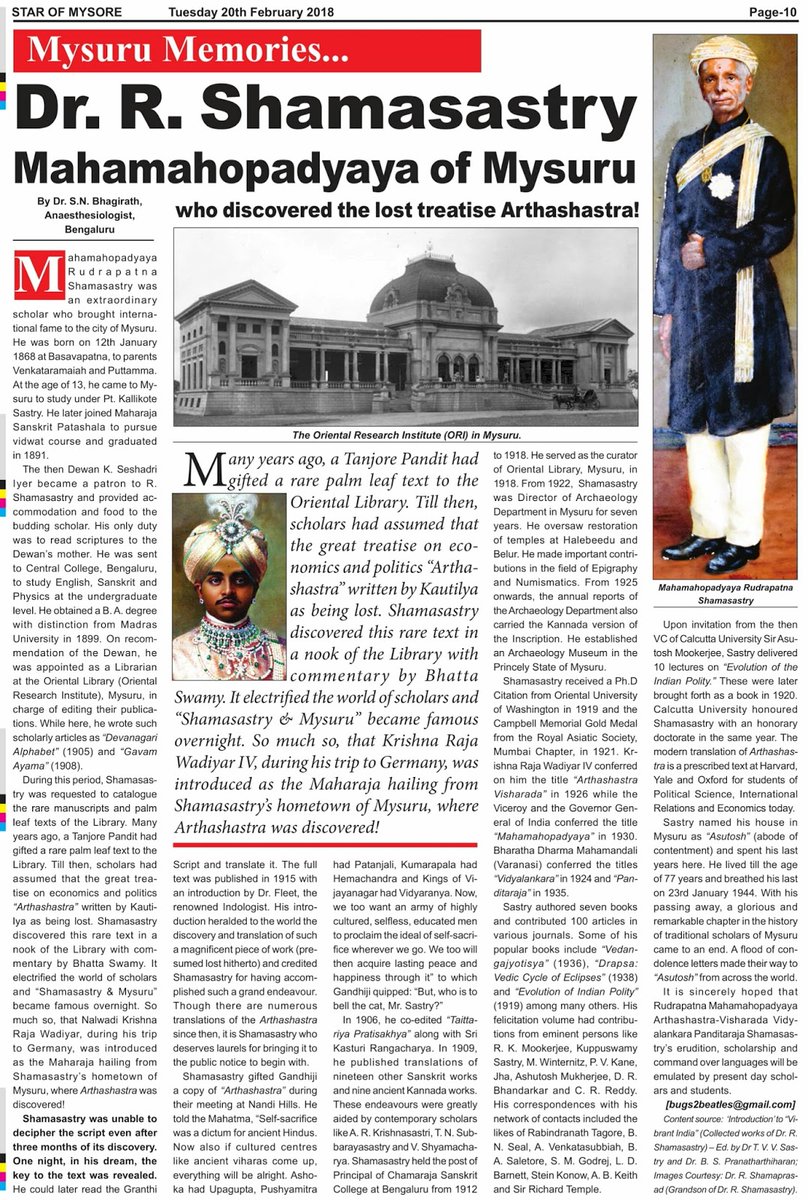
R Shamashastry’s modern translation of Arthashastra is a prescribed text at Harvard, Yale and Oxford for students of Political Science, International Relations and Economics today.
Until this discovery, the
the Arthashastra was known only through references to it in works, including those by Dandin, Bana, Vishnusarma, Mallinathasuri, Megasthenes, as well as others. This discovery was "an epoch-making event in the history of the study of ancient Indian polity".
It altered the
perception of Ancient Bharath and changed the course of history studies, notably the false belief of European scholars at the time that Indians learnt the art of administration from the Greeks.
Shamasastry received a Ph.D Citation from Oriental University of Washington in 1919
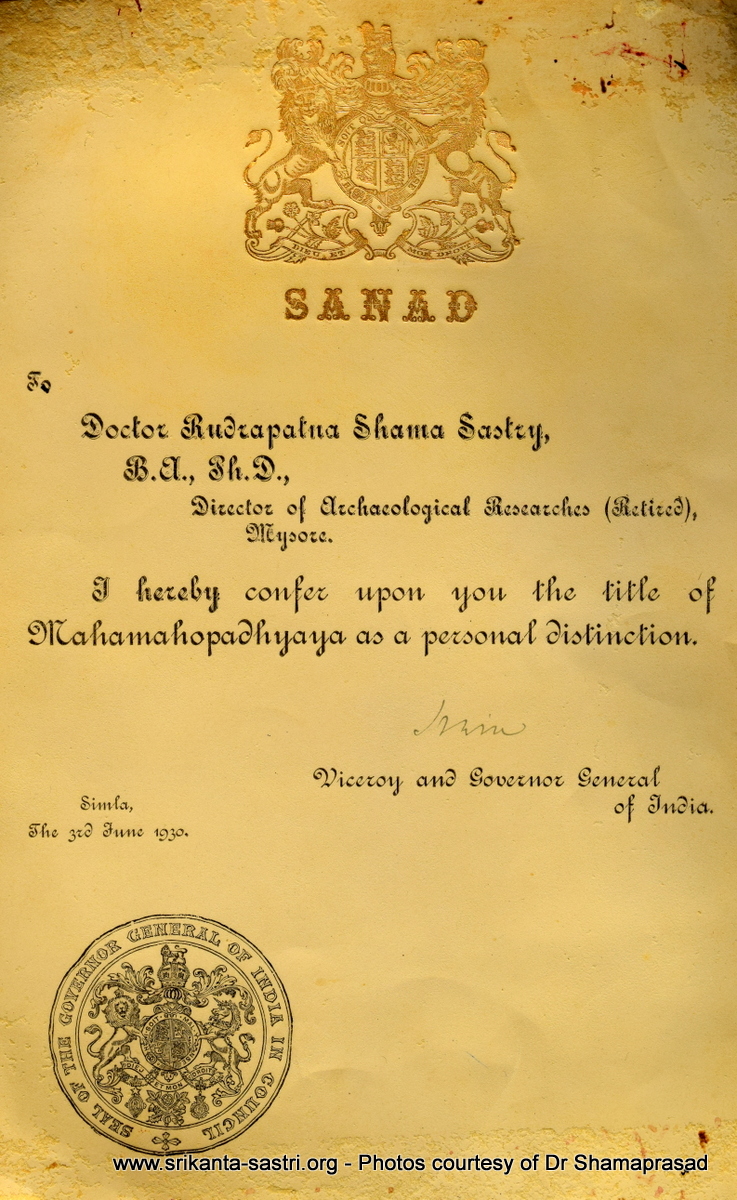
and the Campbell Memorial Gold Medal from the Royal Asiatic Society, Mumbai Chapter, in 1921. Krishna Raja Wadiyar IV conferred on him the title “Arthashastra Visharada” in 1926 while the Viceroy and the Governor General of India conferred the title “Mahamahopadyaya” in 1930.
Bharatha Dharma Mahamandali (Varanasi) conferred the titles “Vidyalankara” in 1924 and “Panditaraja” in 1935.
An often-told anecdote involves the visit of the then-king of Mysore, Krishna Raja Wadiyar IV, to Germany. When introduced as the king of Mysore, he was asked by the
vice-chancellor of a German university whether he was from the Mysore of Shamasastry. On his return, the king honoured Shamasastry and said "In Mysore we are the Maharaja and you are our subject, but in Germany, you are the master and people recognise us by your name and fame."
Gifting MKG, a copy of “Arthashastra” during their meeting at Nandi Hills in 1927, he told Gandhi, “Self-sacrifice was a dictum for ancient Hindus. Now also if cultured centres like ancient viharas come up, everything will be alright. Ashoka had Upagupta, Pushyamitra had
Patanjali, Kumarapala had Hemachandra and Kings of Vijayanagar had Vidyaranya. Now, we too want an army of highly cultured, selfless, educated men to proclaim the ideal of self-sacrifice wherever we go. We too will then acquire lasting peace and happiness through it” to which
Gandhi quipped: “But, who is to bell the cat, Mr. Sastry?” Gandhi’s double standards exposed again and again.
Born on 12th January 1868 at Basavapatna, to parents Venkataramaiah and Puttamma, at the age of 13, he came to Mysuru to study under Pt. Kallikote Sastry. He later
joined Maharaja Sanskrit Patashala to pursue vidwat course and graduated in 1891.
The then Dewan K. Seshadri Iyer became a patron to R. Shamasastry and provided accommodation and food to the budding scholar. His only duty was to read scriptures to the Dewan’s mother. He was sent
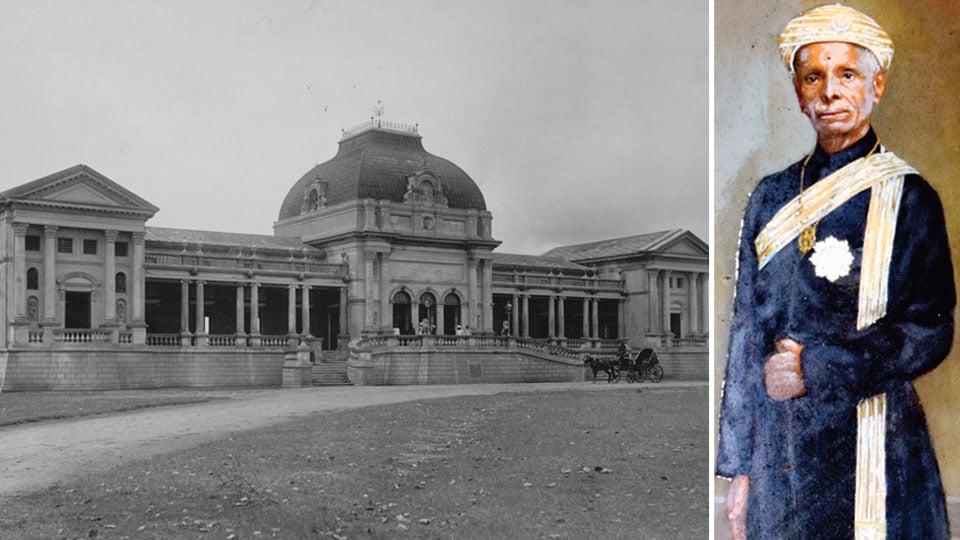
to Central College, Bengaluru, to study English, Sanskrit & Physics at the undergraduate level. He obtained a B. A. degree with distinction from Madras University in 1899. On recommendation of the Dewan, he was appointed as a Librarian at the Oriental Library (Oriental Research
Institute), Mysuru, in charge of editing their publications.
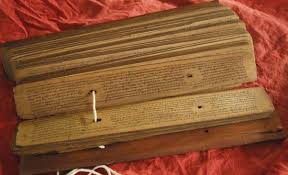
During this period, Shamasastry was requested to catalogue the rare manuscripts and palm leaf texts of the Library. Many years ago, a Tanjore Pandit had gifted a rare palm leaf text to the Library. Till then, scholars
had assumed that the great treatise on economics and politics “Arthashastra” written by Kautilya as being lost. Shamasastry discovered this rare text in a nook of the Library with commentary by Bhatta Swamy. It electrified the world of scholars and “Shamasastry & Mysuru” became
famous overnight.
Shamasastry was unable to decipher the script even after three months of its discovery. One night, in his dream, the key to the text was revealed. He could later read the Granthi Script and translate it. He transcribed, edited and published the Sanskrit edition
in 1909. He proceeded to translate it into English, publishing it in 1915 with an introduction by Dr. Fleet, the renowned Indologist. His introduction heralded to the world the discovery and translation of such a magnificent piece of work (presumed lost hitherto) and credited
Shamasastry for having accomplished such a grand endeavour. Though there are numerous translations of the Arthashastra since then, it is Shamasastry who deserves laurels for bringing it to the public notice to begin with.
Apart from discovering Kautilya's Arthashastra, Sastry
authored seven books and contributed 100 articles in various journals, he pursued his research in the Vedic era and Vedic astronomy, making valuable contributions to Vedic studies. The following are among Shamasastry's works:
1.Vedangajyautishya – A Vedic Manual of Astronomy,
8 BCE
2.Drapsa: The Vedic Cycle of Eclipses – a key to unlock the treasures of the Vedas.
3.Eclipse-Cult in the Vedas, Bible, and Koran – A supplement to the Drapsa. It is this Cult that has given rise to epic and puranic tales in India. The mathematical aspect of eclipse-cycles
is treated at great length and eclipse-tables have been appended. Dr. E. Abegg, Professor, University of Zurich, Switzerland, stated- 'I see with admiration that R Shamasatry, a thorough scholar in the difficult problems of Vedic Astronomy and Calendar, things of which European
Indologists have very rarely a true Knowledge'
4.Gavam Ayana- The Vedic Era- is an exposition of a forgotten sacrificial calendar of the Vedic poets and includes an account of the origin of the Yugas.
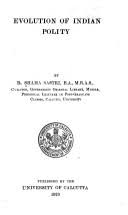
5.Evolution of Indian Polity. This book is a compilation of Ten lectures
delivered in Calcutta University. Sir Asutosh Mookerjee, Vice-chancellor of Calcutta University, personally invited Sastry to deliver these discourses. In this work, the ancient Indian administrative systems and various levels of administrative set-up are critically examined, on
the basis of Vedas, legends, Arthashastra, Mahabharata, Jainagama works etc.
6.The Origin of Devanagari Alphabets.
Upon invitation from the then VC of Calcutta University Sir Asutosh Mookerjee, Sastry delivered 10 lectures on “Evolution of the Indian Polity.” These were later
brought forth as a book in 1920. Calcutta University honoured Shamasastry with an honorary doctorate in the same year.
Most of us may not recognize who Sir Asutosh is, he was the founder & Chancellor of Calcutta University & father of Jan Sangh founder Shyama Prasad Mukherjee.
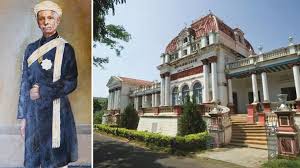
Shamashastry had such high regards towards Mookerjhee that Sastry named his house in Mysuru as “Asutosh” and spent his last years here. He lived till the age of 77 years and breathed his last on 23rd January 1944. With his passing away, a glorious and remarkable chapter in the
history of traditional scholars of Mysuru came to an end. A flood of condolence letters made their way to “Asutosh” from across the world.
It is sincerely hoped that Rudrapatna Mahamahopadyaya Arthashastra-Visharada Vidyalankara Panditaraja Shamasastry’s erudition, scholarship
and command over languages will be emulated by present day scholars and students.
#VANDEMATARAM