Let me provide the backdrop first. This was 1970-71. Threats of Civil War loomed over East Pakistan.
Yahya Khan was making a last-ditch attempt to have control on East Pakistan, and cricket was going to be his tool.
An International XI was touring Pakistan.
+
Their second match was scheduled at Dacca.
In the 1970 Pakistan General Elections, Awami League had won 160 seats out of 300, but were still not allowed to form the Government.
And now Raqibul was roped in, probably as the ruling party's poster boy.
+
A year ago, they had named him twelfth man in the final Test against New Zealand.
Like his teammates, he was given a Gray-Nicolls bat that bore the symbol of the Pakistan People's Party.
There was no way Raqibul, staunch supporter of the Awami League, would agree to that.
+
He sneaked out of Hotel Purbani that night to meet his friend Sheikh Kamal.
They decided that the PPP symbol would be covered with a sticker with the message Joy Bangla (viva Bengal).
The Mukti Bahini used the slogan during the Bangladesh Liberation War later that year.
+
Intikhab Alam won the toss for Pakistan and batted. Raqibul walked out to bat with Azmat Rana.
Somehow the news of the sticker had become public.
Chants of Joy Bangla reverberated across Dacca Stadium (later Bangabandhu Stadium).
Raqibul scored only 1 in each innings.
+
But it did not matter, for he had sent the message he wanted to.
He had used the occasion to provide the movement a significant boost.
Meanwhile, Yahya Khan had officially postponed the Assembly.
This led to a full-fledged civil war.
+
The students attacked the stadium. The marquees were set on fire.
Touring captain Micky Stewart had not grasped the gravity of the situation.
He requested them to wait until the match was over.
They were polite to him, but he was probably fortunate to survive that day.
+
Sarfraz Nawaz was at the crease, trying to save the match.
As the crowd approached, he asked a soldier to fire at them.
The soldier aimed at Sarfraz instead.
Both teams were hurriedly taken to a cantonment in a military vehicle, and later, to the Purbani.
+
En route, they noticed corpses lying on the streets.
The International XI players took the last flight to Lahore.
The Pakistan cricketers were held back in the hotel, and could leave only due to Intikhab's frantic efforts and timely intervention of Brigadier Haider.
+
It usually took fifteen minutes to the airport from the Purbani.
The felled trees and blockades stretched that to three hours that day.
Raqibul stayed back. Before parting ways, Zaheer Abbas bade farewell to Raqibul, assuring they would meet again in Karachi.
+
Raqibul's response was prompt: "Zaheer, the next time I come to Pakistan, I might have to come with a new passport."
Mujibur Rahman declared Civil Disobedience six days after this, on March 7.
Yahya Khan and Zulfiqar Ali Bhutto initiated Operation Searchlight on March 25.
+
I shall not get into details about the bloody episodes that followed.
I shall stick to Raqibul, who took active part in the civil war.
A shoot-at-sight order was issued on him.
+
As his family escaped to Gopalganj, Raqibul and his brother joined the movement.
He lost six family members; and Mushtaq, his cricket mentor.
But he managed to escape to Calcutta.
And he worked towards building a cricketing structure in Bangladesh, almost from scratch.
+
Almost six years after the match mentioned above, another International XI toured Pakistan.
Raqibul played for the *tourists* – for he was now a citizen of Bangladesh, a new nation.
At Karachi, he was up against Zaheer Abbas.
Raqibul had kept his promise.
+
MCC toured Bangladesh in 1976-77. Their first match was against North Zone at Rajshahi.
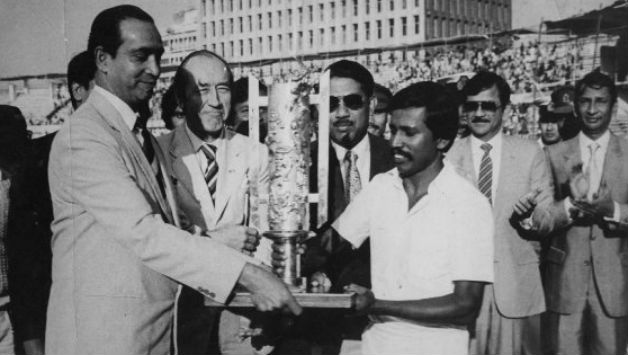
When he walked out to toss, Raqibul created history by becoming the first man to lead a representative Bangladesh side. He scored 15 and 73 in the match.
+
They became an ICC Associate nation next year. Raqibul played in three editions of the ICC Trophy.
In 1983-84, Bangladesh won the South-East Asian Championship under him.
He also played in the 1986 Asia Cup. These were Bangladesh's first ODIs.