I was a recipient of KGSP for my Msc from 2013-2016

Korean Government Scholarship Program (KGSP) Application made easy

Application period- 1 February 2021- 31 March, 2021

MS- 3yrs (1 year Korean language + 2 years MS)

PhD- 4yrs (1 year Korean language + 3 years PhD)

How to navigate the https://t.co/6Ne99JDfyv page

1. Type https://t.co/ow51lWVKcQ in your browser and hit the enter button

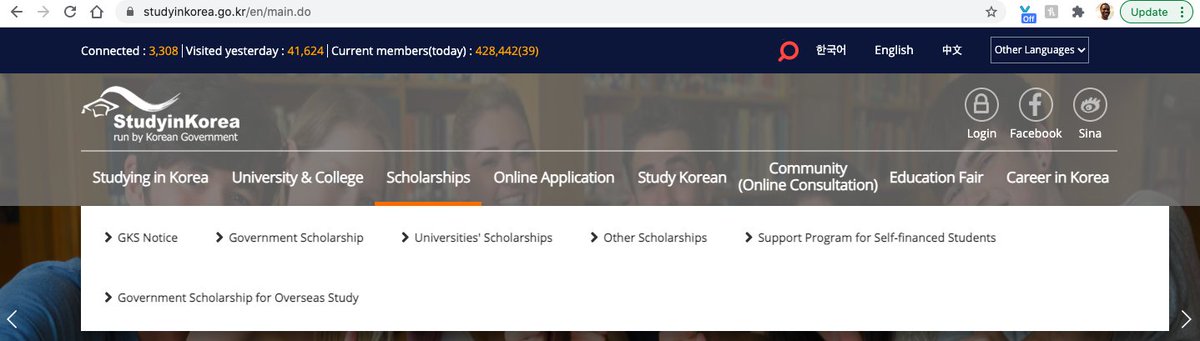
2. Click on scholarships and select GKS notice as attached in the picture👇

3. Play with the notice dashboard to see various announcements from NIIED.
4. E.g in 2020, the Global Korea Scholarship for Graduate Degrees was announced on 11, February as indicated by no 205. You can click to download the application materials to get familiar with what is expected. I attached series of links in this thread to assist too.
Category- All fields

Benefits

1. Visa fee

2. Airfare: Actual cost (To and fro from your home country to Korea and upon completion to your home country)

3. Resettlement Allowance: KRW 200,000 (Given upon arrival in Korea)
4. Monthly stipend: Graduate (MS/PhD)-KRW 1000,000 (362,610.35 Nigerian Naira) per month ,Research Program including Postdoctoral fellow and visiting Professors - 1,500,000 KRW (542,824.78 Nigerian Naira) per month
5. Medical Insurance: KRW 20,000 (per month);

6. Language Courses: KRW 800,000 per quarter;

7. Tuition Fees: Actual cost (No more than 5 million KRW per semester);

8. Award for Excellent Korean Language Proficiency: KRW 100,000;
9. Research Support: KRW 210,000 – 240,000 (per semester);

10. Printing Costs (Dissertation): KRW 500,000 – 800,000;

11. Completion Grant: KRW 100,000 (Once).
Eligibility
To apply for the Global Korean Scholarship (GKS), applicants must meet criteria below:

1. Both an applicant and his/her parents must be citizens of their country of origin.
2. Applicants should not hold Korean citizenship.+

3. Applicants should have adequate health, both mentally and physically, to stay in a foreign country for a long time

4. Possess a grade point average (G.P.A.) above 80% from the last educational
5. Should be under 40 years of age at the date of entrance (Graduate)

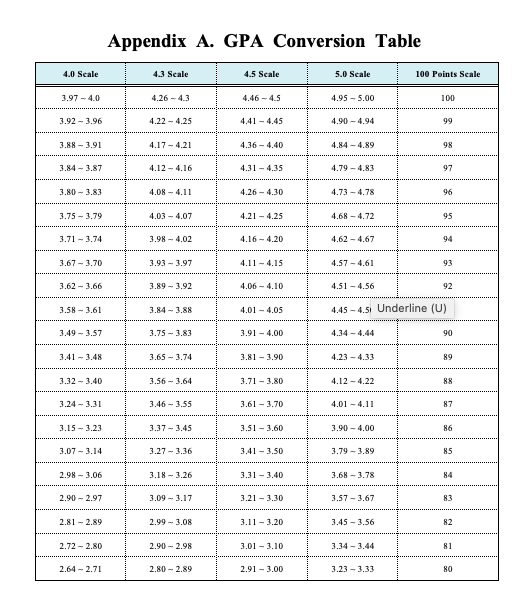
*See 👇 for GPA conversion table
Application procedure

1. There are 64 universities designated by NIIED for the KGSP program as at 2020.

2. To submit your application, you either apply via the embassy or university track.
For the embassy track, you can select up to three universities and after documents review and interview you are admitted to one of them. This is coordinated by the Korean embassy in your home country.
In the second case, you send the documents to only one university of your choice and they select or reject you on the basis of your documents. Interview of applicants are done via email or phone call.
Your CGPA, discipline, no of publications, research plan, SOP count. While Professor acceptance is optional, it's never a bad idea. You may be offered Professor scholarship if you do not make the KGSP list.
The Korean embassy in Abuja is the best route to submit for Nigerians whereas in other countries, kindly confirm accordingly. No of recipient from Nigeria yearly (Embassy-4, University-8).
3. Notarization of academic credentials (optional for some universities, please confirm before hand) can only be done at the Korean embassy. The main documents must first be certified by the Ministry of Foreign Affairs in Nigeria.
I submitted high court certified documents while applying but over time, things seems to have changed.
4. The Research Program applicants must receive invitation from universities prior to applying to
this program. The applicants submit their application either to the Korean embassy in the
country where they hold the citizenship or to one of our partner universities.
Checklist

Please see this for required documents 👇
Note

1. Applicants who received outstanding scores for their proficiency in Korean or English may be given
preference. Some examples include the followings:
- Proficiency in Korean: TOPIK (Test of Proficiency in Korean)
2. Proficiency in English: TOEFL, TOEIC, or IELTS Academic (TOEFL ITPs are NOT acceptable)
3. Applicants who apply for majors in the field of Natural Science and Engineering are given priority
when they receive same marks with other candidates.
4. Applicants who apply for majors under the Industrial Professionals Training Project are given
priority when they receive same marks with other candidates.
5. Academic professors holding citizenship of developing countries, especially ODA recipients, are given priority when they receive same marks with other candidates.

6. Application form can be requested from you school of choice or download it from the https://t.co/ow51lWVKcQ
2020 application form-https://t.co/7UweDM5Eau
Application guidelines -

https://t.co/2S3zU1P7XW

3_2020 GKS-G University Information https://t.co/WUEkSO3vtb

2020 Global Korea Scholarship for Graduate Degrees: FAQ

https://t.co/OQV91zJvBg
I will also be joining @Ijesha_canadian on his Youtube page (@Scholars Pivot https://t.co/VKHZ4mTunf) in the next couple of days to answer questions that you make have on KGSP and related graduate school applications
@Oludeewon @Dr_Adeleke @drhammed @NoahAluko @particular6 @Iam_MrPackagin @arawu_samuel @james_omoboye @oulawal @bestmanojo @adejimiadeniji @AaronAkpuPhilip @yanjus4christ @oguntuyakitimi @SamdGreat01 @matajson @Ijesha_canadian @MICHAELSEGZY @Okafor_SC @jueedalo @zainab__tiamiyu

More from Education

Last month I presented seven sentences in seven different languages, all written in a form of the Chinese-character script. The challenge was to identify the languages and, if possible, provide a


Here again are those seven sentences:

1) 他的剑从船上掉到河里去
2) 於世𡗉番𧡊哭唭𢆥尼歲㐌外四𨑮
3) 入良沙寢矣見昆腳烏伊四是良羅
4) 佢而家喺邊喥呀
5) 夜久毛多都伊豆毛夜幣賀岐都麻碁微爾夜幣賀岐都久流曾能夜幣賀岐袁
6) 其劍自舟中墜於水
7) 今天愛晚特語兔吃二魚佛午飯

Six of those seven sentences are historically attested. One is not: I invented #7. I’m going to dive into an exploration of that seventh sentence in today’s thread.

Sentence #7 is an English-language sentence written sinographically — that is, using graphs that originate in the Chinese script. I didn’t do this for fun (even though it is fun), or as a proposal for a new way to write


I did it as a thought experiment. Why? Because thinking about how the modern Chinese script might be adapted to write modern English can give us valuable insights into historical instances of script borrowing, like those that took place centuries ago in Japan, Korea, and Vietnam.
I get asked a lot how you can improve your skills and chances of getting a job as a developer. Best way is to work on a real-world project, deploy it, make it open-source, get feedback from others, share your knowledge, rinse, repeat.

Here are my top 7 project ideas. Thread 👇

1. 📊 Build an embeddable user feedback form (clone of
https://t.co/xFHvT7iFEf) . Have a top notch design, fully working, minimal bugs, open-source, deploy it free on Heroku / Netlify / Vercel. If you can spare $11, buy a domain. Share with the whole world when done.

2. 🚀 Build a product roadmap SAAS.(https://t.co/Rq9DBeCMlh) Users can create new projects, create different stages for their projects. The community can submit project ideas, vote on existing ideas. Project owners pay a monthly fee per project.

3. ⛈️ Build a digital marketplace. (https://t.co/BWd1aeWMt5) Sellers can upload digital products for sale. Customers can purchase digital products and securely download. Sellers are paid out at the end of every month. Don't make it complicated, implement a great design.

4. 👨‍🏭 Build a job board software (https://t.co/EjWoMyqi9H). Companies can post jobs for a price, providing a link to the job application form. Jobs can be highlighted as urgent for an additional price.
Time for some thoughts on schools given the revised SickKids document and the fact that ON decided to leave most schools closed. ON is not the only jurisdiction to do so, but important to note that many jurisdictions would not have done so -even with higher incidence rates.


As outlined in the tweet by @NishaOttawa yesterday, the situation is complex, and not a simple right or wrong https://t.co/DO0v3j9wzr. And no one needs to list all the potential risks and downsides of prolonged school closures.


On the other hand: while school closures do not directly protect our most vulnerable in long-term care at all, one cannot deny that any factor potentially increasing community transmission may have an indirect effect on the risk to these institutions, and on healthcare.

The question is: to what extend do schools contribute to transmission, and how to balance this against the risk of prolonged school closures. The leaked data from yesterday shows a mixed picture -schools are neither unicorns (ie COVID free) nor infernos.

Assuming this data is largely correct -while waiting for an official publication of the data, it shows first and foremost the known high case numbers at Thorncliff, while other schools had been doing very well -are safe- reiterating the impact of socioeconomics on the COVID risk.

You May Also Like

I just finished Eric Adler's The Battle of the Classics, and wanted to say something about Joel Christiansen's review linked below. I am not sure what motivates the review (I speculate a bit below), but it gives a very misleading impression of the book. 1/x


The meat of the criticism is that the history Adler gives is insufficiently critical. Adler describes a few figures who had a great influence on how the modern US university was formed. It's certainly critical: it focuses on the social Darwinism of these figures. 2/x

Other insinuations and suggestions in the review seem wildly off the mark, distorted, or inappropriate-- for example, that the book is clickbaity (it is scholarly) or conservative (hardly) or connected to the events at the Capitol (give me a break). 3/x

The core question: in what sense is classics inherently racist? Classics is old. On Adler's account, it begins in ancient Rome and is revived in the Renaissance. Slavery (Christiansen's primary concern) is also very old. Let's say classics is an education for slaveowners. 4/x

It's worth remembering that literacy itself is elite throughout most of this history. Literacy is, then, also the education of slaveowners. We can honor oral and musical traditions without denying that literacy is, generally, good. 5/x