
🤝 Tech skills in demand
Happy Monday!
We combined a list of helpful resources from @TundeTASH and @myfreelancehq
This thread entails TOP TEN (10)
🤝 Sites to learn Excel for free
🤝 Sites for online education
🤝 Sites for your career
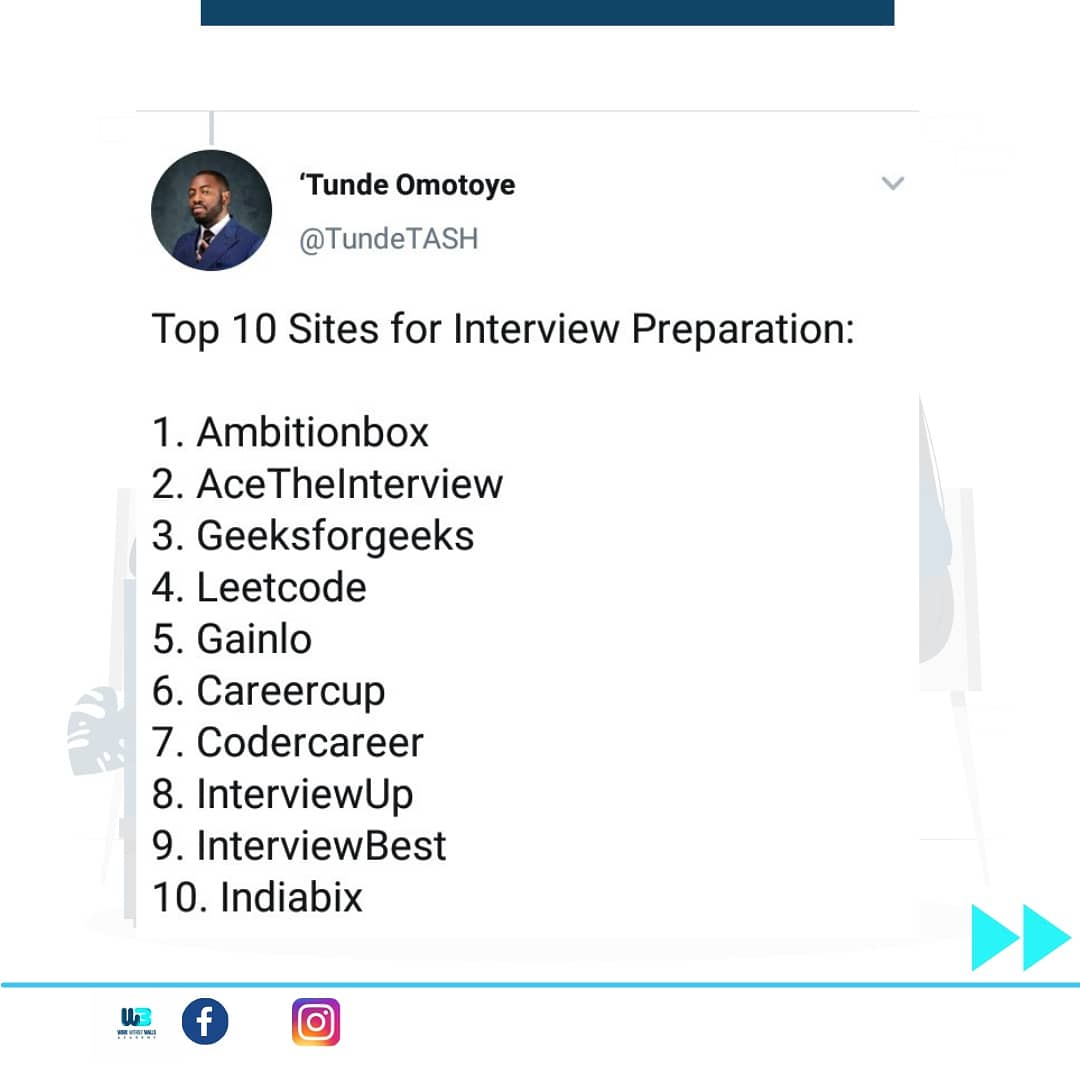
🤝 Sites for interview preparation

Search for these on Google:
1. Microsoft Excel Help Center
2. Excel Exposure
3. Chando
4. Excel Central
5. Contextures
6. Excel Hero
7. Mr. Excel
8. Improve Your Excel
9. Excel Easy
10. Excel Jet
Search for these on Google:
1. Coursera
2. edX
3. Khan Academy
4. Udemy
5. iTunesU Free Courses
6. MIT OpenCourseWare
7. Stanford Online
8. Codecademy
9. Open Culture Online Courses
10. TED-Ed
1. LinkedIN
2. Indeed
3. Careerealism
4. Job-Hunt
5. JobBait
6. Careercloud
7. GM4JH
8. Personalbrandingblog
9. Jibberjobber
10. Neighbors-helping-neighbors
1. Ambitionbox
2. AceTheInterview
3. Geeksforgeeks
4. Leetcode
5. Gainlo
6. Careercup
7. Codercareer
8. interview
9. InterviewBest
10. Indiabix
1. Writing
2. Translation
3. Online tutoring
4. Editing and proofreading
5. Data Entry
6. Social Media Management
7. Virtual Assistant
8. Customer service
9. Transcription
10. Research
1. Amazon AWS
2. Digital Marketing
3. Copywriting
4. UI/UX designs
5. Web development
6. Cloud computing
7. Data analytics
8. Edge computing
9. Graphics designing
10. Blockchain
You can register via this link: https://t.co/HG9RtqwNzX

More from Education


When the university starts sending out teaching evaluation reminders, I tell all my classes about bias in teaching evals, with links to the evidence. Here's a version of the email I send, in case anyone else wants to poach from it.
1/16
When I say "anyone": needless to say, the people who are benefitting from the bias (like me) are the ones who should helping to correct it. Men in math, this is your job! Of course, it should also be dealt with at the institutional level, not just ad hoc.
OK, on to my email:
2/16
"You may have received automated reminders about course evals this fall. I encourage you to fill the evals out. I'd be particularly grateful for written feedback about what worked for you in the class, what was difficult, & how you ultimately spent your time for this class.
3/16
However, I don't feel comfortable just sending you an email saying: "please take the time to evaluate me". I do think student evaluations of teachers can be valuable: I have made changes to my teaching style as a direct result of comments from student teaching evaluations.
4/16
But teaching evaluations have a weakness: they are not an unbiased estimator of teaching quality. There is strong evidence that teaching evals tend to favour men over women, and that teaching evals tend to favour white instructors over non-white instructors.
5/16
1/16
When a teaching award is based solely on teaching evals and then only men get it. pic.twitter.com/szIBkCvTe9
— Dr. Marissa Kawehi (@MarissaKawehi) February 12, 2021
When I say "anyone": needless to say, the people who are benefitting from the bias (like me) are the ones who should helping to correct it. Men in math, this is your job! Of course, it should also be dealt with at the institutional level, not just ad hoc.
OK, on to my email:
2/16
"You may have received automated reminders about course evals this fall. I encourage you to fill the evals out. I'd be particularly grateful for written feedback about what worked for you in the class, what was difficult, & how you ultimately spent your time for this class.
3/16
However, I don't feel comfortable just sending you an email saying: "please take the time to evaluate me". I do think student evaluations of teachers can be valuable: I have made changes to my teaching style as a direct result of comments from student teaching evaluations.
4/16
But teaching evaluations have a weakness: they are not an unbiased estimator of teaching quality. There is strong evidence that teaching evals tend to favour men over women, and that teaching evals tend to favour white instructors over non-white instructors.
5/16

New from me:
I’m launching my Forecasting For SEO course next month.
It’s everything I’ve learned, tried and tested about SEO forecasting.
The course: https://t.co/bovuIns9OZ
Following along 👇
Why forecasting?
Last year I launched https://t.co/I6osuvrGAK to provide reliable forecasts to SEO teams.
It went crazy.
I also noticed an appetite for learning more about forecasting and reached out on Twitter to gauge interest:
The interest encouraged me to make a start...
I’ve also been inspired by what others are doing: @tom_hirst, @dvassallo and @azarchick 👏👏
And their guts to be build so openly in public.
So here goes it...
In the last 2 years I’ve only written 3 blog posts on my site.
- Probabilistic thinking in SEO
- Rethinking technical SEO audits
- How to deliver better SEO strategies.
I only write when I feel like I’ve got something to say.
With forecasting, I’ve got something to say. 💭
There are mixed feelings about forecasting in the SEO industry.
Uncertainty is everywhere. Algorithm updates impacting rankings, economic challenges impacting demand.
It’s difficult. 😩

Last month I presented seven sentences in seven different languages, all written in a form of the Chinese-character script. The challenge was to identify the languages and, if possible, provide a
Here again are those seven sentences:
1) 他的剑从船上掉到河里去
2) 於世𡗉番𧡊哭唭𢆥尼歲㐌外四𨑮
3) 入良沙寢矣見昆腳烏伊四是良羅
4) 佢而家喺邊喥呀
5) 夜久毛多都伊豆毛夜幣賀岐都麻碁微爾夜幣賀岐都久流曾能夜幣賀岐袁
6) 其劍自舟中墜於水
7) 今天愛晚特語兔吃二魚佛午飯
Six of those seven sentences are historically attested. One is not: I invented #7. I’m going to dive into an exploration of that seventh sentence in today’s thread.
Sentence #7 is an English-language sentence written sinographically — that is, using graphs that originate in the Chinese script. I didn’t do this for fun (even though it is fun), or as a proposal for a new way to write
I did it as a thought experiment. Why? Because thinking about how the modern Chinese script might be adapted to write modern English can give us valuable insights into historical instances of script borrowing, like those that took place centuries ago in Japan, Korea, and Vietnam.
\U0001f17b\U0001f130\U0001f17d\U0001f176\U0001f184\U0001f130\U0001f176\U0001f174 \U0001f180\U0001f184\U0001f178\U0001f189
— zev handel (@ZevHandel) December 17, 2020
The following sentences are in seven different languages, all written in Chinese-character script (or a modification of it). Can you identify the languages?
Sentences are in thread.
(1/3)
Here again are those seven sentences:
1) 他的剑从船上掉到河里去
2) 於世𡗉番𧡊哭唭𢆥尼歲㐌外四𨑮
3) 入良沙寢矣見昆腳烏伊四是良羅
4) 佢而家喺邊喥呀
5) 夜久毛多都伊豆毛夜幣賀岐都麻碁微爾夜幣賀岐都久流曾能夜幣賀岐袁
6) 其劍自舟中墜於水
7) 今天愛晚特語兔吃二魚佛午飯
Six of those seven sentences are historically attested. One is not: I invented #7. I’m going to dive into an exploration of that seventh sentence in today’s thread.
Sentence #7 is an English-language sentence written sinographically — that is, using graphs that originate in the Chinese script. I didn’t do this for fun (even though it is fun), or as a proposal for a new way to write
7) \u4eca\u5929\u611b\u665a\u7279\u8a9e\u5154\u5403\u4e8c\u9b5a\u4f5b\u5348\u98ef \u2013 Modern English
— zev handel (@ZevHandel) December 21, 2020
Today I want you to each two fish for lunch.
That this sentence is a written form of English is undeniable, as the sentence is made up entirely of English words following the rules of English grammar. 23/
I did it as a thought experiment. Why? Because thinking about how the modern Chinese script might be adapted to write modern English can give us valuable insights into historical instances of script borrowing, like those that took place centuries ago in Japan, Korea, and Vietnam.

Our preprint on the impact of reopening schools on reproduction number in England is now available online: https://t.co/CpfUGzAJ2S. With @Jarvis_Stats @amyg225 @kerrylmwong @KevinvZandvoort @sbfnk + John Edmunds. NOT YET PEER REVIEWED. 1/

We used contact survey data collected by CoMix (https://t.co/ezbCIOgRa1) to quantify differences in contact patterns during November (Schools open) and January (Schools closed) 'Lockdown periods'. NOT YET PEER REVIEWED 2/
We combined this analysis with estimates of susceptibility and infectiousness of children relative to adults from literature. We also inferred relative susceptibility by fitting R estimates from CoMix to EpiForecasts estimates(https://t.co/6lUM2wK0bn). NOT YET PEER REVIEWED 3/

We estimated that reopening all schools would increase R by between 20% to 90% whereas reopening primary or secondary schools alone would increase R by 10% to 40%, depending on the infectiousness/susceptibility profile we used. NOT YET PEER REVIEWED 4/

Assuming a current R of 0.8 (in line with Govt. estimates: https://t.co/ZZhCe79zC4). Reopening all schools would increase R to between 1.0 and 1.5 and reopening either primary or secondary schools would increase R to between 0.9 and 1.2. NOT YET PEER REVIEWED 5/

We used contact survey data collected by CoMix (https://t.co/ezbCIOgRa1) to quantify differences in contact patterns during November (Schools open) and January (Schools closed) 'Lockdown periods'. NOT YET PEER REVIEWED 2/
We combined this analysis with estimates of susceptibility and infectiousness of children relative to adults from literature. We also inferred relative susceptibility by fitting R estimates from CoMix to EpiForecasts estimates(https://t.co/6lUM2wK0bn). NOT YET PEER REVIEWED 3/
We estimated that reopening all schools would increase R by between 20% to 90% whereas reopening primary or secondary schools alone would increase R by 10% to 40%, depending on the infectiousness/susceptibility profile we used. NOT YET PEER REVIEWED 4/
Assuming a current R of 0.8 (in line with Govt. estimates: https://t.co/ZZhCe79zC4). Reopening all schools would increase R to between 1.0 and 1.5 and reopening either primary or secondary schools would increase R to between 0.9 and 1.2. NOT YET PEER REVIEWED 5/
You May Also Like










Stan Lee’s fictional superheroes lived in the real New York. Here’s where they lived, and why. https://t.co/oV1IGGN8R6

Stan Lee, who died Monday at 95, was born in Manhattan and graduated from DeWitt Clinton High School in the Bronx. His pulp-fiction heroes have come to define much of popular culture in the early 21st century.
Tying Marvel’s stable of pulp-fiction heroes to a real place — New York — served a counterbalance to the sometimes gravity-challenged action and the improbability of the stories. That was just what Stan Lee wanted. https://t.co/rDosqzpP8i
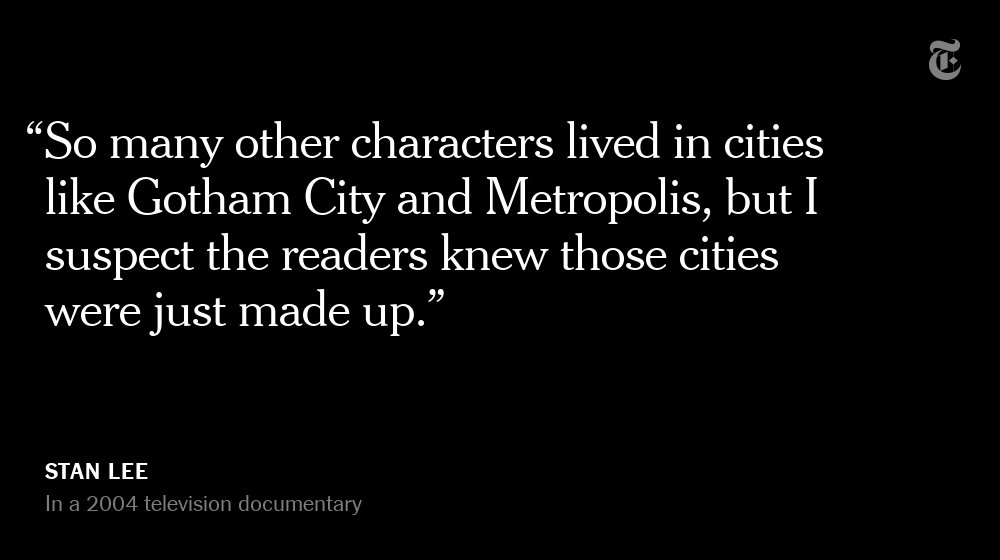
The New York universe hooked readers. And the artists drew what they were familiar with, which made the Marvel universe authentic-looking, down to the water towers atop many of the buildings. https://t.co/rDosqzpP8i

The Avengers Mansion was a Beaux-Arts palace. Fans know it as 890 Fifth Avenue. The Frick Collection, which now occupies the place, uses the address of the front door: 1 East 70th Street.
Stan Lee, who died Monday at 95, was born in Manhattan and graduated from DeWitt Clinton High School in the Bronx. His pulp-fiction heroes have come to define much of popular culture in the early 21st century.
Tying Marvel’s stable of pulp-fiction heroes to a real place — New York — served a counterbalance to the sometimes gravity-challenged action and the improbability of the stories. That was just what Stan Lee wanted. https://t.co/rDosqzpP8i
The New York universe hooked readers. And the artists drew what they were familiar with, which made the Marvel universe authentic-looking, down to the water towers atop many of the buildings. https://t.co/rDosqzpP8i
The Avengers Mansion was a Beaux-Arts palace. Fans know it as 890 Fifth Avenue. The Frick Collection, which now occupies the place, uses the address of the front door: 1 East 70th Street.
