
A lot happened in my MSc: I won several scholarships, my Dad died, I submitted my thesis work to a major conference, annnd there was the pandemic.
I’ve had a fantastic MSc experience (almost done!) and have been talking to a lot of incoming or current students. Some topics / questions come up a lot. Here’s what I know!
🧵 Tips for an awesome MSc experience.
#AcademicTwitter #AcademicChatter @OpenAcademics @academeology
A lot happened in my MSc: I won several scholarships, my Dad died, I submitted my thesis work to a major conference, annnd there was the pandemic.
Choosing a thesis topic: Read read read.
What are you interested? Pick an umbrella topic and start reading. Follow the rabbit holes. Write questions, answers, more questions. When you find questions you cannot answer, you might have a thesis topic.
My first semester a professor said “if your research ideas don’t change, you haven’t learned anything.”
No one is going to pull up your SOP and hold you to whatever you said you were interested in upfront.
What will you do, broadly? One study? Two? A review paper? Meta-analysis? As early as possible, find out what YOU actually need to do to complete your thesis. ESPECIALLY if you’re in a lab with lots going on. What is YOUR requirement?
Make up a timeline with your PI. Consider your goals: do you want to submit to a particular conference? Conduct a follow up study? Work backwards. When do you need data? Ethics? Your proposal done? The best thing I did was set goals and work backwards to time it.
If you do human or animal research you need ethics approval. Look into the process right away. Different schools follow different procedures. Black out dates, differing protocols depending on your sample, etc. could all impact your timeline. Look into this ASAP.
I use Mendeley, others use Zotero. It doesn’t really matter, just use one starting immediately. It will save you HOURS and help you stay organized. Make it a top priority to get comfortable with a referencing software.
I guarantee you that your department has a badass and under utilized librarian. The first time you do a lit review, see the librarian. Writing your first paper? Librarian. Unsure about how to cite/reference? You guessed it. Librarian!
This could be a whole other thread, but in short: apply to everything you are eligible for. Put them on your calendar, get crystal clear on the requirements and START EARLY. I have held 4 scholarships during my MSc worth $45,000.
You’re going to work one-on-one with your PI a lot but there are other people in your department who will make your experience better. Stop in the hall and talk to them. Read their papers. Still online? Invite them for virtual coffee.
You have probably heard that your relationship with your supervisor is important it SO TRUE. If you still have some choice, choose someone who get along with, whose mentorship style works for you, and who supports your goals.
You will need work ethic and a plan, particularly once you no longer have courses and the structure ends. I work in time blocks. Find what works for you and work every day.
Grad school is not a straight line. Things happen. Like I mentioned, I had a major blow: my Dad died. I have learned, though, that the more you work consistently and the more you have a plan, the more you will be buffered against the blows.
Don't just track of your accomplishments; pay attention to what learned to do. Data analysis. Lit review. Grant writing. These are transferable skills into both PhD and industry. Think about this - constantly.
If you ever look at your schedule or consider taking on a project and think “Ok... if I stick to this EXACT schedule... ” then you have over done it. If sleeping through your alarm would make your life fall apart, it's too much.
My friend and I are also hosting a Clubhouse Room tonight at 8PM EST on these topics and more. All are welcome! https://t.co/RJCF2vlNjG
More from Education


Time for some thoughts on schools given the revised SickKids document and the fact that ON decided to leave most schools closed. ON is not the only jurisdiction to do so, but important to note that many jurisdictions would not have done so -even with higher incidence rates.
As outlined in the tweet by @NishaOttawa yesterday, the situation is complex, and not a simple right or wrong https://t.co/DO0v3j9wzr. And no one needs to list all the potential risks and downsides of prolonged school closures.
On the other hand: while school closures do not directly protect our most vulnerable in long-term care at all, one cannot deny that any factor potentially increasing community transmission may have an indirect effect on the risk to these institutions, and on healthcare.
The question is: to what extend do schools contribute to transmission, and how to balance this against the risk of prolonged school closures. The leaked data from yesterday shows a mixed picture -schools are neither unicorns (ie COVID free) nor infernos.
Assuming this data is largely correct -while waiting for an official publication of the data, it shows first and foremost the known high case numbers at Thorncliff, while other schools had been doing very well -are safe- reiterating the impact of socioeconomics on the COVID risk.
A group of Ontario experts led by SickKids has updated its guidance for school operation during the COVID-19 pandemic. The living document, COVID-19: Updated Guidance for School Operation During the Pandemic, can be read here: https://t.co/rotLqDqkQh pic.twitter.com/q7kVezAPoG
— SickKids_TheHospital (@SickKidsNews) January 21, 2021
As outlined in the tweet by @NishaOttawa yesterday, the situation is complex, and not a simple right or wrong https://t.co/DO0v3j9wzr. And no one needs to list all the potential risks and downsides of prolonged school closures.
1/It's the eve of provincial announcements on schools reopening for in-person instruction.
— Nisha Thampi (@NishaOttawa) January 20, 2021
Households are under stress and experts are divided on whether schools are unicorns or infernos.
Everyone wants to do right by kids, who have borne so much throughout this pandemic.
On the other hand: while school closures do not directly protect our most vulnerable in long-term care at all, one cannot deny that any factor potentially increasing community transmission may have an indirect effect on the risk to these institutions, and on healthcare.
The question is: to what extend do schools contribute to transmission, and how to balance this against the risk of prolonged school closures. The leaked data from yesterday shows a mixed picture -schools are neither unicorns (ie COVID free) nor infernos.
Assuming this data is largely correct -while waiting for an official publication of the data, it shows first and foremost the known high case numbers at Thorncliff, while other schools had been doing very well -are safe- reiterating the impact of socioeconomics on the COVID risk.

Saturday Morning Graduate School Admissions/Funding Breakfast
• 1297 USA Scholarships
• 5 Hot Tips for current B.S, Master/PhD applicants
• Admission and FULL Funding Info to Sweden🇸🇪, Australia🇦🇺, France🇫🇷, Germany🇩🇪 and China🇹🇷
• 6 IGTV Videos
Follow @Okpala_IU
A Thread
Are you working hard to study full time (Bachelor, MS, MBA, PhD) in the United States of America🇺🇸?
Here are 1297 verified Scholarships for year 2021
Search here: https://t.co/3AHhW7RUfK
Follow @Okpala_IU for more
Watch other videos on IGTV:
5 Hot Tips for current Bachelor, Master/PhD applicants
1. Standardized Tests (TOEFL, GRE, GMAT)
Yes, the school may have waived it for admissions but providing it definitely increasing your chances of getting funded. If it strengthens your overall profile, that is excellent.
2. Do not trivialize Letters of Recommendations
Remember that your application packet (all supporting documents) is what is being looked at while you are being considered for admission and funding. A lot of schools read LoRs very carefully so ensure you get strong letters.
Read my notes on LoRs:
• 1297 USA Scholarships
• 5 Hot Tips for current B.S, Master/PhD applicants
• Admission and FULL Funding Info to Sweden🇸🇪, Australia🇦🇺, France🇫🇷, Germany🇩🇪 and China🇹🇷
• 6 IGTV Videos
Follow @Okpala_IU
A Thread
Are you working hard to study full time (Bachelor, MS, MBA, PhD) in the United States of America🇺🇸?
Here are 1297 verified Scholarships for year 2021
Search here: https://t.co/3AHhW7RUfK
Follow @Okpala_IU for more
Watch other videos on IGTV:
5 Hot Tips for current Bachelor, Master/PhD applicants
1. Standardized Tests (TOEFL, GRE, GMAT)
Yes, the school may have waived it for admissions but providing it definitely increasing your chances of getting funded. If it strengthens your overall profile, that is excellent.
2. Do not trivialize Letters of Recommendations
Remember that your application packet (all supporting documents) is what is being looked at while you are being considered for admission and funding. A lot of schools read LoRs very carefully so ensure you get strong letters.
Read my notes on LoRs:
If you are submitting a MS/PhD application for admission in the USA, this is for you.
— Ifeanyi Okpala (@Okpala_IU) June 23, 2020
Today, I am going to share one tip associated with the \u201cLetters of Recommendation\u201d required, which I think can make a lot of difference.
- Guiding your Recommenders on Information
Thread pic.twitter.com/uxPHB0W0Su

This is the steady stream of propaganda that's going to be hitting us daily, selling "deprogramming" and "re-education" as normal and reasonable, attempting to convince us that the Biden-Harris side is the good-guy side, admittedly 'backed by corporate billionaires'.
Don\u2019t know who this dude is but he broke that shit DOWN!! Listen especially the ones that need to hear it!! pic.twitter.com/gSZno2yaRh
— Leslie Jones \U0001f98b (@Lesdoggg) January 17, 2021

Normally I enjoy the high standards of journalism in @guardian . Not today as disappointed with misleading headline that suggest infections are spreading fastest in children. It'll worry parents/teachers & I doubt most readers will unpick the
The latest REACT1 report shows prevalence of infection in ALL age groups has fallen, including children aged 5-12 from 1.59% in Round 8 to 0.86% in Round 9a. The authors of REACT1 report also (wisely) didn't try to interpret the prevalence figures.
If this were a research trial you wouldn't place much weight on the age differences in % prevalence because of the wide confidence intervals, i.e. differences weren't statistically significant.
3/
I've previously tweeted on the challenges (& dangers) of interpreting surveillance data. One would need lots more contextual info to make sense of it & arrive at sound
Undoubtedly some will extrapolate from the prevalence of infection figures in children to other settings i.e. schools based on the headline. I'd advise caution as there is a real risk of over-interpretation through extrapolation of limited data. Association is not causation.
5/
The latest REACT1 report shows prevalence of infection in ALL age groups has fallen, including children aged 5-12 from 1.59% in Round 8 to 0.86% in Round 9a. The authors of REACT1 report also (wisely) didn't try to interpret the prevalence figures.
If this were a research trial you wouldn't place much weight on the age differences in % prevalence because of the wide confidence intervals, i.e. differences weren't statistically significant.
3/
I've previously tweeted on the challenges (& dangers) of interpreting surveillance data. One would need lots more contextual info to make sense of it & arrive at sound
Misinterpretation of surveillance data is a serious issue. Surveillance data needs to come with a warning label - Open to biases - interpret with caution! Some may not realize that surveillance often does not measure all infection, it's a proxy for actual disease incidence.
— Andrew Lee (@andrewleedr) February 14, 2021
1/
Undoubtedly some will extrapolate from the prevalence of infection figures in children to other settings i.e. schools based on the headline. I'd advise caution as there is a real risk of over-interpretation through extrapolation of limited data. Association is not causation.
5/
You May Also Like




THREAD: 12 Things Everyone Should Know About IQ
1. IQ is one of the most heritable psychological traits – that is, individual differences in IQ are strongly associated with individual differences in genes (at least in fairly typical modern environments). https://t.co/3XxzW9bxLE
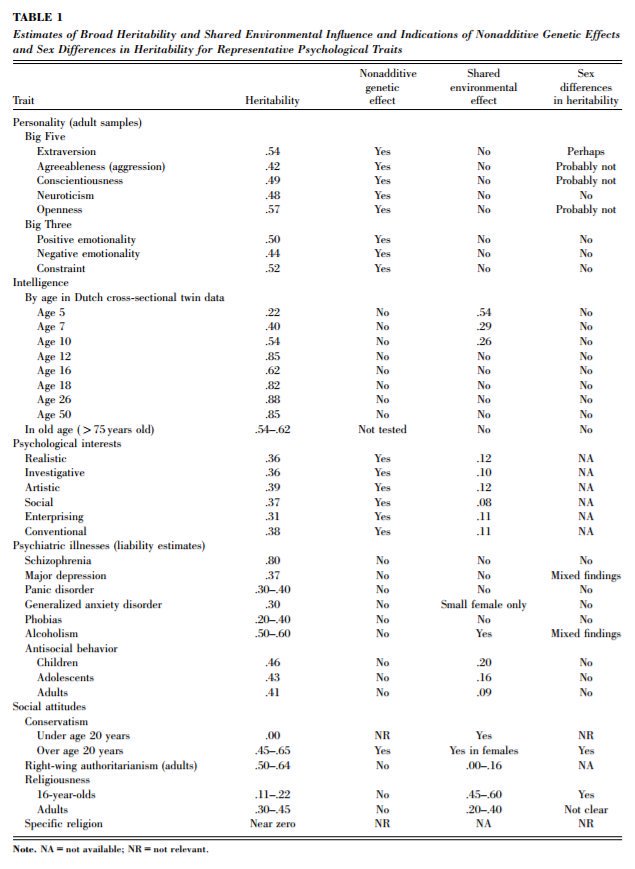
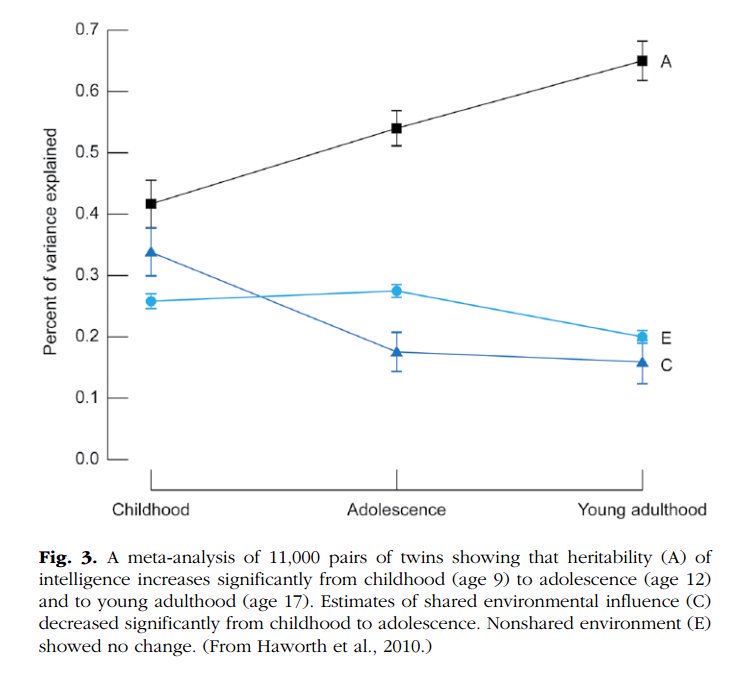
2. The heritability of IQ *increases* from childhood to adulthood. Meanwhile, the effect of the shared environment largely fades away. In other words, when it comes to IQ, nature becomes more important as we get older, nurture less. https://t.co/UqtS1lpw3n
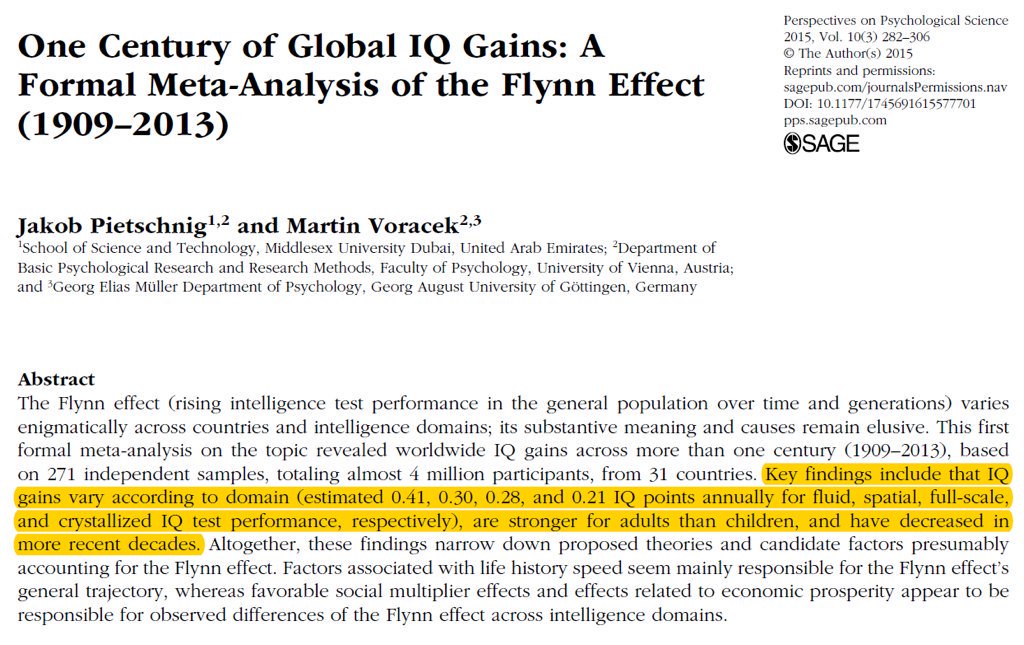
3. IQ scores have been increasing for the last century or so, a phenomenon known as the Flynn effect. https://t.co/sCZvCst3hw (N ≈ 4 million)
(Note that the Flynn effect shows that IQ isn't 100% genetic; it doesn't show that it's 100% environmental.)
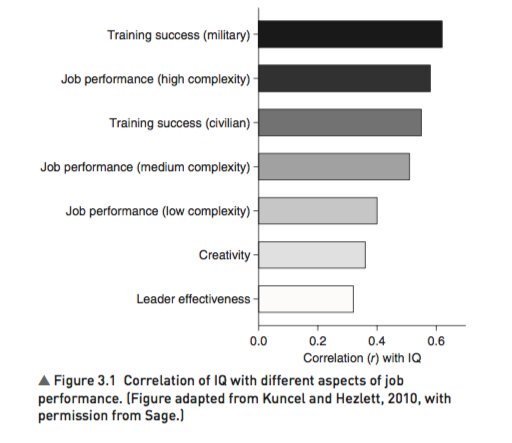
4. IQ predicts many important real world outcomes.
For example, though far from perfect, IQ is the single-best predictor of job performance we have – much better than Emotional Intelligence, the Big Five, Grit, etc. https://t.co/rKUgKDAAVx https://t.co/DWbVI8QSU3
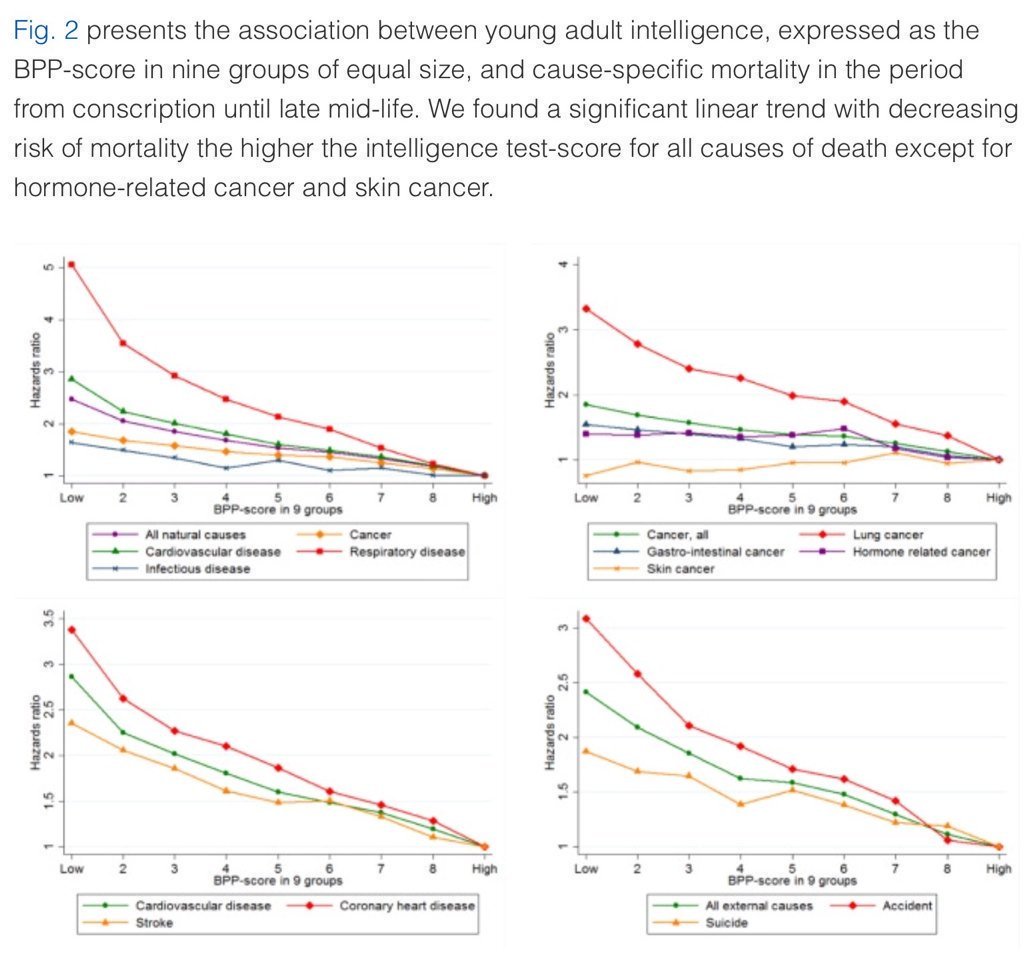
5. Higher IQ is associated with a lower risk of death from most causes, including cardiovascular disease, respiratory disease, most forms of cancer, homicide, suicide, and accident. https://t.co/PJjGNyeQRA (N = 728,160)
1. IQ is one of the most heritable psychological traits – that is, individual differences in IQ are strongly associated with individual differences in genes (at least in fairly typical modern environments). https://t.co/3XxzW9bxLE
2. The heritability of IQ *increases* from childhood to adulthood. Meanwhile, the effect of the shared environment largely fades away. In other words, when it comes to IQ, nature becomes more important as we get older, nurture less. https://t.co/UqtS1lpw3n
3. IQ scores have been increasing for the last century or so, a phenomenon known as the Flynn effect. https://t.co/sCZvCst3hw (N ≈ 4 million)
(Note that the Flynn effect shows that IQ isn't 100% genetic; it doesn't show that it's 100% environmental.)
4. IQ predicts many important real world outcomes.
For example, though far from perfect, IQ is the single-best predictor of job performance we have – much better than Emotional Intelligence, the Big Five, Grit, etc. https://t.co/rKUgKDAAVx https://t.co/DWbVI8QSU3
5. Higher IQ is associated with a lower risk of death from most causes, including cardiovascular disease, respiratory disease, most forms of cancer, homicide, suicide, and accident. https://t.co/PJjGNyeQRA (N = 728,160)


