There is *real* anger toward this organization. Honestly, more than I even heard about from MD students and the NBME.
You asked. So here are my thoughts on how osteopathic medical students should respond to the NBOME.
(thread)
I think most of us are over here waiting to see what @jbcarmody has to say about the latest NBOME email pic.twitter.com/bVWkS23V7z
— Jake Berg (@jberg521) January 28, 2021
There is *real* anger toward this organization. Honestly, more than I even heard about from MD students and the NBME.
Amorphous anger on social media is easy to ignore. But if that anger gets channeled into organized efforts to facilitate change, then improvements are possible.
Best case scenario, you’ll get another “town hall” meeting, a handful of platitudes, and some thoughtful beard stroking before being told that they’re keeping the exam.
Almost all states allow DO licensure by completing the USMLE series. If you aren’t required to engage with the NBOME, don’t.
As an MD who has passed the USMLE, I could practice in any state. Why shouldn’t a DO who passed the USMLE be able to do the same?
(State boards that prop up the NBOME with a COMLEX requirement are listed in the Tweet below.) https://t.co/stace4lMjD
For those wondering, DO students who completed Step1 & Step2CK are eligible to sit for Step3 and receive state licensure w/o COMLEX series in ~44/50 states; 5 states can accommodate others w/o Level2PE; 1 state, FL, does not.
— Mustafa Basree MS (@mustafabasree) January 26, 2021
See below if you're considering below 5 states \U0001f447\U0001f3fd
The board may be friendly with the NBOME, but they’re still accountable to the legislature.
It’s ultimately the COCA requirement that keeps the NBOME in business.
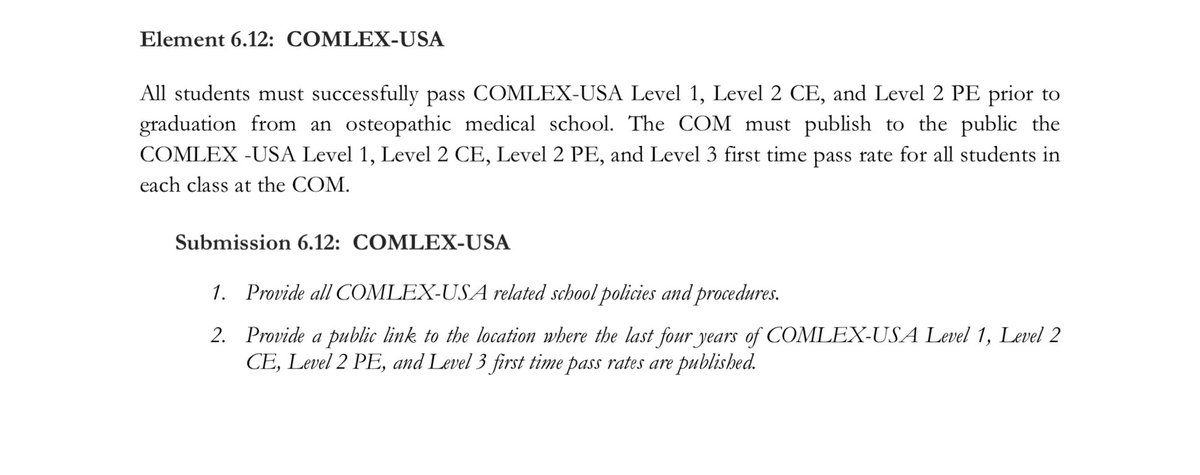
They should think carefully about whether, at this point in history, a “separate but equal” licensing exam hurts DOs more than it helps.
https://t.co/pFwaAx01oB

More from Education

Last month I presented seven sentences in seven different languages, all written in a form of the Chinese-character script. The challenge was to identify the languages and, if possible, provide a
Here again are those seven sentences:
1) 他的剑从船上掉到河里去
2) 於世𡗉番𧡊哭唭𢆥尼歲㐌外四𨑮
3) 入良沙寢矣見昆腳烏伊四是良羅
4) 佢而家喺邊喥呀
5) 夜久毛多都伊豆毛夜幣賀岐都麻碁微爾夜幣賀岐都久流曾能夜幣賀岐袁
6) 其劍自舟中墜於水
7) 今天愛晚特語兔吃二魚佛午飯
Six of those seven sentences are historically attested. One is not: I invented #7. I’m going to dive into an exploration of that seventh sentence in today’s thread.
Sentence #7 is an English-language sentence written sinographically — that is, using graphs that originate in the Chinese script. I didn’t do this for fun (even though it is fun), or as a proposal for a new way to write
I did it as a thought experiment. Why? Because thinking about how the modern Chinese script might be adapted to write modern English can give us valuable insights into historical instances of script borrowing, like those that took place centuries ago in Japan, Korea, and Vietnam.
\U0001f17b\U0001f130\U0001f17d\U0001f176\U0001f184\U0001f130\U0001f176\U0001f174 \U0001f180\U0001f184\U0001f178\U0001f189
— zev handel (@ZevHandel) December 17, 2020
The following sentences are in seven different languages, all written in Chinese-character script (or a modification of it). Can you identify the languages?
Sentences are in thread.
(1/3)
Here again are those seven sentences:
1) 他的剑从船上掉到河里去
2) 於世𡗉番𧡊哭唭𢆥尼歲㐌外四𨑮
3) 入良沙寢矣見昆腳烏伊四是良羅
4) 佢而家喺邊喥呀
5) 夜久毛多都伊豆毛夜幣賀岐都麻碁微爾夜幣賀岐都久流曾能夜幣賀岐袁
6) 其劍自舟中墜於水
7) 今天愛晚特語兔吃二魚佛午飯
Six of those seven sentences are historically attested. One is not: I invented #7. I’m going to dive into an exploration of that seventh sentence in today’s thread.
Sentence #7 is an English-language sentence written sinographically — that is, using graphs that originate in the Chinese script. I didn’t do this for fun (even though it is fun), or as a proposal for a new way to write
7) \u4eca\u5929\u611b\u665a\u7279\u8a9e\u5154\u5403\u4e8c\u9b5a\u4f5b\u5348\u98ef \u2013 Modern English
— zev handel (@ZevHandel) December 21, 2020
Today I want you to each two fish for lunch.
That this sentence is a written form of English is undeniable, as the sentence is made up entirely of English words following the rules of English grammar. 23/
I did it as a thought experiment. Why? Because thinking about how the modern Chinese script might be adapted to write modern English can give us valuable insights into historical instances of script borrowing, like those that took place centuries ago in Japan, Korea, and Vietnam.

The outrage is not that she fit better. The outrage is that she stated very firmly on national television with no caveat, that there are no conditions not improved by exercise. Many people with viral sequelae have been saying for years that exercise has made them more disabled 1/
And the new draft NICE guidelines for ME/CFS which often has a viral onset specifically say that ME/CFS patients shouldn't do graded exercise. Clare is fully aware of this but still made a sweeping and very firm statement that all conditions are improved by exercise. This 2/
was an active dismissal of the lived experience of hundreds of thousands of patients with viral sequelae. Yes, exercise does help so many conditions. Yes, a very small number of people with an ME/CFS diagnosis are helped by exercise. But the vast majority of people with ME, a 3/
a quintessential post-viral condition, are made worse by exercise. Many have been left wheelchair dependent of bedbound by graded exercise therapy when they could walk before. To dismiss the lived experience of these patients with such a sweeping statement is unethical and 4/
unsafe. Clare has every right to her lived experience. But she can't, and you can't justifiably speak out on favour of listening to lived experience but cherry pick the lived experiences you are going to listen to. Why are the lived experiences of most people with ME dismissed?
Why is it such a source of collective outrage that a person with fatigue following a viral illness gets better?https://t.co/5lcwQBPLU5
— Trisha Greenhalgh \U0001f637 #CovidIsAirborne (@trishgreenhalgh) January 30, 2021
And the new draft NICE guidelines for ME/CFS which often has a viral onset specifically say that ME/CFS patients shouldn't do graded exercise. Clare is fully aware of this but still made a sweeping and very firm statement that all conditions are improved by exercise. This 2/
was an active dismissal of the lived experience of hundreds of thousands of patients with viral sequelae. Yes, exercise does help so many conditions. Yes, a very small number of people with an ME/CFS diagnosis are helped by exercise. But the vast majority of people with ME, a 3/
a quintessential post-viral condition, are made worse by exercise. Many have been left wheelchair dependent of bedbound by graded exercise therapy when they could walk before. To dismiss the lived experience of these patients with such a sweeping statement is unethical and 4/
unsafe. Clare has every right to her lived experience. But she can't, and you can't justifiably speak out on favour of listening to lived experience but cherry pick the lived experiences you are going to listen to. Why are the lived experiences of most people with ME dismissed?


You May Also Like





Stan Lee’s fictional superheroes lived in the real New York. Here’s where they lived, and why. https://t.co/oV1IGGN8R6

Stan Lee, who died Monday at 95, was born in Manhattan and graduated from DeWitt Clinton High School in the Bronx. His pulp-fiction heroes have come to define much of popular culture in the early 21st century.
Tying Marvel’s stable of pulp-fiction heroes to a real place — New York — served a counterbalance to the sometimes gravity-challenged action and the improbability of the stories. That was just what Stan Lee wanted. https://t.co/rDosqzpP8i
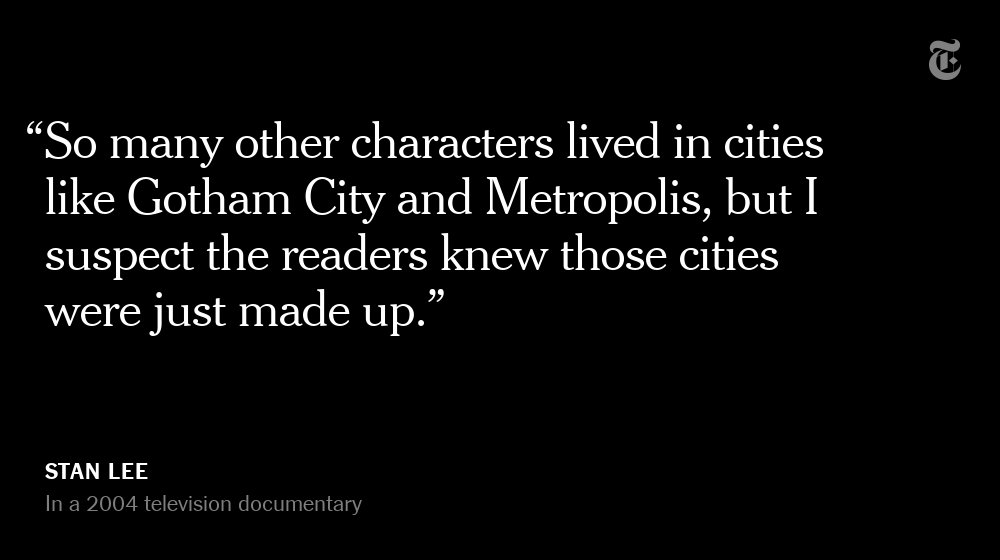
The New York universe hooked readers. And the artists drew what they were familiar with, which made the Marvel universe authentic-looking, down to the water towers atop many of the buildings. https://t.co/rDosqzpP8i

The Avengers Mansion was a Beaux-Arts palace. Fans know it as 890 Fifth Avenue. The Frick Collection, which now occupies the place, uses the address of the front door: 1 East 70th Street.
Stan Lee, who died Monday at 95, was born in Manhattan and graduated from DeWitt Clinton High School in the Bronx. His pulp-fiction heroes have come to define much of popular culture in the early 21st century.
Tying Marvel’s stable of pulp-fiction heroes to a real place — New York — served a counterbalance to the sometimes gravity-challenged action and the improbability of the stories. That was just what Stan Lee wanted. https://t.co/rDosqzpP8i
The New York universe hooked readers. And the artists drew what they were familiar with, which made the Marvel universe authentic-looking, down to the water towers atop many of the buildings. https://t.co/rDosqzpP8i
The Avengers Mansion was a Beaux-Arts palace. Fans know it as 890 Fifth Avenue. The Frick Collection, which now occupies the place, uses the address of the front door: 1 East 70th Street.