
🧵THREAD 🧵As it's the start of a new year, there seems to be a lot more calls for freelance pitches about. If you're thinking of pitching for the first time, or wanted a refresher, here are some of the things I find useful. /1
1️⃣ https://t.co/1otlK6UJQj
2️⃣ https://t.co/qk9hmC7V7h
3️⃣ https://t.co/vGvh3Q9OT2
More from Economy




Long rant: This @WSJ article bemoaning the decline of price theory is really worth highlighting. The economic theories and so called "laws of economics" that the WSJ consistently and religiously defends, are the source of their authority, power and privilege.
So called economic "theories" like "you get paid exactly what you are worth" and "markets are perfectly efficient" and "when wages rise, jobs fall" and "raising taxes on the rich kills jobs and growth" and "increasing justice decreases economic efficiency" and...
"Government intervention in markets always creates more harm than good" and "any regulation that constrains corporations kills growth and productivity", etc etc are effectively a protection racket for the rich. It is a set of internally consistent and mathematized conjectures...
That are all demonstrably nonsense. But getting people to accept these "theories" as laws of nature and immutable, timeless truths is the most effective way our current economic elites have found to maintain and enhance the status of the powerful and persuade the weak and poor...
to shut the fuck up and accept their lot in life. Now, FINALLY, some economists- are actually beginning to look at the real world evidence to determine whether these propositions actually describe anything real here on planet earth. Let me save you some time. The answer is NO.
Hilarious. The WSJ editorial page bemoans the waning influence of The neoliberal priesthood, and hence their own. https://t.co/pQT8Dstg8I
— Nick Hanauer (@NickHanauer) January 28, 2021
So called economic "theories" like "you get paid exactly what you are worth" and "markets are perfectly efficient" and "when wages rise, jobs fall" and "raising taxes on the rich kills jobs and growth" and "increasing justice decreases economic efficiency" and...
"Government intervention in markets always creates more harm than good" and "any regulation that constrains corporations kills growth and productivity", etc etc are effectively a protection racket for the rich. It is a set of internally consistent and mathematized conjectures...
That are all demonstrably nonsense. But getting people to accept these "theories" as laws of nature and immutable, timeless truths is the most effective way our current economic elites have found to maintain and enhance the status of the powerful and persuade the weak and poor...
to shut the fuck up and accept their lot in life. Now, FINALLY, some economists- are actually beginning to look at the real world evidence to determine whether these propositions actually describe anything real here on planet earth. Let me save you some time. The answer is NO.

You May Also Like







I'm going to do two history threads on Ethiopia, one on its ancient history, one on its modern story (1800 to today). 🇪🇹
I'll begin with the ancient history ... and it goes way back. Because modern humans - and before that, the ancestors of humans - almost certainly originated in Ethiopia. 🇪🇹 (sub-thread):
The first likely historical reference to Ethiopia is ancient Egyptian records of trade expeditions to the "Land of Punt" in search of gold, ebony, ivory, incense, and wild animals, starting in c 2500 BC 🇪🇹

Ethiopians themselves believe that the Queen of Sheba, who visited Israel's King Solomon in the Bible (c 950 BC), came from Ethiopia (not Yemen, as others believe). Here she is meeting Solomon in a stain-glassed window in Addis Ababa's Holy Trinity Church. 🇪🇹
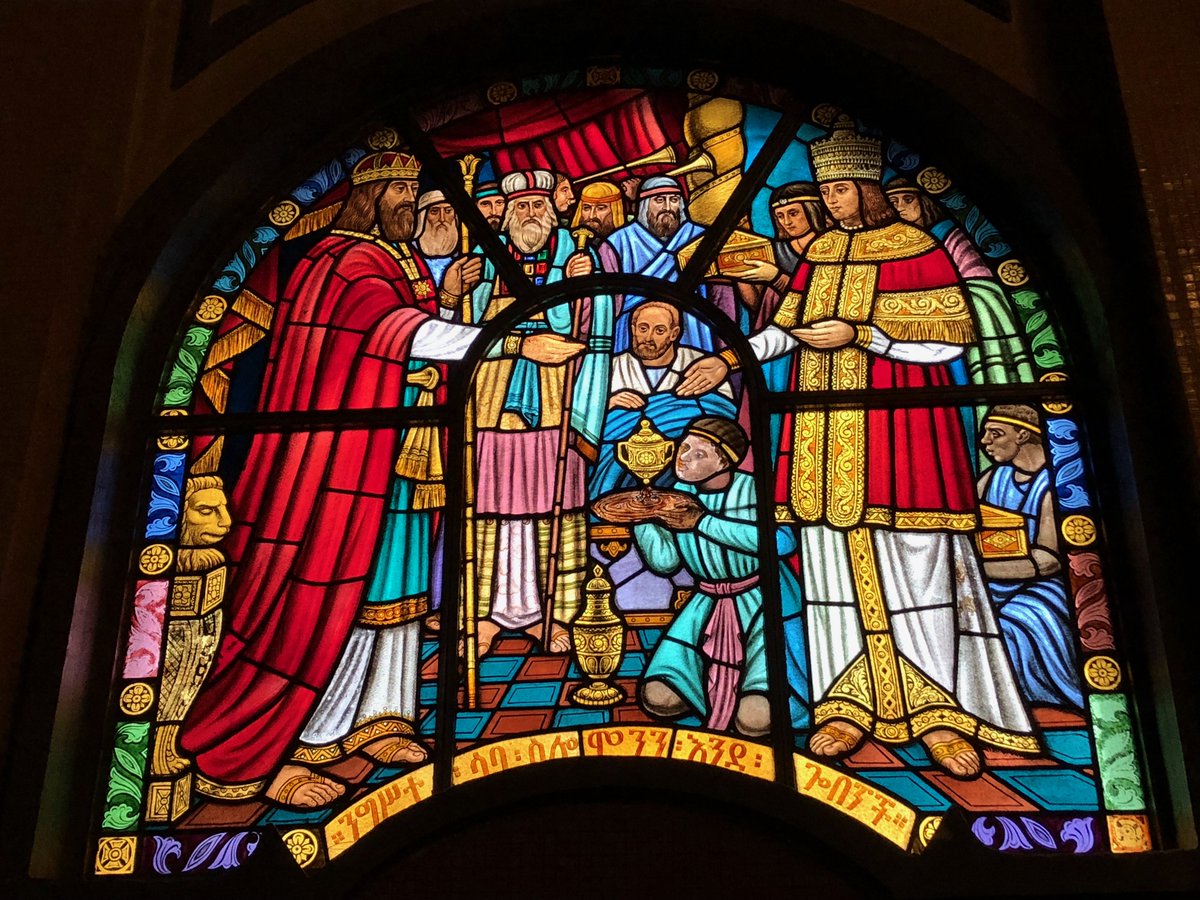
References to the Queen of Sheba are everywhere in Ethiopia. The national airline's frequent flier miles are even called "ShebaMiles". 🇪🇹

I'll begin with the ancient history ... and it goes way back. Because modern humans - and before that, the ancestors of humans - almost certainly originated in Ethiopia. 🇪🇹 (sub-thread):
The famous \u201cLucy\u201d, an early ancestor of modern humans (Australopithecus) that lived 3.2 million years ago, and was discovered in 1974 in Ethiopia, displayed in the national museum in Addis Ababa \U0001f1ea\U0001f1f9 pic.twitter.com/N3oWqk1SW2
— Patrick Chovanec (@prchovanec) November 9, 2018
The first likely historical reference to Ethiopia is ancient Egyptian records of trade expeditions to the "Land of Punt" in search of gold, ebony, ivory, incense, and wild animals, starting in c 2500 BC 🇪🇹
Ethiopians themselves believe that the Queen of Sheba, who visited Israel's King Solomon in the Bible (c 950 BC), came from Ethiopia (not Yemen, as others believe). Here she is meeting Solomon in a stain-glassed window in Addis Ababa's Holy Trinity Church. 🇪🇹
References to the Queen of Sheba are everywhere in Ethiopia. The national airline's frequent flier miles are even called "ShebaMiles". 🇪🇹


