1/x The market continues to try & shake out weak hands from overextended positioning by both HF & Retail...After a strong Vanna run up overnight, as expected, retail exuberance exploded on the open in the form of retail call buying, this fragility, paired w/a)Mean reverting flows

More from Cem Karsan 🥐



1/x Vanna joined the wheel of fortune on this day in 1982,& 38 years later she’s stronger than ever...Friday’s into the Mon of qrtrly OpEx in particular aren’t a time to trifle w/her...As called for, the market continues to try & shake out weak hands from overextended positioning
2/x by both HF & Retail, but ultimately these moves are no match for our fair lady’s charming flows during this window, & should continue to support this market through 12/16 w/ qrtrly Vixperation & the Fed upon us....As I highlighted Fri, the minor correction in price/time that
3/x we got down to the 20 day, w/precise technical support at that level, paired w/ increasingly positive Dark Pool (DIX) demand was a textbook buy signal, given the timing...Despite all of this, the real story is not these positive flows nearly as much as the continued reflexive
4/x IVol compression...This is the holiday gift that keeps on giving. Along w/ continued targeted short Vol, massive calendar expansion & dispersion opportunities continue to print $ with VRP >94th % of occurrences & post 1/8 Vol still at a floor... This $ train doesn’t show any
5/x sign of stopping yet, as I expect Ivol oversupply should continue to be the dominant force through at least 12/16 & once we get through 12/21 without incident, likely beyond...W/ lots of imbedded potential energy still in the VRP to fuel more vanna/charm flows in the month to
\U0001f4faOn December 13, 1982, Vanna White joined @WheelofFortune pic.twitter.com/rzrPcBTI59
— RetroNewsNow (@RetroNewsNow) December 13, 2020
2/x by both HF & Retail, but ultimately these moves are no match for our fair lady’s charming flows during this window, & should continue to support this market through 12/16 w/ qrtrly Vixperation & the Fed upon us....As I highlighted Fri, the minor correction in price/time that
3/x we got down to the 20 day, w/precise technical support at that level, paired w/ increasingly positive Dark Pool (DIX) demand was a textbook buy signal, given the timing...Despite all of this, the real story is not these positive flows nearly as much as the continued reflexive
4/x IVol compression...This is the holiday gift that keeps on giving. Along w/ continued targeted short Vol, massive calendar expansion & dispersion opportunities continue to print $ with VRP >94th % of occurrences & post 1/8 Vol still at a floor... This $ train doesn’t show any
5/x sign of stopping yet, as I expect Ivol oversupply should continue to be the dominant force through at least 12/16 & once we get through 12/21 without incident, likely beyond...W/ lots of imbedded potential energy still in the VRP to fuel more vanna/charm flows in the month to
More from Economy

1/ Trend Factor: Any Economic Gains from Using Information over Investment Horizons? (Han, Zhou, Zhu)
"A trend factor using multiple time lengths outperforms ST reversal, momentum, and LT reversal, which are based on the three price trends separately."
https://t.co/udkvsdw2Lz
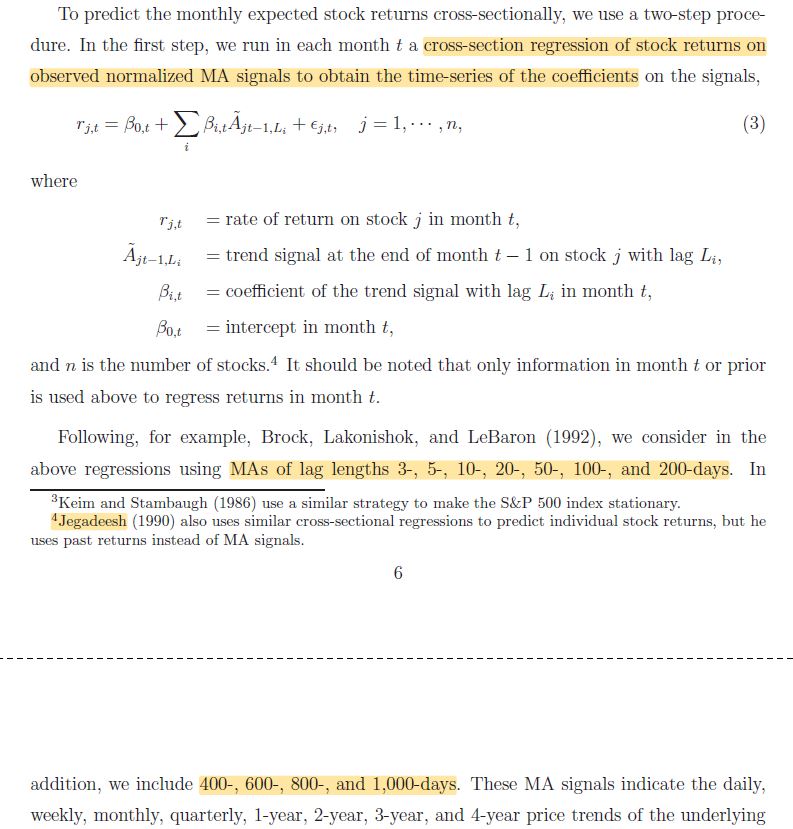
2/ This resembles combining multiple measures of ST reversal, momentum, and LT reversal (forecasts determined by walking forward rather than using signs from the full sample).
Unlike normal moving average signals, these are *cross-sectional.* More below:
https://t.co/wkIFLg9jtK
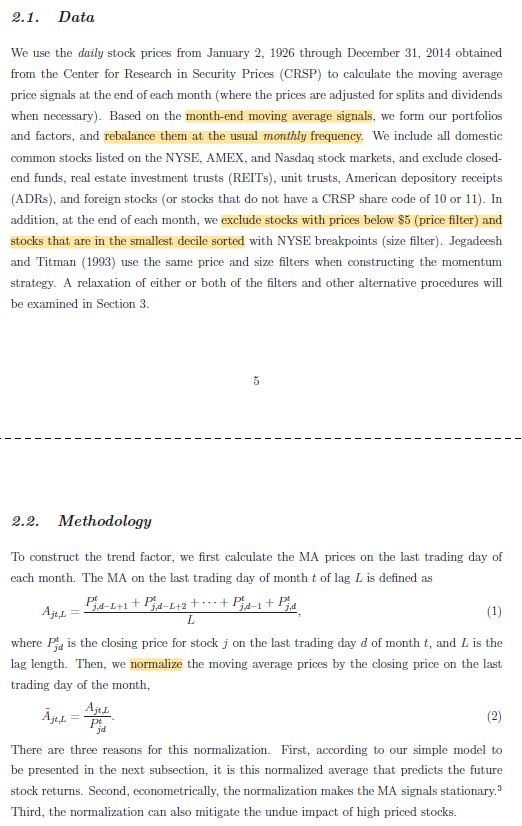
3/ Unsurprisingly, the Trend factor formed by this approach outperforms benchmarks in terms of both Sharpe ratio and tail metrics. It's combining momentum with two factors that are negatively correlated to it AND using multiple specifications.
More here:
https://t.co/x8Tloz3iyL
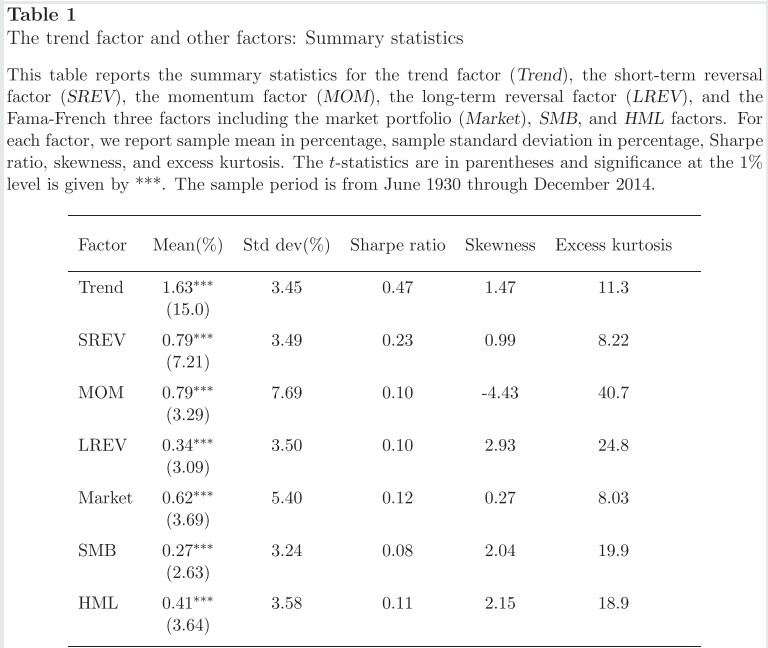
4/ "Average return and volatility of the trend factor are both higher in recession periods. However, the Sharpe ratio is virtually the same.
"Interestingly, all of the factors still have positive average returns.
"Momentum experiences the greatest increase in volatility."
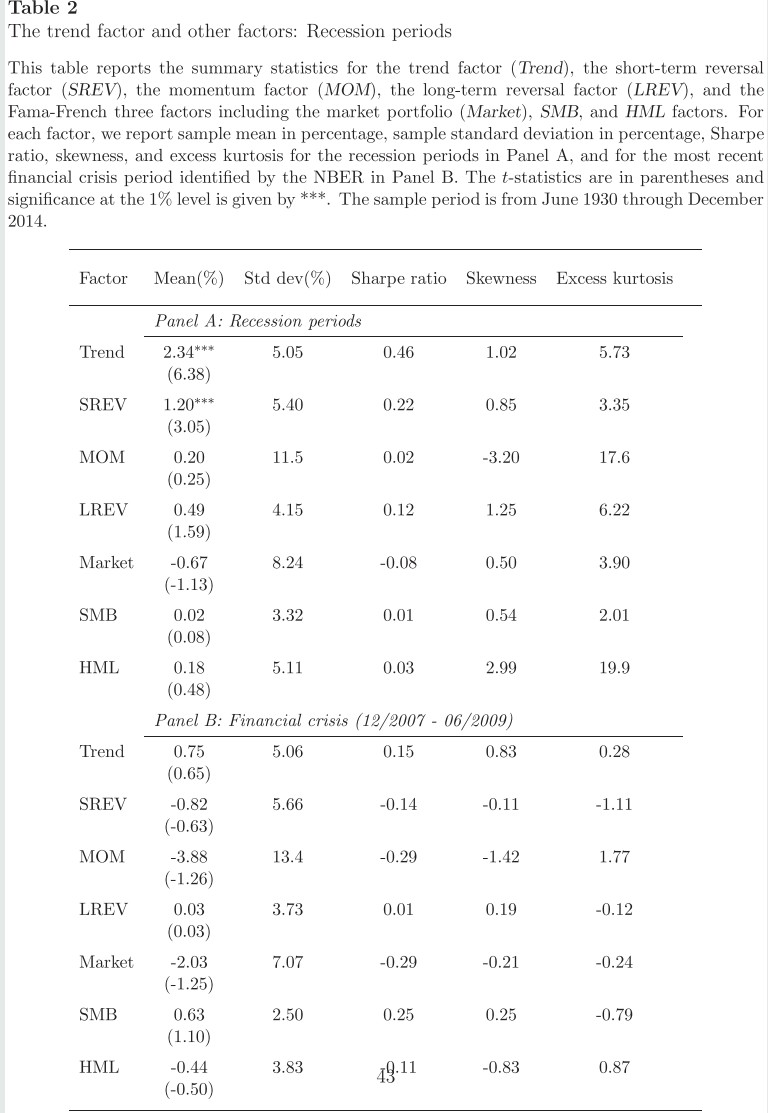
5/ "In terms of maximum drawdown and the Calmar ratio, the trend factor performs the best.
"The trend factor is correlated with the short-term reversal factor (35%), long-term reversal factor (14%), and the market (20%) but is virtually uncorrelated with the momentum factor."
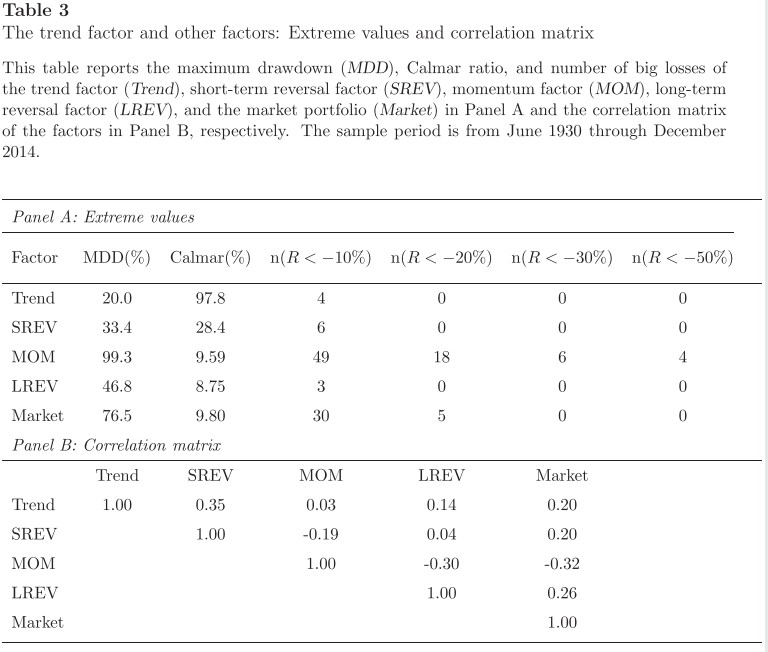
"A trend factor using multiple time lengths outperforms ST reversal, momentum, and LT reversal, which are based on the three price trends separately."
https://t.co/udkvsdw2Lz
2/ This resembles combining multiple measures of ST reversal, momentum, and LT reversal (forecasts determined by walking forward rather than using signs from the full sample).
Unlike normal moving average signals, these are *cross-sectional.* More below:
https://t.co/wkIFLg9jtK
1/ Cross-Sectional and Time-Series Tests of Return Predictability: What Is the Difference? (Goyal, Jegadeesh)
— Darren \U0001f95a (@ReformedTrader) June 18, 2019
"The difference between the performances of TS and CS strategies is largely due to a time-varying net-long investment in risky assets."https://t.co/CSIn3ujN2R pic.twitter.com/XHnVmIart4
3/ Unsurprisingly, the Trend factor formed by this approach outperforms benchmarks in terms of both Sharpe ratio and tail metrics. It's combining momentum with two factors that are negatively correlated to it AND using multiple specifications.
More here:
https://t.co/x8Tloz3iyL
1/ An Executive Summary (in Tweet form) of our new paper
— Adam Butler (@GestaltU) March 27, 2019
Dual Momentum \u2013 A Craftsman\u2019s Perspective
Download here: https://t.co/Y9GlGNohBg
Everything that follows in this thread is based on HYPOTHETICAL AND SIMULATED RESULTS. pic.twitter.com/9m5YJnTdtq
4/ "Average return and volatility of the trend factor are both higher in recession periods. However, the Sharpe ratio is virtually the same.
"Interestingly, all of the factors still have positive average returns.
"Momentum experiences the greatest increase in volatility."
5/ "In terms of maximum drawdown and the Calmar ratio, the trend factor performs the best.
"The trend factor is correlated with the short-term reversal factor (35%), long-term reversal factor (14%), and the market (20%) but is virtually uncorrelated with the momentum factor."



Interesting thread, but I don't think ecosocialists or degrowthers are arguing that if German socialists had come to power the world would be green by now. Socialism is not automatically green. Eco-socialism is what it says - a green version of socialism - to be tested /1
The historical counterfactual also in not totally convincing. So let's assume Germany and Europe went socialist. The world economy would have evolved exactly the same way it did? 🤔 I doubt it, this is too deterministic. Examples: /2
We do not know if the transition from coal to oil would have taken place when it took place, the way it did. From Timothy Mitchell we know that oil was a fix for capitalism to bypass the labour strikes of coal workers. One would think that socialists would treat workers better /3
We also do not know if socialist governments would strong arm the Middle East the way capitalists did, starting wars to secure cheap oil, and setting up puppet governments. One would want to think that Rosa Luxembourg would not go down that path..../4
We also do not know if they would have continued colonial unequal exchange, extracting raw materials as cheap as possible from the rest of the world. Without cheap oil and cheap materials, it is anyone's guess if GDP and CO2 would be where it is now. /5
You get the impression from the eco-socialists and degrowthers that humanity wouldn\u2019t face the threat of climate change or biodiversity loss if it weren\u2019t for capitalism (or rather, if it weren\u2019t for capitalist modernity).
— Leigh Phillips (@Leigh_Phillips) February 2, 2021
But I see no evidence to suggest this is the case.
The historical counterfactual also in not totally convincing. So let's assume Germany and Europe went socialist. The world economy would have evolved exactly the same way it did? 🤔 I doubt it, this is too deterministic. Examples: /2
We do not know if the transition from coal to oil would have taken place when it took place, the way it did. From Timothy Mitchell we know that oil was a fix for capitalism to bypass the labour strikes of coal workers. One would think that socialists would treat workers better /3
We also do not know if socialist governments would strong arm the Middle East the way capitalists did, starting wars to secure cheap oil, and setting up puppet governments. One would want to think that Rosa Luxembourg would not go down that path..../4
We also do not know if they would have continued colonial unequal exchange, extracting raw materials as cheap as possible from the rest of the world. Without cheap oil and cheap materials, it is anyone's guess if GDP and CO2 would be where it is now. /5

Long rant: This @WSJ article bemoaning the decline of price theory is really worth highlighting. The economic theories and so called "laws of economics" that the WSJ consistently and religiously defends, are the source of their authority, power and privilege.
So called economic "theories" like "you get paid exactly what you are worth" and "markets are perfectly efficient" and "when wages rise, jobs fall" and "raising taxes on the rich kills jobs and growth" and "increasing justice decreases economic efficiency" and...
"Government intervention in markets always creates more harm than good" and "any regulation that constrains corporations kills growth and productivity", etc etc are effectively a protection racket for the rich. It is a set of internally consistent and mathematized conjectures...
That are all demonstrably nonsense. But getting people to accept these "theories" as laws of nature and immutable, timeless truths is the most effective way our current economic elites have found to maintain and enhance the status of the powerful and persuade the weak and poor...
to shut the fuck up and accept their lot in life. Now, FINALLY, some economists- are actually beginning to look at the real world evidence to determine whether these propositions actually describe anything real here on planet earth. Let me save you some time. The answer is NO.
Hilarious. The WSJ editorial page bemoans the waning influence of The neoliberal priesthood, and hence their own. https://t.co/pQT8Dstg8I
— Nick Hanauer (@NickHanauer) January 28, 2021
So called economic "theories" like "you get paid exactly what you are worth" and "markets are perfectly efficient" and "when wages rise, jobs fall" and "raising taxes on the rich kills jobs and growth" and "increasing justice decreases economic efficiency" and...
"Government intervention in markets always creates more harm than good" and "any regulation that constrains corporations kills growth and productivity", etc etc are effectively a protection racket for the rich. It is a set of internally consistent and mathematized conjectures...
That are all demonstrably nonsense. But getting people to accept these "theories" as laws of nature and immutable, timeless truths is the most effective way our current economic elites have found to maintain and enhance the status of the powerful and persuade the weak and poor...
to shut the fuck up and accept their lot in life. Now, FINALLY, some economists- are actually beginning to look at the real world evidence to determine whether these propositions actually describe anything real here on planet earth. Let me save you some time. The answer is NO.
You May Also Like







1/Politics thread time.
To me, the most important aspect of the 2018 midterms wasn't even about partisan control, but about democracy and voting rights. That's the real battle.
2/The good news: It's now an issue that everyone's talking about, and that everyone cares about.
3/More good news: Florida's proposition to give felons voting rights won. But it didn't just win - it won with substantial support from Republican voters.
That suggests there is still SOME grassroots support for democracy that transcends
4/Yet more good news: Michigan made it easier to vote. Again, by plebiscite, showing broad support for voting rights as an
5/OK, now the bad news.
We seem to have accepted electoral dysfunction in Florida as a permanent thing. The 2000 election has never really
To me, the most important aspect of the 2018 midterms wasn't even about partisan control, but about democracy and voting rights. That's the real battle.
2/The good news: It's now an issue that everyone's talking about, and that everyone cares about.
3/More good news: Florida's proposition to give felons voting rights won. But it didn't just win - it won with substantial support from Republican voters.
That suggests there is still SOME grassroots support for democracy that transcends
4/Yet more good news: Michigan made it easier to vote. Again, by plebiscite, showing broad support for voting rights as an
5/OK, now the bad news.
We seem to have accepted electoral dysfunction in Florida as a permanent thing. The 2000 election has never really
Bad ballot design led to a lot of undervotes for Bill Nelson in Broward Co., possibly even enough to cost him his Senate seat. They do appear to be real undervotes, though, instead of tabulation errors. He doesn't really seem to have a path to victory. https://t.co/utUhY2KTaR
— Nate Silver (@NateSilver538) November 16, 2018