

A product which provides a fixed income which is better than FD & an upside like equity.
Should you invest in Real Estate Investment Trusts (REITs)?
A Thread 🧵👇

In listed REITs, Most of the completed properties are pre-leased to big companies.
Why no residential? As yields of 1-3% make them unattractive to investors.
REITs have to distribute at least 90% of their taxable income to their shareholders.
Both listed REITs trade at 6-7% dividend yield (which is also tax-free)
What about debt then? There's a restriction there too.
Not more than 49% of the total equity.
REITs are traded on the exchange (like stocks). Yes, Instant liquidity in a very illiquid product (Bulky Commercial Real Estate)
An investor can take part by buying 200 units at a time (60-70k rupees)
Under the current structure, Dividends remain tax-free (6-7% yields vs pre-tax FD yield of 5%)
On capital gains, while selling your units:
STCG of 15% on gains (if sold in less than 3 years)
LTCG of 10% on gains (if sold after 3 years)
US REITs have 5 decades of history behind them & they have continued to outperform the broader equity markets
Interesting fact: US has 194 listed REITs with a combined market cap of $1.3Trillion

This leaves an upside potential once contracts expire.
Moreover, REITs have contractual escalations of 10-15% every 3-5 years.
Directly buying RE? Get ready for 👇
- Huge Ticket Size (vs limited capital)
- Hassle of managing operational cost
- No valid data source
- Illiquid investment with high transaction costs
- Committed Occupancy & collections efficiency (higher the better)
- Weighted Average Lease Expiry (WALE)
- Sector Concentration (lesser the better) & Quality of tenants
- Healthy Balance Sheet
- Upcoming portfolio

No (in the context of India)
- Rents are a fraction of global rents
- Indian Outsourcing is a big opportunity given the resilience & performance in COVID
- Young Population needs direction via physical interactions.
Commercial RE supply is hit, especially for Single Building Projects, Speculative construction, Strata Title assets
Most are facing a cash crunch
Great for future rent scenario, if demand increases
- Slowdown in Commercial RE (follow vacancies)
- Oversupply: Renegotiation at lower rates
- Concentration risks (tenant & location wise)
- Difference b/w REIT yield & FD rate
- Broader stock market movements will have an impact on unit price
More from JST Investments
Key insights from Hikal
🧪 Lowered interest rates
🧪 Pharma: Growth in generics as well as CDMO
🧪 Crop Protection: Scaleup of a fungicide for a Japanese CDMO client
🧪 Healthy pipeline of new products: Supported by new capacities; Investing in Animal Health & Biocides verticals https://t.co/D70j9oriCa

🧪 Lowered interest rates
🧪 Pharma: Growth in generics as well as CDMO
🧪 Crop Protection: Scaleup of a fungicide for a Japanese CDMO client
🧪 Healthy pipeline of new products: Supported by new capacities; Investing in Animal Health & Biocides verticals https://t.co/D70j9oriCa
Hikal: Strong
— JST Investments (@JstInvestments) August 5, 2021
\U0001f9ea Rev up 27% YoY
\U0001f9ea 22% EBITDA margin
\U0001f9ea Pat of 50crs
\U0001f9ea Growth across both pharmaceuticals & crop protection.#Q1withJST #Pharma pic.twitter.com/8lFo68KzPe


A Thread of our threads on the Business Analysis of specific companies 🧵👇
RT if this adds value to your investing journey.

1/ Chemcon: A specialty chemical company that is a globally dominant player in its molecules, most of which go into the Pharmaceutical industry & have a high criticality attached to
2/ Aegis Logistics: An oil & gas logistics company, with a stronghold on the LPG supply chain & riding the tailwinds of increased exports owning to weak domestic production. Their fight to grow much larger is on, short-term demand problems
3/ Varroc Engineering: An auto ancillary company that has propelled down under its own enterprising projects fueled by a ton of debt. Will the fortunes ever illuminate for this significant participant of the global automobile
4/ Jubilant Ingrevia: A specialty chemical company that has redefined backward integration as it begins from the basic chemicals to achieving complex vitamins & many more. Their fight to outgrow commoditized parts of the business goes
RT if this adds value to your investing journey.
1/ Chemcon: A specialty chemical company that is a globally dominant player in its molecules, most of which go into the Pharmaceutical industry & have a high criticality attached to
Chemcon Speciality Chemicals: Business Analysis \U0001f9ec
— JST Investments (@JstInvestments) March 15, 2022
A Thread on this Import substitution play \U0001f9f5\U0001f447(RT if beneficial) pic.twitter.com/YU7aoQ8ibC
2/ Aegis Logistics: An oil & gas logistics company, with a stronghold on the LPG supply chain & riding the tailwinds of increased exports owning to weak domestic production. Their fight to grow much larger is on, short-term demand problems
Aegis Logistics business analysis \u26fd\ufe0f (RT if beneficial)
— JST Investments (@JstInvestments) March 4, 2022
A PSU to Private play.
A Thread \U0001f9f5\U0001f447
3/ Varroc Engineering: An auto ancillary company that has propelled down under its own enterprising projects fueled by a ton of debt. Will the fortunes ever illuminate for this significant participant of the global automobile
Varroc Engineering: Business Analysis \U0001fa94
— JST Investments (@JstInvestments) December 22, 2021
2nd largest Indian auto ancillary company.
Hit the 'retweet' for max reach
A Thread \U0001f9f5\U0001f447 pic.twitter.com/Es86oTDoek
4/ Jubilant Ingrevia: A specialty chemical company that has redefined backward integration as it begins from the basic chemicals to achieving complex vitamins & many more. Their fight to outgrow commoditized parts of the business goes
Jubilant Ingrevia Business Analysis \U0001f331
— JST Investments (@JstInvestments) March 10, 2022
Ingrevia = \u201cIngre\u201d denoting Ingredients & \u201cvie\u201d in French meaning Life, ie. Ingredients for Life
A Thread \U0001f9f5\U0001f447 (RT if beneficial) pic.twitter.com/QmKpr9HFI7


More from Economy


What a year: 203 essays about degrowth in English since the beginning of March. Here is a selection of some of my favourites. Thank you @fem_degrowth, @beth_stratford, @thedownshifters, @corbinkbarthold, @degrowth_info for these brilliant texts.
THREAD/
https://t.co/1lFaJM52RX
https://t.co/i5HOfZ19r7
https://t.co/DuPSrrqnzz
https://t.co/0ANveWdvFO
THREAD/
https://t.co/1lFaJM52RX
https://t.co/i5HOfZ19r7
https://t.co/DuPSrrqnzz
https://t.co/0ANveWdvFO

You May Also Like






Krugman is, of course, right about this. BUT, note that universities can do a lot to revitalize declining and rural regions.
See this thing that @lymanstoneky wrote:
And see this thing that I wrote:
And see this book that @JamesFallows wrote:
And see this other thing that I wrote:
One thing I've been noticing about responses to today's column is that many people still don't get how strong the forces behind regional divergence are, and how hard to reverse 1/ https://t.co/Ft2aH1NcQt
— Paul Krugman (@paulkrugman) November 20, 2018
See this thing that @lymanstoneky wrote:
And see this thing that I wrote:
And see this book that @JamesFallows wrote:
And see this other thing that I wrote:


So friends here is the thread on the recommended pathway for new entrants in the stock market.
Here I will share what I believe are essentials for anybody who is interested in stock markets and the resources to learn them, its from my experience and by no means exhaustive..
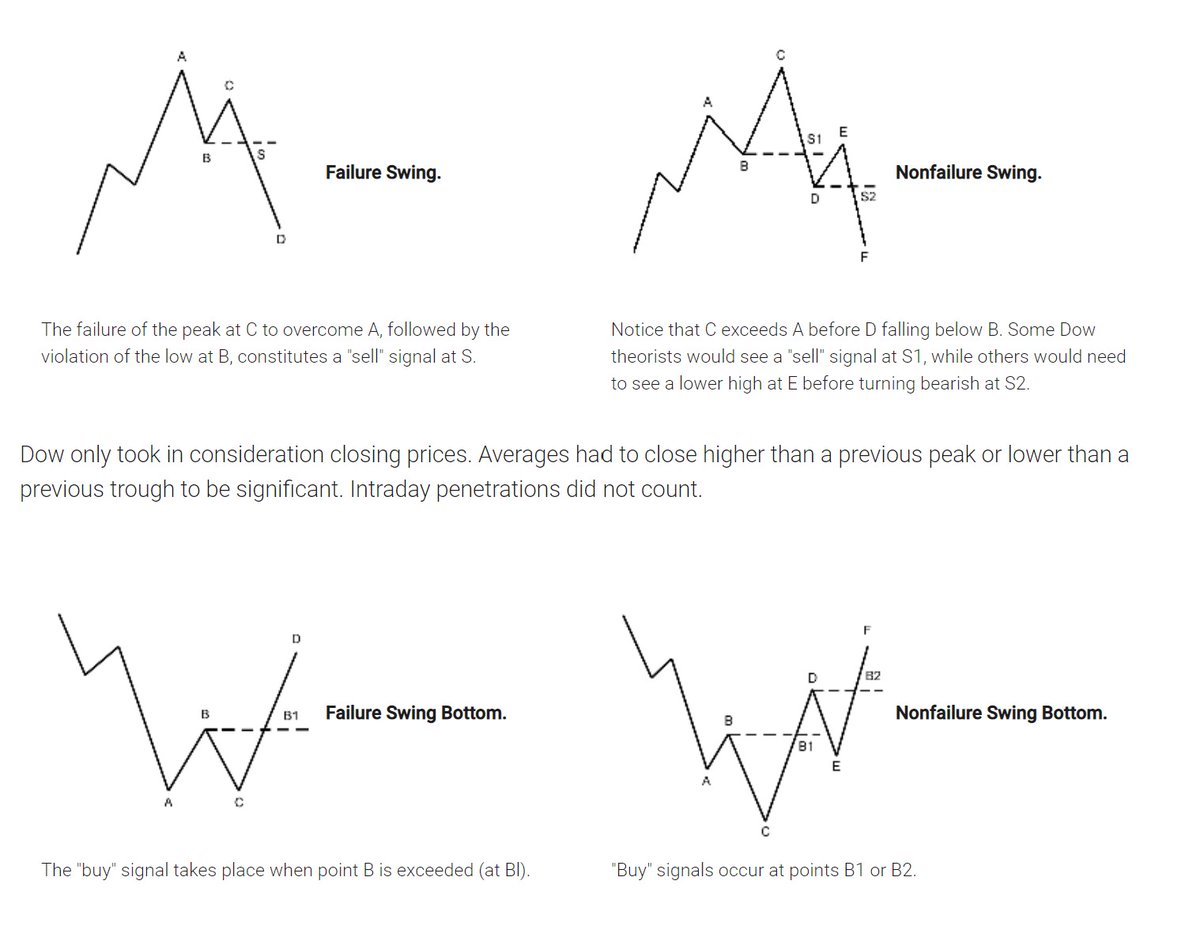
First the very basic : The Dow theory, Everybody must have basic understanding of it and must learn to observe High Highs, Higher Lows, Lower Highs and Lowers lows on charts and their
Even those who are more inclined towards fundamental side can also benefit from Dow theory, as it can hint start & end of Bull/Bear runs thereby indication entry and exits.
Next basic is Wyckoff's Theory. It tells how accumulation and distribution happens with regularity and how the market actually
Dow theory is old but
Here I will share what I believe are essentials for anybody who is interested in stock markets and the resources to learn them, its from my experience and by no means exhaustive..
First the very basic : The Dow theory, Everybody must have basic understanding of it and must learn to observe High Highs, Higher Lows, Lower Highs and Lowers lows on charts and their
Even those who are more inclined towards fundamental side can also benefit from Dow theory, as it can hint start & end of Bull/Bear runs thereby indication entry and exits.
Next basic is Wyckoff's Theory. It tells how accumulation and distribution happens with regularity and how the market actually
Dow theory is old but
Old is Gold....
— Professor (@DillikiBiili) January 23, 2020
this Bharti Airtel chart is a true copy of the Wyckoff Pattern propounded in 1931....... pic.twitter.com/tQ1PNebq7d