When costs are reduced, margins and profits increase.
Interpretation of Financial Statements - preliminary filters.
1. Looking for sustainable competitive advantage:
When looking for sustainable moat, you wanna see consistency - in earnings, in having low debt, in having growing earnings, low spending in capital expenditures, etc.
When costs are reduced, margins and profits increase.
Let's take a look at Apple:
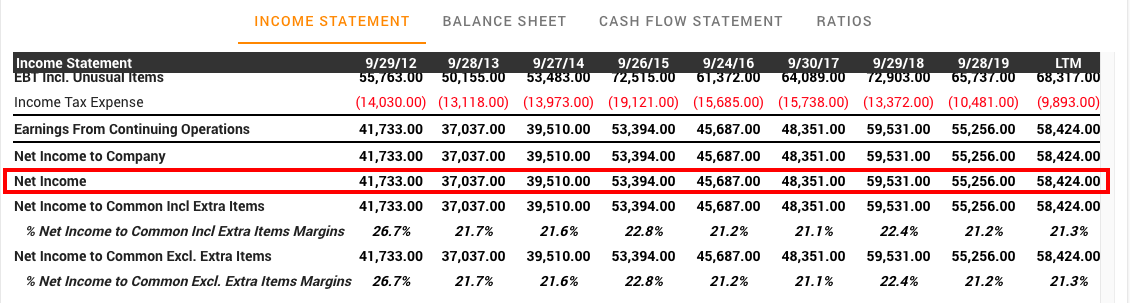
i) You want to see earnings grow at a steady pace. Take a look at the net income below.
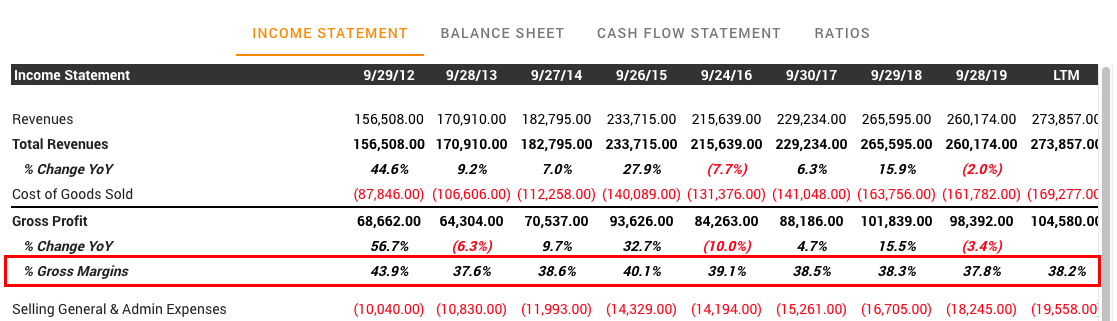
As a thumb rule, Warren Buffett wants to see a gross margin of around 40% or above.
Although not quite 40%, it's around that range with respect to Apple.
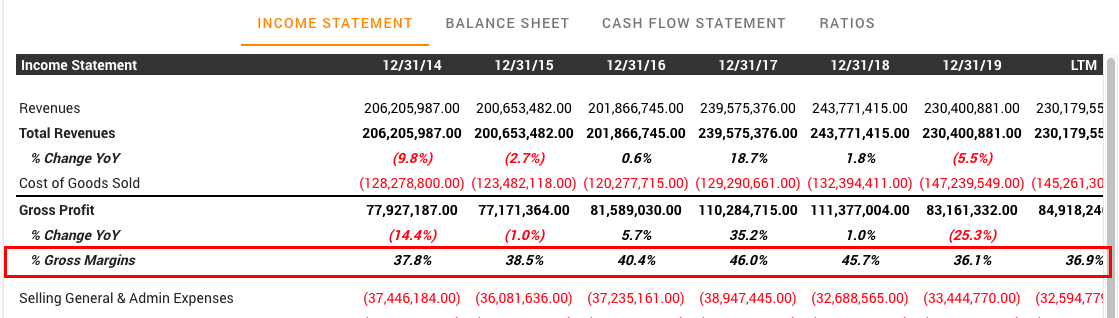
Samsung's gross margins are around similar range, highest being 45.7% in 2018, and Huawei had a gross margin of 38.6%.
Gross margin = (revenue - cost of goods sold) / revenue
Net margin = net income / revenue.
You want to see the company having higher net margin compared to their competitors.
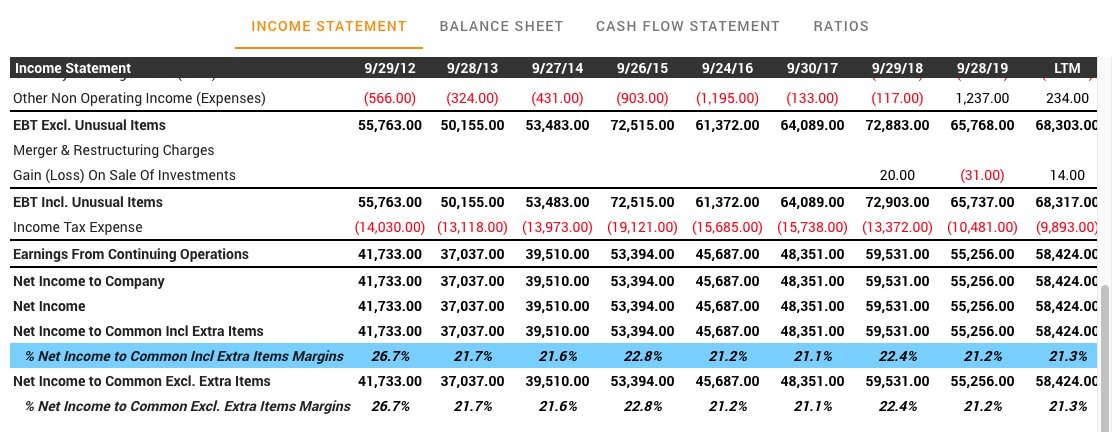
Typically, net margin above 20% is a very strong one, indicating that we are dealing with a smoothly run business.
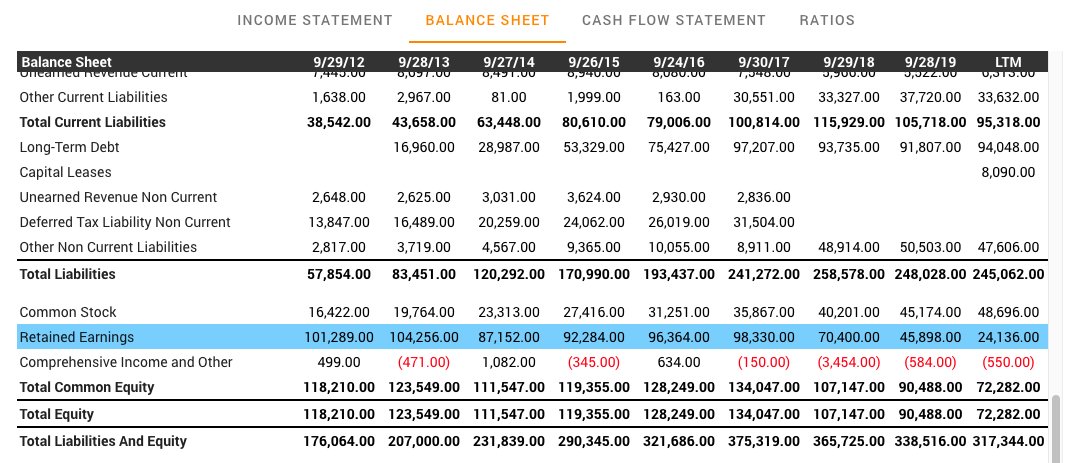
Look at the figure - "Retained Earnings".
Using retained earnings, you can find out if a company is reinvesting its income or not. A steady growth in this number means the business is profitable, and that it's identifying good investing opportunities.
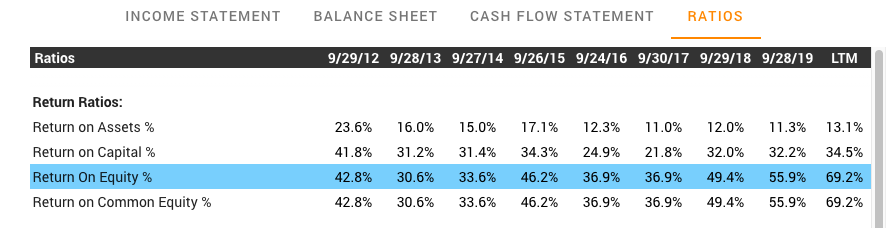
To measure how efficiently a company is using these retained earnings, Return on Equity (ROE) is used.
Apple looks quite strong in this aspect. It's partly an effect of distributing a lot of their earnings to shareholders. It also signifies the sustainable competitive moat.
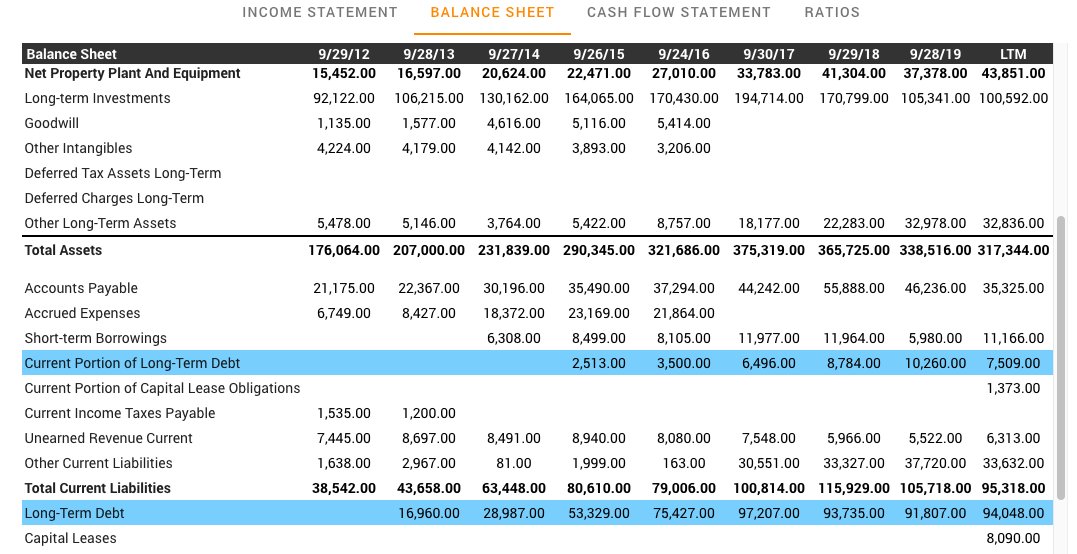
4) Exceptional businesses seldom require a lot of debt to expand (except maybe banks/NBFCs). Instead, they can just use the strong cashflow from the business.
This is where you see the actual in's and out's of money.
Look at "Capital Expenditures" on the cashflow statement.
This is the money being spent on properties, plant, and equipment.
Exceptions: One time payment to grow the business in some capex activity.

3 instances when you could consider selling the stock.
i) You need money for a better investments. This is more so applicable in a bear market, for you to switch from something great to something exceptional.
This may not always apply to all markets, all stocks. But with anything above 40PE, tread carefully and cautiously.
- Competitive advantage and scale
- Consistently high net income, return on equity
- Requires very little debt
- Retained earnings has steady growth
- Capital expenditures should be < 25%
- Sell a company if prices are crazy, or a better opportunity comes up.
https://t.co/nbKA5Bzpi6
https://t.co/MbmUKsE968
More from Shravan Venkataraman 🎡
** MEGA THREAD ON Cryptocurrencies/Blockchain**
I wanted to know the best resources to learn about cryptocurrencies and blockchain for someone with zero knowledge. I asked Twitter, and Twitter answered.
This thread is a compilation of the best resources I was recommended. 👇👇
Let's start with ** BOOKS **
The first thing you should do before you pick up any book:
Learn about Bitcoin & Ethereum by reading the respective whitepapers.
- [Bitcoin white paper](https://t.co/cErOaFn6QL) by Satoshi Nakamoto
- [Ethereum White paper] (https://t.co/0g5kYCGJGq) by Vitalik Buterin
Even if you are not tech savvy, you can get a good grasp about how blockchain functions from these papers.
1) *The Basics of Bitcoins and Blockchains: An Introduction to Cryptocurrencies and the Technology that Powers Them* by Antony Lewis
This book covers topics such as the history of Bitcoin, the Bitcoin blockchain, and Bitcoin buying, selling, and mining.
It also answers how payments are made and how transactions are kept secure.
Other cryptocurrencies and cryptocurrency pricing are examined, answering how one puts a value on cryptocurrencies and digital tokens.
I wanted to know the best resources to learn about cryptocurrencies and blockchain for someone with zero knowledge. I asked Twitter, and Twitter answered.
This thread is a compilation of the best resources I was recommended. 👇👇
Let's start with ** BOOKS **
The first thing you should do before you pick up any book:
Learn about Bitcoin & Ethereum by reading the respective whitepapers.
- [Bitcoin white paper](https://t.co/cErOaFn6QL) by Satoshi Nakamoto
- [Ethereum White paper] (https://t.co/0g5kYCGJGq) by Vitalik Buterin
Even if you are not tech savvy, you can get a good grasp about how blockchain functions from these papers.
1) *The Basics of Bitcoins and Blockchains: An Introduction to Cryptocurrencies and the Technology that Powers Them* by Antony Lewis
This book covers topics such as the history of Bitcoin, the Bitcoin blockchain, and Bitcoin buying, selling, and mining.
It also answers how payments are made and how transactions are kept secure.
Other cryptocurrencies and cryptocurrency pricing are examined, answering how one puts a value on cryptocurrencies and digital tokens.

More from Economy


1/ To add a little texture to @NickHanauer's thread, it's important to recognize that there's a good reason why orthodox economists (& economic cosplayers) so vehemently oppose a $15 min wage:
The min wage is a wedge that threatens to undermine all of orthodox economic theory.
2/ Orthodox economics is grounded in two fundamental models: a systems model that describes the market as a closed equilibrium system, and a behavioral model that describes humans as rational, self-interested utility-maximizers. The modern min wage debate undermines both models.
3/ The assertion that a min wage kills jobs is so central to orthodox economics that it is often used as the textbook example of the Supply/Demand curve. Raise the cost of labor and businesses will buy less of it. It's literally Econ 101!
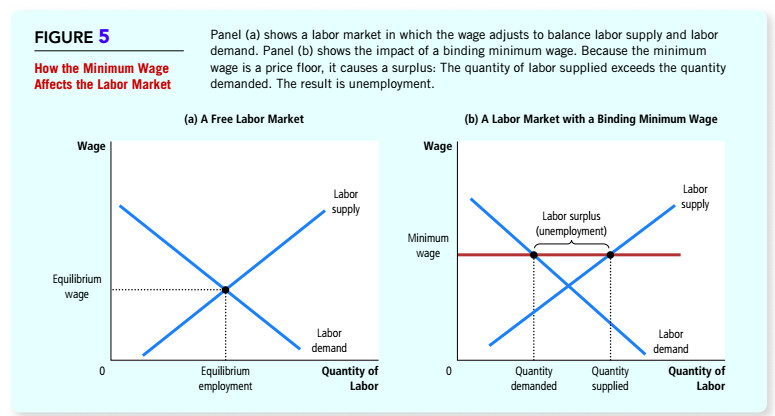
4/ Econ 101 insists that markets automatically set an efficient "equilibrium price" for labor & everything else. Mess with this price and bad things happen. Yet decades of empirical research has persuaded a majority of economists that this just isn't
5/ How can this be? Well, either the market is not a closed equilibrium system in which if you raise the price of labor employers automatically purchase less of it... OR the market is not automatically setting an efficient and fair equilibrium wage. Or maybe both. #FAIL
The min wage is a wedge that threatens to undermine all of orthodox economic theory.
1/4 Most people, especially academic economists, think that the controversy over the minimum wage is a contest over facts. It's not. It's a contest over power, status, and wealth. It is just like the contest over racial and gender justice.
— Nick Hanauer (@NickHanauer) January 17, 2021
2/ Orthodox economics is grounded in two fundamental models: a systems model that describes the market as a closed equilibrium system, and a behavioral model that describes humans as rational, self-interested utility-maximizers. The modern min wage debate undermines both models.
3/ The assertion that a min wage kills jobs is so central to orthodox economics that it is often used as the textbook example of the Supply/Demand curve. Raise the cost of labor and businesses will buy less of it. It's literally Econ 101!
4/ Econ 101 insists that markets automatically set an efficient "equilibrium price" for labor & everything else. Mess with this price and bad things happen. Yet decades of empirical research has persuaded a majority of economists that this just isn't
5/ How can this be? Well, either the market is not a closed equilibrium system in which if you raise the price of labor employers automatically purchase less of it... OR the market is not automatically setting an efficient and fair equilibrium wage. Or maybe both. #FAIL

The argument for deficits & debt raising interest rates in the US is not increased credit risk, it is that interest rates are a function of economic fundamentals, flows & policy. Deficits/debt change those.
I can't tell if I'm agreeing or disagreeing with @jc_econ.
Increasing government spending or reducing taxes increases demand (or reduces saving). This raises the price of loanable funds or the interest rate.
In a dynamic context, more demand means a stronger economy, the central bank raises interest rates sooner, and long rates rise.
(As an aside, we are not close to the United States needing to worry about credit risk and the risks are more overstated than understated in most other advanced economies too. But credit risk is not always & everywhere irrelevant, just look at the UK in 1976 or Canada in 1994.)
Interest rates have fallen over the last 20 yrs while debt has risen. This does not necessarily mean that debt rising causes interest rates to fall. It could also mean that other things have happened at he same time that pushed down interest rates more than debt pushed them up.
The suspects for these "other things" include slower productivity growth, slower popln growth, higher inequality, less investment, etc. All of which either increase the supply of saving or reduce the demand for investment, reducing the equilibrium interest rate.
I can't tell if I'm agreeing or disagreeing with @jc_econ.
There is no relationship b/w deficits & interest rates in the US & many other advanced economies. Centuries of dynamic institution building underpin our reserve currency status that allows rates to be a function of economic fundamentals, flows & policy not credit risk 1/3
— Dr. Julia Coronado (@jc_econ) January 26, 2021
Increasing government spending or reducing taxes increases demand (or reduces saving). This raises the price of loanable funds or the interest rate.
In a dynamic context, more demand means a stronger economy, the central bank raises interest rates sooner, and long rates rise.
(As an aside, we are not close to the United States needing to worry about credit risk and the risks are more overstated than understated in most other advanced economies too. But credit risk is not always & everywhere irrelevant, just look at the UK in 1976 or Canada in 1994.)
Interest rates have fallen over the last 20 yrs while debt has risen. This does not necessarily mean that debt rising causes interest rates to fall. It could also mean that other things have happened at he same time that pushed down interest rates more than debt pushed them up.
The suspects for these "other things" include slower productivity growth, slower popln growth, higher inequality, less investment, etc. All of which either increase the supply of saving or reduce the demand for investment, reducing the equilibrium interest rate.
You May Also Like


https://t.co/6cRR2B3jBE
Viruses and other pathogens are often studied as stand-alone entities, despite that, in nature, they mostly live in multispecies associations called biofilms—both externally and within the host.
https://t.co/FBfXhUrH5d

Microorganisms in biofilms are enclosed by an extracellular matrix that confers protection and improves survival. Previous studies have shown that viruses can secondarily colonize preexisting biofilms, and viral biofilms have also been described.

...we raise the perspective that CoVs can persistently infect bats due to their association with biofilm structures. This phenomenon potentially provides an optimal environment for nonpathogenic & well-adapted viruses to interact with the host, as well as for viral recombination.

Biofilms can also enhance virion viability in extracellular environments, such as on fomites and in aquatic sediments, allowing viral persistence and dissemination.

Viruses and other pathogens are often studied as stand-alone entities, despite that, in nature, they mostly live in multispecies associations called biofilms—both externally and within the host.
https://t.co/FBfXhUrH5d
Microorganisms in biofilms are enclosed by an extracellular matrix that confers protection and improves survival. Previous studies have shown that viruses can secondarily colonize preexisting biofilms, and viral biofilms have also been described.
...we raise the perspective that CoVs can persistently infect bats due to their association with biofilm structures. This phenomenon potentially provides an optimal environment for nonpathogenic & well-adapted viruses to interact with the host, as well as for viral recombination.
Biofilms can also enhance virion viability in extracellular environments, such as on fomites and in aquatic sediments, allowing viral persistence and dissemination.