OK, let's start talking about the House's 80 page brief on impeachment. It really is an incredibly well-done piece of work. There are some things I'd do differently and some pieces I didn't love, but overall, it's very very good.
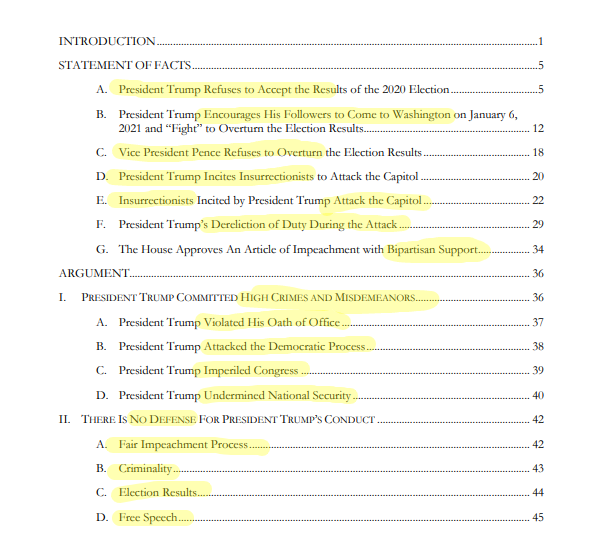
1) Why, on their own merits, Trump's conduct requires conviction
2) Why Trump's defenses don't fly
3) The Senate can convict Trump even though he's out of office
And 27 pages - again, a whole brief by itself - on "ex-President"
They're pretty confident that they can get whatever R-votes are gettable on the basics; after all, those Senators lived through the Capitol assault, they know what's what. But ...
More from Akiva Cohen
OK, #Squidigation fans, I think we need to talk about the new Wisconsin suit Donald Trump filed - personally - in Federal Court last night. The suit is (as usual) meritless. But it's meritless in new and disturbing ways. This thread will be
Not, I hope, Seth Abramson long. But will see.
I apologize in advance to my wife, who would very much prefer I be billing time (today's a light day, though) and to my assistant, to whom I owe some administrative stuff this will likely keep me from 😃
First, some background. Trump's suit essentially tries to Federalize the Wisconsin Supreme Court complaint his campaign filed, which we discussed here.
If you haven't already, go read that thread. I'm not going to be re-doing the same analysis, and I'm not going to be cross-linking to that discussion as we go. (Sorry, I like you guys, and I see this as public service, but there are limits)
Also, @5DollarFeminist has a good stand-alone thread analyzing the new Federal complaint - it's worth reading as well, though some of the analysis will overlap.
\U0001f6a8BREAKING: Trump files new federal court lawsuit in Wisconsin challenging the results of the election.https://t.co/LfKb2PUIkq
— Marc E. Elias (@marceelias) December 3, 2020
Not, I hope, Seth Abramson long. But will see.
I apologize in advance to my wife, who would very much prefer I be billing time (today's a light day, though) and to my assistant, to whom I owe some administrative stuff this will likely keep me from 😃
First, some background. Trump's suit essentially tries to Federalize the Wisconsin Supreme Court complaint his campaign filed, which we discussed here.
OK, #squidigation fans. This is a new Wisconsin case not filed by the Krake[n/d] team of Powell and Wood and NOT focusing on wild conspiracy theories. It's a competent and professional filing that raises things that would be real issues ... if you don't understand why they aren't https://t.co/ETvUiWV5du
— Akiva Cohen (@AkivaMCohen) December 1, 2020
If you haven't already, go read that thread. I'm not going to be re-doing the same analysis, and I'm not going to be cross-linking to that discussion as we go. (Sorry, I like you guys, and I see this as public service, but there are limits)
Also, @5DollarFeminist has a good stand-alone thread analyzing the new Federal complaint - it's worth reading as well, though some of the analysis will overlap.
Every one of these Trump election suits is the same gobbledygook garbage barge:
— Liz Dye (@5DollarFeminist) December 3, 2020
FRAUD!
It coulda happened.
Well, no, we can't prove it.
But just to be safe, best let the gerrymandered legislature give us all the electoral votes!https://t.co/Z926668H05 pic.twitter.com/xGZsJKIO7Y