1/ First, a few definitions.
The Lindy Effect is a theory that the future life expectancy of specific non-perishable items, like a technology or idea, is proportional to their age.
Put simply, the longer it has already lasted, the higher the likelihood it will continue to last.
2/ The term "Lindy effect" is a reference to Lindy's, a New York deli frequented by comedians in the 1960s.
While author Albert Goldman used the term "Lindy's Law" in a 1964 article, it was mathematician Benoit Mandlebrot who moved the dialogue towards the current definition.
3/ In his book, entitled The Fractal Geometry of Nature, Mandlebrot commented that the more stage appearances a Lindy's comedian made, the more future appearances he could be predicted to make.
The longer he lasted, the longer he would continue to last.
4/
@nntaleb built upon Mandelbrot's work, formally coining the term "Lindy Effect" in his book, Antifragile.
He noted the Lindy Effect with books - the longer a book has been in print, the longer it is likely to survive.
With no natural upper bound, power laws come into play.
5/ "If a book has been in print for 40 years, I can expect it to be in print for another 40...if it survives another decade, then it will be expected to be in print another 50 years. Every year that passes without extinction doubles the additional life expectancy." -
@nntaleb
6/ So who cares?
What are some useful applications of the Lindy Effect in helping you understand the world?
Given its recent rise and accelerating mainstream adoption, let's look at Bitcoin and how the Lindy Effect may apply.
7/ First off, it is a technology - a durable, non-perishable item. This checks the first box.
The Bitcoin Genesis Block was created in January 2009 and it has continued to survive in the nearly 12 years since that date.
It has withstood technological and societal attacks.
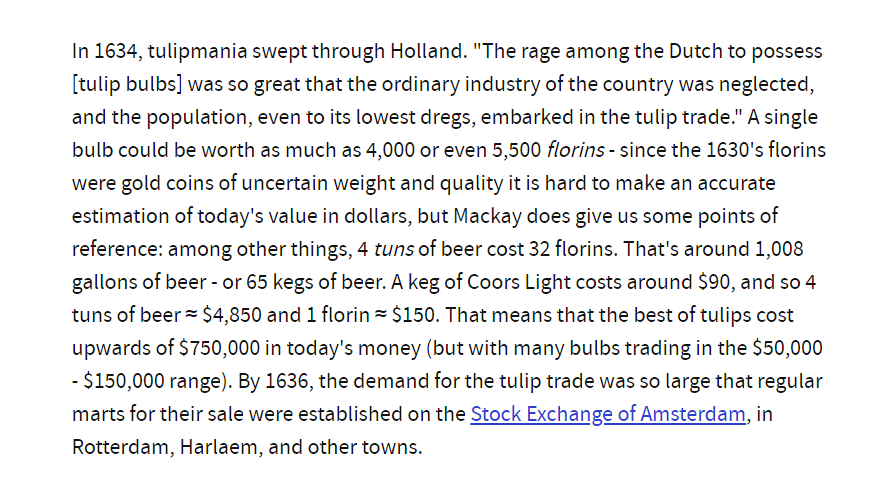
8/ From technology-based attacks to societal attacks (please read my thread below before you compare it to tulips!), it has shown its robustness.
The Lindy effect says the fact that Bitcoin has survived this long makes it likely to survive much longer.
https://t.co/2MRgHzP9Dy
9/ So as you sit down for Thanksgiving dinner, prepared for the inevitable questions about Bitcoin and its long-term viability, remember the Lindy Effect!
That was Lindy Effect 101. I hope you found it useful.
And special thank you to my friend
@GavinBaker for the thread idea!
10/ For more interesting insights on the topic, I highly recommend reading
@nntaleb's Antifragile: Things That Gain from Disorder. It is simply foundational!
https://t.co/R85Kan6pWU
11/ And for more education threads on business, finance, money, and economics, check out my meta-thread below. Turn on post notifications so you never miss a thread!
https://t.co/JyqunaYxDe