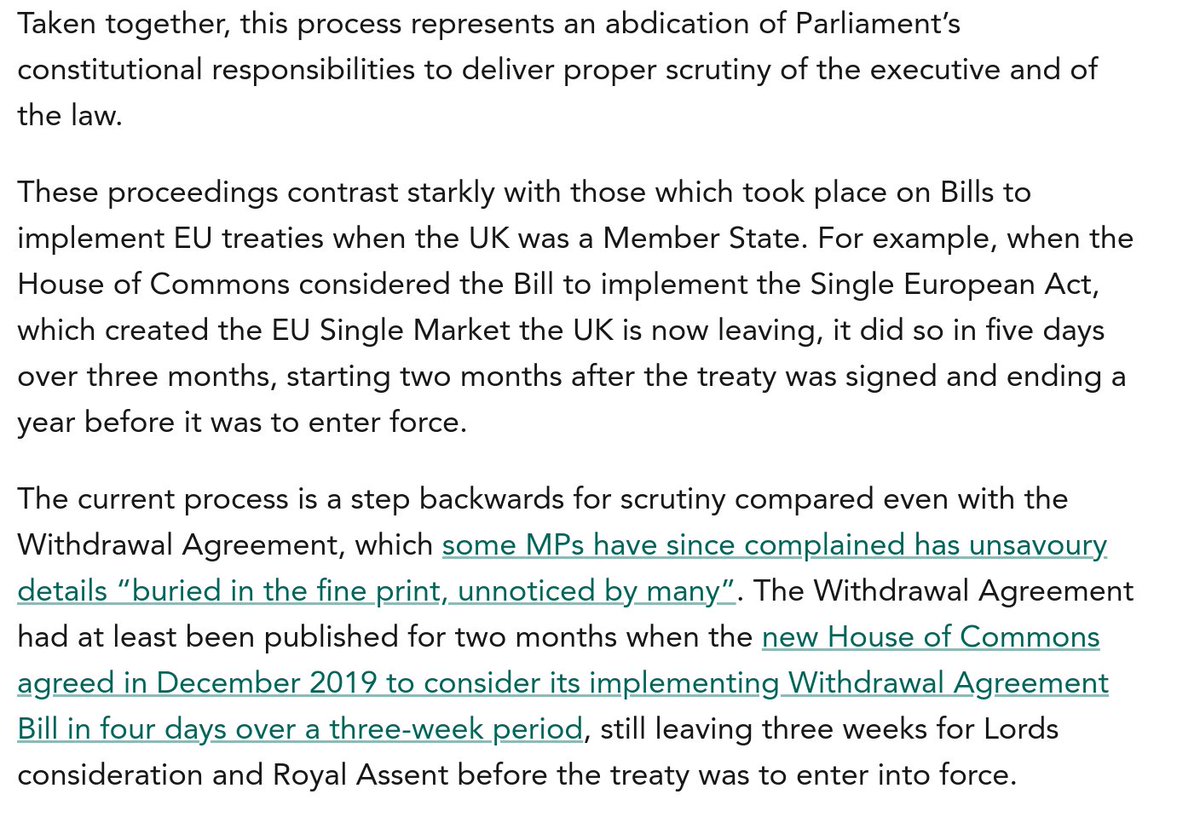
1. #Belfast #IrishSeaBorder There is no doubt that Brexit & the accompanying Irish Sea Border has destabilised the Union. Whilst the constitutional status of Northern Ireland has not changed, the fact of N.I remaining in the single market of the EU confirms it is”a place apart”.
More from Brexit
Been waiting for 👇 🚨
Important story on what a “tariff-free” deal means in practice and why it’s not enough for two economies as closely integrated.
Tariffs are removed on goods that meet rules of origin. This is a complex and nuanced area of customs.
/1
Important to remember that trade deals (FTAs) weren't designed with such a high degree of economic integration in mind.
So some of the standard RoO provisions will seem incredibly restrictive under the UK-EU deal.
/2
Minimal operations or insufficient processing is a standard part of an FTA. Most, if not all FTAs, include a provision on minimal processing – processing not considered sufficient to confer originating status even if rules of origin have been met.
/3
It is standard procedure not to apply cumulation when goods have only been subject to minimal processing.
To be able to cumulate origin and consider the final product of UK origin, the processing carried out in the UK needs to exceed minimal operations.
/4
The level of integration between the UK and the EU means that this will have significant consequences for a number of industries.
For example, in supply chains where goods are brought into the UK from the EU and reassembled, sorted or repackaged and re-exported to ROI.
/5
Important story on what a “tariff-free” deal means in practice and why it’s not enough for two economies as closely integrated.
Tariffs are removed on goods that meet rules of origin. This is a complex and nuanced area of customs.
/1
\U0001f6a8\U0001f6a8\U0001f6a8\U0001f1ea\U0001f1fa\U0001f1ec\U0001f1e7\U0001f69b\U0001f692\U0001f1ea\U0001f1fa\U0001f1ec\U0001f1e7\U0001f6a8\U0001f6a8\U0001f6a8 serious #brexit story alert - companies now starting to see penny drop on what rules of origin does to supply chains (food for example) but Brussels seems deaf to both EU & U.K. pleading. A bellwether? \U0001f62c Stay with me. 1/
— Peter Foster (@pmdfoster) January 6, 2021
https://t.co/HoDSDxhKaL
Important to remember that trade deals (FTAs) weren't designed with such a high degree of economic integration in mind.
So some of the standard RoO provisions will seem incredibly restrictive under the UK-EU deal.
/2
Minimal operations or insufficient processing is a standard part of an FTA. Most, if not all FTAs, include a provision on minimal processing – processing not considered sufficient to confer originating status even if rules of origin have been met.
/3
It is standard procedure not to apply cumulation when goods have only been subject to minimal processing.
To be able to cumulate origin and consider the final product of UK origin, the processing carried out in the UK needs to exceed minimal operations.
/4
The level of integration between the UK and the EU means that this will have significant consequences for a number of industries.
For example, in supply chains where goods are brought into the UK from the EU and reassembled, sorted or repackaged and re-exported to ROI.
/5
You May Also Like
A brief analysis and comparison of the CSS for Twitter's PWA vs Twitter's legacy desktop website. The difference is dramatic and I'll touch on some reasons why.
Legacy site *downloads* ~630 KB CSS per theme and writing direction.
6,769 rules
9,252 selectors
16.7k declarations
3,370 unique declarations
44 media queries
36 unique colors
50 unique background colors
46 unique font sizes
39 unique z-indices
https://t.co/qyl4Bt1i5x
PWA *incrementally generates* ~30 KB CSS that handles all themes and writing directions.
735 rules
740 selectors
757 declarations
730 unique declarations
0 media queries
11 unique colors
32 unique background colors
15 unique font sizes
7 unique z-indices
https://t.co/w7oNG5KUkJ
The legacy site's CSS is what happens when hundreds of people directly write CSS over many years. Specificity wars, redundancy, a house of cards that can't be fixed. The result is extremely inefficient and error-prone styling that punishes users and developers.
The PWA's CSS is generated on-demand by a JS framework that manages styles and outputs "atomic CSS". The framework can enforce strict constraints and perform optimisations, which is why the CSS is so much smaller and safer. Style conflicts and unbounded CSS growth are avoided.
Legacy site *downloads* ~630 KB CSS per theme and writing direction.
6,769 rules
9,252 selectors
16.7k declarations
3,370 unique declarations
44 media queries
36 unique colors
50 unique background colors
46 unique font sizes
39 unique z-indices
https://t.co/qyl4Bt1i5x
PWA *incrementally generates* ~30 KB CSS that handles all themes and writing directions.
735 rules
740 selectors
757 declarations
730 unique declarations
0 media queries
11 unique colors
32 unique background colors
15 unique font sizes
7 unique z-indices
https://t.co/w7oNG5KUkJ
The legacy site's CSS is what happens when hundreds of people directly write CSS over many years. Specificity wars, redundancy, a house of cards that can't be fixed. The result is extremely inefficient and error-prone styling that punishes users and developers.
The PWA's CSS is generated on-demand by a JS framework that manages styles and outputs "atomic CSS". The framework can enforce strict constraints and perform optimisations, which is why the CSS is so much smaller and safer. Style conflicts and unbounded CSS growth are avoided.