Just bringing together my various bits and pieces on the UK-EU. The first reactions - a significant agreement...
The fracturing of UK politics into the comic book version of heroes and villains, and the real one of trade-offs and choices. But the first is more fun, and the PM plays it well. The second one is dull by comparison.
— David Henig (@DavidHenigUK) December 27, 2020
More from David Henig
We need to talk about UK politics. More specifically we need to talk about the absence of opposition to a no-deal Brexit risking Scottish independence, Northern Irish peace, the end of the mass market car industry, more expensive food, and damaged relations with US and EU 1/n
Project fear and the red wall. The first meaning that every serious threat, such as that of Nissan that their plant will be unsustainable, is dismissed with little discussion. The red wall, apparently so angry with Labour about the EU they are afraid to have a position. 2/
Because 'sovereignty' apparently. But a particularly nefarious form of sovereignty in which the normal kind of things you discuss in a Free Trade Agreement - shared rules, access to waters - become when discussed with the EU unacceptable infringements and threats. 3/
You note in the UK we aren't having a discussion on what level playing field rules or access to fishing waters might be acceptable. Or normal. Or even what we might want, like shared increased commitments on climate change. No, all rumours. Evil EU. Worse French. 4/
Those who follow closely see incredible briefings in the papers, like today claiming the EU demand for raising minimum shared standards was only raised on Thursday, treated as fact. This was known months ago. But the media too often just reports the spin as fact. 5/
UK cabinet to back Johnson over no-deal Brexit - The Times https://t.co/uCuOTsNdJL pic.twitter.com/88x5Tw2g53
— Reuters (@Reuters) December 6, 2020
Project fear and the red wall. The first meaning that every serious threat, such as that of Nissan that their plant will be unsustainable, is dismissed with little discussion. The red wall, apparently so angry with Labour about the EU they are afraid to have a position. 2/
Because 'sovereignty' apparently. But a particularly nefarious form of sovereignty in which the normal kind of things you discuss in a Free Trade Agreement - shared rules, access to waters - become when discussed with the EU unacceptable infringements and threats. 3/
You note in the UK we aren't having a discussion on what level playing field rules or access to fishing waters might be acceptable. Or normal. Or even what we might want, like shared increased commitments on climate change. No, all rumours. Evil EU. Worse French. 4/
Those who follow closely see incredible briefings in the papers, like today claiming the EU demand for raising minimum shared standards was only raised on Thursday, treated as fact. This was known months ago. But the media too often just reports the spin as fact. 5/
Not the easiest to follow, but for those interested in the big picture of trade relations between US, EU and China this exchange between @alanbeattie and @IanaDreyer is an essential read. Real debate on key issues, and good points on both sides.
Also reading this from @gideonrachman on EU-China. My view (cynically?) - that EU-China is a deal that makes a lot of sense given a probably unresolvable trade policy superpower triangle with the US, and best for the EU to move while China will.
The US and EU roughly agree on China that it should do some things differently, but not really the details of what those are. Meanwhile the EU and US have long standing trade policy differences, which neither (or their key stakeholders) prioritise resolving.
For the EU, the China deal has sent a message to the new US administration, you can't just tell us what to do. And delivered some (probably marginal in reality) benefits to business. For China, this is the 3rd deal with EU or US in 12 months. Pretty clear strategy there.
The key assumption that lies at the heart of too much writing on EU-US relations is that the two should cooperate on trade. After 25 years of largely failing to do so, I'd suggest we might want to question that a bit more deeply.
V good points but overall I stick with the conclusion that this is a v risky deal.
— Alan Beattie (@alanbeattie) January 5, 2021
1. It\u2019s overstating it to say that COM now has final say over investment. FDI screening remains a MS competency. COM has had to take a v secondary supporting role over Huawei and 5G.
1/n https://t.co/RVg2jnoFgK
Also reading this from @gideonrachman on EU-China. My view (cynically?) - that EU-China is a deal that makes a lot of sense given a probably unresolvable trade policy superpower triangle with the US, and best for the EU to move while China will.
The US and EU roughly agree on China that it should do some things differently, but not really the details of what those are. Meanwhile the EU and US have long standing trade policy differences, which neither (or their key stakeholders) prioritise resolving.
For the EU, the China deal has sent a message to the new US administration, you can't just tell us what to do. And delivered some (probably marginal in reality) benefits to business. For China, this is the 3rd deal with EU or US in 12 months. Pretty clear strategy there.
The key assumption that lies at the heart of too much writing on EU-US relations is that the two should cooperate on trade. After 25 years of largely failing to do so, I'd suggest we might want to question that a bit more deeply.
More from Brexit


Another head-banging day for the £112bn UK creative sector that is starting to ingest how difficult #Brexit is going to make their lives - and how little the government is really willing to do to fix the lack of a 'mobility' chapter in the EU-UK trade deal. Quick update.../1
First Equity @EquityUK put out a letter to @BorisJohnson warning that #brexit was a "towering hurdle" (you'd want Brian Blessed reading that part) to UK actors plying their trade in EU - a double whammy with #COVID19 /2
https://t.co/mXjTAISqZk
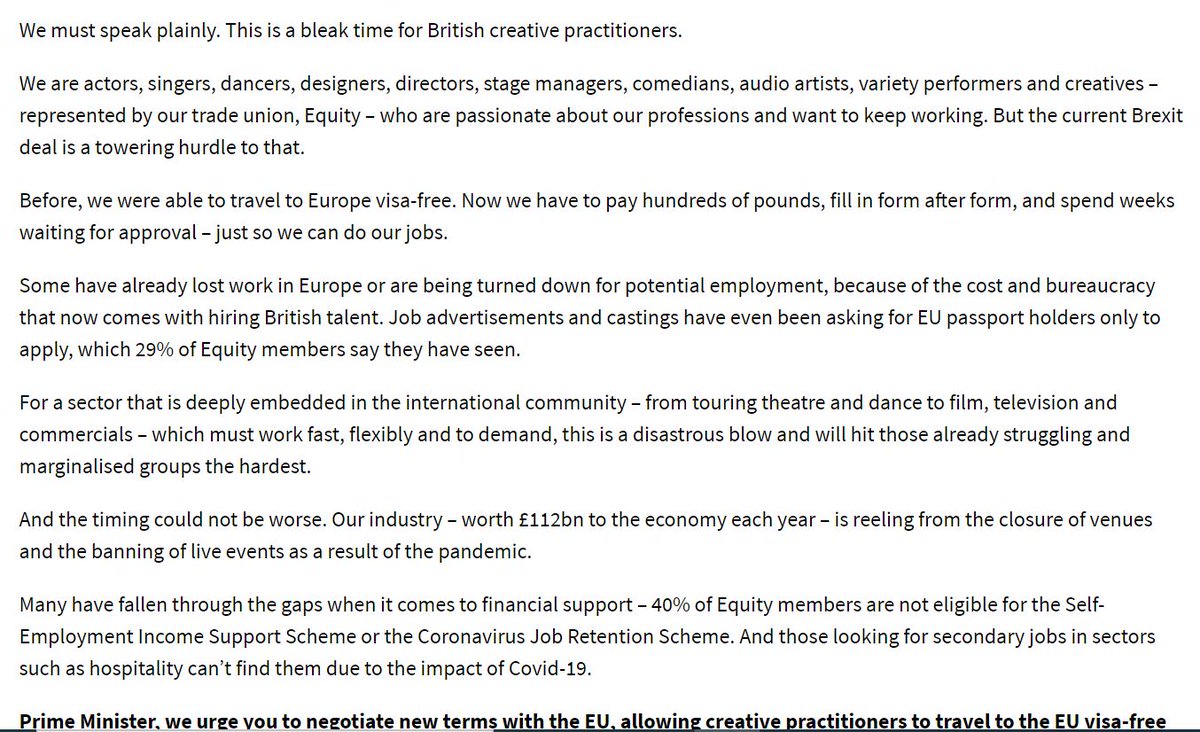
@BorisJohnson One third of Equity members say they've seen job ads asking for EU passport holders: "Before, we were able to travel to Europe visa-free. Now we have to pay hundreds of pounds, fill in form after form, and spend weeks waiting for approval" /3
@BorisJohnson Worth recalling that all this goes back to the UK desire NOT to have a 'mobility' provision within the TCA - all part of 'ending Free Movement' and the professional services folk - including musicians, actors, fashion models etc -are all victim of
@BorisJohnson What's the government going to do about all this? Good question, which brings us to todays @CommonsDCMS hearing in which the Culture Minister Caroline Dinenage @cj_dinenage frankly pin-balled around the issues /5
First Equity @EquityUK put out a letter to @BorisJohnson warning that #brexit was a "towering hurdle" (you'd want Brian Blessed reading that part) to UK actors plying their trade in EU - a double whammy with #COVID19 /2
https://t.co/mXjTAISqZk
@BorisJohnson One third of Equity members say they've seen job ads asking for EU passport holders: "Before, we were able to travel to Europe visa-free. Now we have to pay hundreds of pounds, fill in form after form, and spend weeks waiting for approval" /3
@BorisJohnson Worth recalling that all this goes back to the UK desire NOT to have a 'mobility' provision within the TCA - all part of 'ending Free Movement' and the professional services folk - including musicians, actors, fashion models etc -are all victim of
@BorisJohnson What's the government going to do about all this? Good question, which brings us to todays @CommonsDCMS hearing in which the Culture Minister Caroline Dinenage @cj_dinenage frankly pin-balled around the issues /5