Marathon Asset produced several iconic investors such as Nick Sleep and Jeremy Hosking.

Their letters from 2002 to 2015 provided a treasure trove of insights into their investment frameworks and how they look at the capital cycle.

Here are my main takeaways:

1/ Periods of high profitability leads to reckless investments.

When profits are high:

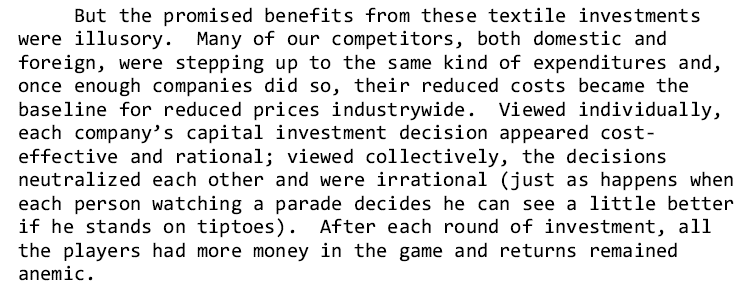
-Boost CAPEX with little regard for ROIC
-Competitors will follow suit to avoid losing market share
-CEO's incentives aren't aligned with shareholders

It's a race to the bottom.
2/ The capital cycle will swing down when investments are taken too far.

Forecasts that were reasonable will now look overly optimistic.

Profits collapse, management teams are changed, CAPEX is cut, and consolidation begins.

This will pave way for a recovery of profits.
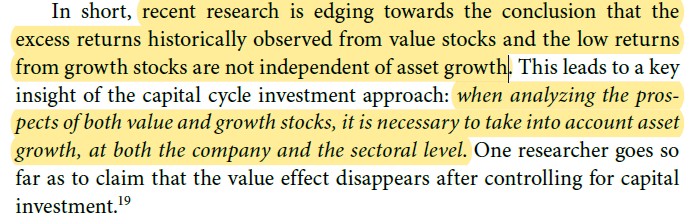
3/ Asset growth matters

Consider both asset growth at the company and industry level.

Avoid industries where assets are growing rapidly.
4/ We tend to extrapolate

When overdone, investments that appear logical at first can become disastrous.

We have a tendency to forecast linearly when many things are cyclical.

Examples: trade cycles, credit cycles, etc
5/ Overconfidence

In making forecasts, investors and corporate managers are prone to be overconfident.

The overinvestment behavior is reinforced when many players in the industry do the same.
6/ Focus on supply when making forecasts

Supply is far less uncertain than demand.

Since most analysts focus on demand, stock markets rarely price in supply shocks.
7/ Six tenets of capital cycle analysis
8/ Hunting for growth & value

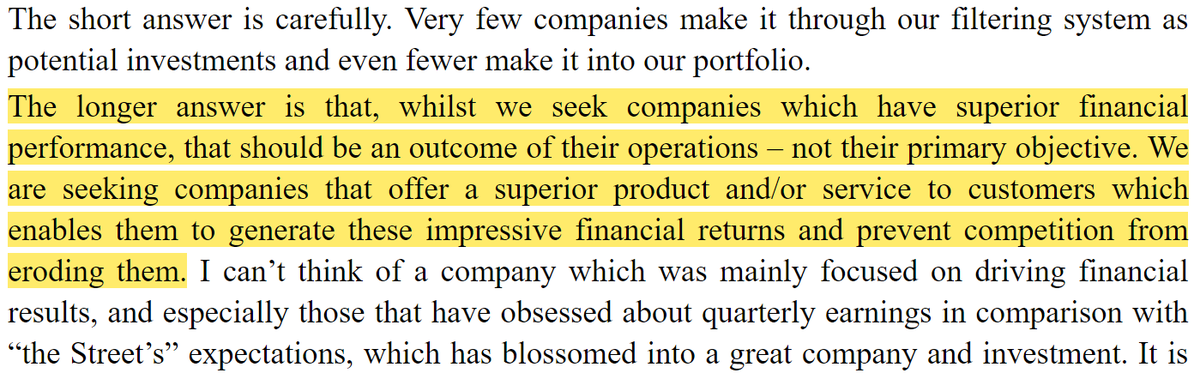
When seeking growth, they look for businesses whose returns are more sustainable than what the market expects.

When seeking value, they look for companies whose improvement potential is generally underestimated.
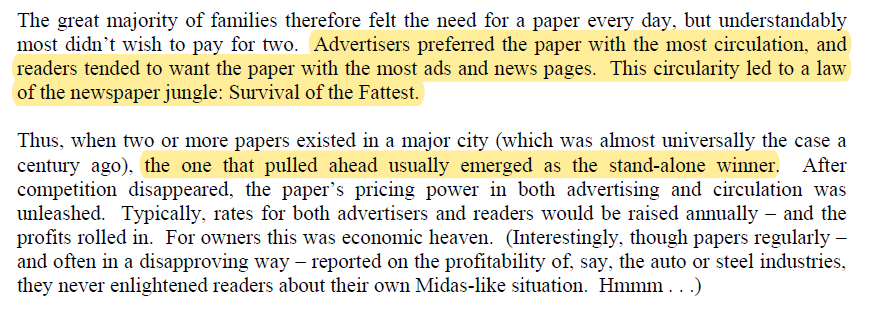
9/ Primary driver of value is a favorable supply side.

In fact, a strong demand may destroy value as it triggers the industry to invest excessively.
10/ Look at where capital has withdrawn

When competition exits, it is when profitability and valuation start to rise.
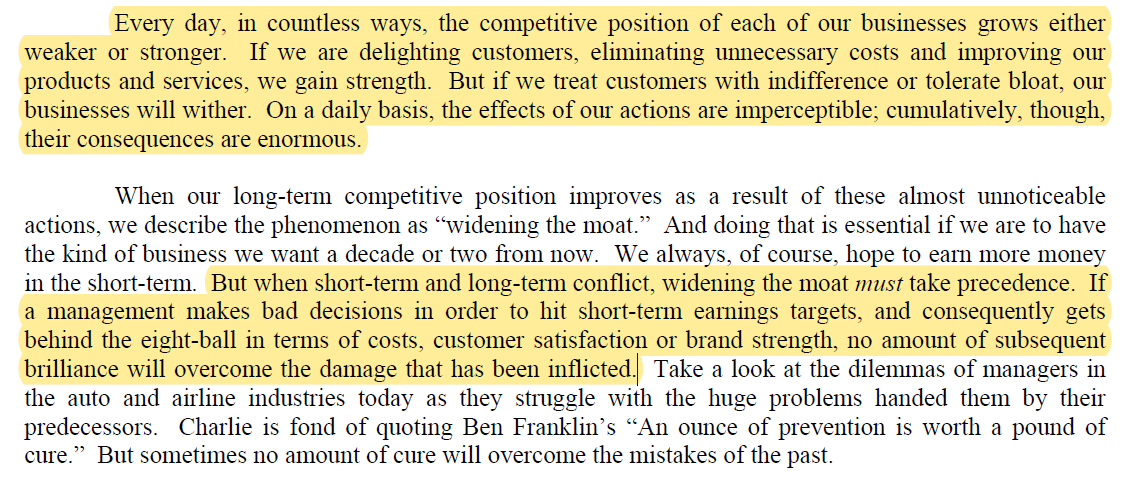
11/ Companies with pricing power generate durable returns

It usually comes from:
-Oligopolistic market structure
- "Intrinsic" pricing power embedded in the product.

I.e. Branding of consumer products or mission-critical products.
If you like this, follow me here @steadycompound

I write about investment concepts, business breakdowns and growth philosophies.
If you have enjoyed this thread, you're gonna love my newsletter where I curate 3 ideas on investing and growth philosophies.

Every week.

https://t.co/96pjE7aGBm

More from Thomas Chua

Having a finance degree did not make me a better investor.

Rather, I learned 10x more about investing from Twitter University.

🧵 Here are 5 threads from world-class Fintwitters.

What you learn: Build an investing checklist.

From: @BrianFeroldi, writer at Motley


What you learn: Read 10Ks like a Hedge Fund

From: @FabiusMercurius


What you learn: Perform a DCF analysis.

From: @10kdiver


What you learn: When to sell your stocks

From: @borrowed_ideas, founder at

More from Books

You May Also Like

Department List of UCAS-China PROFESSORs for ANSO, CSC and UCAS (fully or partial) Scholarship Acceptance
1) UCAS School of physical sciences Professor
https://t.co/9X8OheIvRw
2) UCAS School of mathematical sciences Professor

3) UCAS School of nuclear sciences and technology
https://t.co/nQH8JnewcJ
4) UCAS School of astronomy and space sciences
https://t.co/7Ikc6CuKHZ
5) UCAS School of engineering

6) Geotechnical Engineering Teaching and Research Office
https://t.co/jBCJW7UKlQ
7) Multi-scale Mechanics Teaching and Research Section
https://t.co/eqfQnX1LEQ
😎 Microgravity Science Teaching and Research

9) High temperature gas dynamics teaching and research section
https://t.co/tVIdKgTPl3
10) Department of Biomechanics and Medical Engineering
https://t.co/ubW4xhZY2R
11) Ocean Engineering Teaching and Research

12) Department of Dynamics and Advanced Manufacturing
https://t.co/42BKXEugGv
13) Refrigeration and Cryogenic Engineering Teaching and Research Office
https://t.co/pZdUXFTvw3
14) Power Machinery and Engineering Teaching and Research
THE MEANING, SIGNIFICANCE AND HISTORY OF SWASTIK

The Swastik is a geometrical figure and an ancient religious icon. Swastik has been Sanatan Dharma’s symbol of auspiciousness – mangalya since time immemorial.


The name swastika comes from Sanskrit (Devanagari: स्वस्तिक, pronounced: swastik) &denotes “conducive to wellbeing or auspicious”.
The word Swastik has a definite etymological origin in Sanskrit. It is derived from the roots su – meaning “well or auspicious” & as meaning “being”.


"सु अस्ति येन तत स्वस्तिकं"
Swastik is de symbol through which everything auspicios occurs

Scholars believe word’s origin in Vedas,known as Swasti mantra;

"🕉स्वस्ति ना इन्द्रो वृधश्रवाहा
स्वस्ति ना पूषा विश्ववेदाहा
स्वस्तिनास्तरक्ष्यो अरिश्तनेमिही
स्वस्तिनो बृहस्पतिर्दधातु"


It translates to," O famed Indra, redeem us. O Pusha, the beholder of all knowledge, redeem us. Redeem us O Garudji, of limitless speed and O Bruhaspati, redeem us".

SWASTIK’s COSMIC ORIGIN

The Swastika represents the living creation in the whole Cosmos.


Hindu astronomers divide the ecliptic circle of cosmos in 27 divisions called
https://t.co/sLeuV1R2eQ this manner a cross forms in 4 directions in the celestial sky. At centre of this cross is Dhruva(Polestar). In a line from Dhruva, the stars known as Saptarishi can be observed.