A more detailed explanation of the whole

"A double-spend broke Bitcoin" FUD that was circulated by an irresponsible publication.

1/

There was a chain re-organization in the Bitcoin blockchain. This is a common occurrence that is part of Bitcoin's normal operation. It is a result of decentralized consensus under Proof-of-Work. All PoW chains do this.

2/
Two blocks were mined almost simultaneously, competing for the same height, meaning that they had the same parent block and were trying to extend the chain of the same block

3/
Only one can ever succeed in the long run. It is possible that different nodes and miners see one or the other block first and assume it is the winner. This is also normal in a decentralized consensus algorithm

4/
Eventually, within an average of 10 minutes another block is mined. This new block has as its parent *one* of the two competing blocks. Which one? Whichever one the miner saw first and assumed to be the winner.

The new block extends the chain, resolving the issue.

5/
Of the two originally competing blocks, one is now a parent and the other is the last descendant of a shorter chain. The chain with the greatest cumulative difficulty is selected by all. This "orphans" any descendants from the other chain because it is discarded.

6/
Again, all of this is normal. A 1-block reorganization happens every couple of weeks on average as a consequence of decentralized PoW.

A 2-block reorganization happens less often, maybe a few times a year

A 3-block reorg is extremely rare. I don't think we've ever seen one

7/
What happens to any transactions in the discarded block? If they are also in the winning block then all is well. If they are not in the winning block, each node puts them back into its mempool as "unconfirmed" and they wait for another opportunity

8/
During a re-organization, there is a chance for someone to attempt a "double spend". This is not a double spend from the perspective of the blockchain as a whole. Only one spend survives, therefore no double spends happen. That's the whole point of PoW consensus.

9/
But from the perspective of the recipient of a payment, they may see a transaction that appears to have 1 confirmation (it is in a block), then disappears when that block is discarded.

10/
Very rarely, the sender will sneak a *different* transaction in the competing/winning block. Let's say this is a payment for a lesser amount (more change back), or to a different address.

11/
Because the original transaction is gone (discarded block), the new transaction (winning block) is the only "real" transaction. The blockchain has prevented a double spend by discarding one and only recording the other.

12/
From the perspective of the recipient, they thought they were "paid" after 1 block, then they... weren't. This is why "confirmations" provide /probabilistic/ immutability. The chance of a reorg drops with each subsequent confirmation

13/
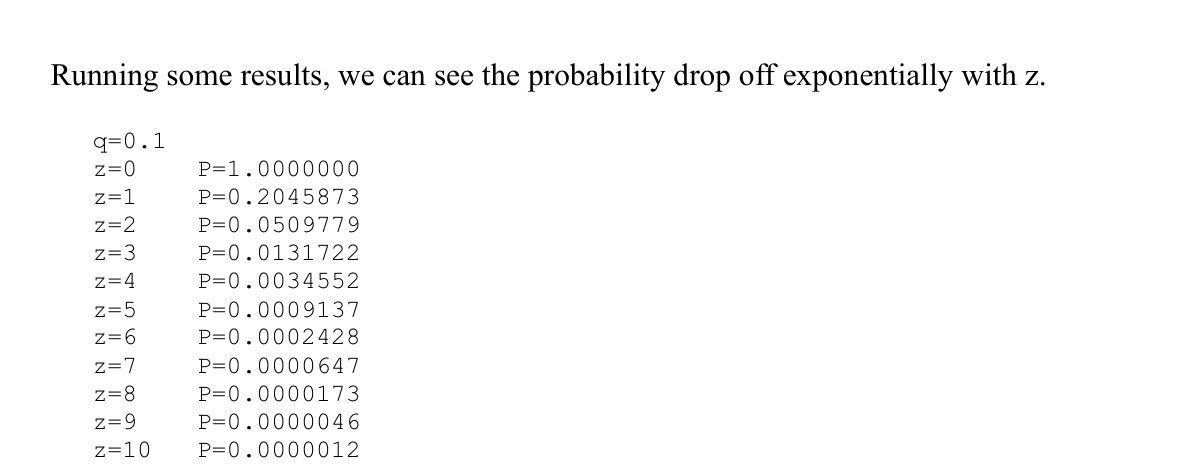
This is described in the Satoshi whitepaper on page 8. In fact, it's the only math equation in the paper and it describes the declining probability of a re-org, showing why "6 confirmations", though arbitrarily chosen is a good basis to consider a transaction finalized

14/
Here's page 8. As you can see the chance of a block getting discarded from a reorg declines /exponentially/ as more blocks are added to the chain. Finality is based on probability.

15/
So when do you consider a transaction finalized and when is it safe to give your customer the TV or the fiat or whatever value you are exchanging? It depends on the amount!

I waited 3 confirmations after selling my car for $11,000 USD (IIRC). Was enough for me.

16/
It also depends on the risk of the buyer going away. I'd sell a house on 0-conf, *because I know where they live!*. They can't run away with it. Some things are more dangerous: I'd wait 6 confs to exchange for cryptocurrency, because once I give it I can't get it back.

17/
During this most recent re-org, a transaction of $22 was in both competing blocks as two competing transactions. We don't know why. We don't know who. But there's nothing "impossible" about this. It is part of the protocol

18/
Now, for $22 many would accept 1 confirmation. Worst case, you're out $22 of something you gave in return that was delivered instantly and irreversibly. Not a big deal.

19/
Many credit card vendors don't take a signature for amounts under $25 for the same reason: while it can be disputed without a signature, it's not worth the extra time and delay to get one for such an amount. Same risk model here.

20/
In fact, we do not know that the recipient of that payment lost money. They may have been waiting for 2 confirmations and not delivered the other part of the value. So in that case, they lost nothing - they consider this "unpaid" because it didn't get 2+ confirmations

21/
Someone article quoted the lie "it could've been $22 million". Well, no, it couldn't. If you accept a $22m payment on bitcoin, I would assume you understand how Bitcoin has worked since 2008, exactly as specified in the paper. You don't "deliver" on that payment after 1 conf

22/
Several other incorrect statements are also made in that and other articles about RBF and Segwit. Here's the truth: this is a normal function of any PoW blockchain. A re-org with two different versions of a transaction can occur in every other PoW chain.

23/
Nothing weird or outside the consensus algorithm happened. Bitcoin continues to work exactly as it should. The only thing that happened is bad "journalism" if it can even be called that. In a bubbly market, a rumour can circle the globe before it is debunked.

24/
Consider it debunked.

More from Bitcoin

You May Also Like

॥ॐ॥
अस्य श्री गायत्री ध्यान श्लोक:
(gAyatri dhyAna shlOka)
• This shloka to meditate personified form of वेदमाता गायत्री was given by Bhagwaan Brahma to Sage yAgnavalkya (याज्ञवल्क्य).

• 14th shloka of गायत्री कवचम् which is taken from वशिष्ठ संहिता, goes as follows..


• मुक्ता-विद्रुम-हेम-नील धवलच्छायैर्मुखस्त्रीक्षणै:।
muktA vidruma hEma nIla dhavalachhAyaiH mukhaistrlkShaNaiH.

• युक्तामिन्दुकला-निबद्धमुकुटां तत्वार्थवर्णात्मिकाम्॥
yuktAmindukalA nibaddha makutAm tatvArtha varNAtmikam.

• गायत्रीं वरदाभयाङ्कुश कशां शुभ्रं कपालं गदाम्।
gAyatrIm vardAbhayANkusha kashAm shubhram kapAlam gadAm.

• शंखं चक्रमथारविन्दयुगलं हस्तैर्वहन्ती भजै॥
shankham chakramathArvinda yugalam hastairvahantIm bhajE.

This shloka describes the form of वेदमाता गायत्री.

• It says, "She has five faces which shine with the colours of a Pearl 'मुक्ता', Coral 'विद्रुम', Gold 'हेम्', Sapphire 'नील्', & a Diamond 'धवलम्'.

• These five faces are symbolic of the five primordial elements called पञ्चमहाभूत:' which makes up the entire existence.

• These are the elements of SPACE, FIRE, WIND, EARTH & WATER.

• All these five faces shine with three eyes 'त्रिक्षणै:'.
प्राचीन काल में गाधि नामक एक राजा थे।उनकी सत्यवती नाम की एक पुत्री थी।राजा गाधि ने अपनी पुत्री का विवाह महर्षि भृगु के पुत्र से करवा दिया।महर्षि भृगु इस विवाह से बहुत प्रसन्न हुए और उन्होने अपनी पुत्रवधु को आशीर्वाद देकर उसे कोई भी वर मांगने को कहा।


सत्यवती ने महर्षि भृगु से अपने तथा अपनी माता के लिए पुत्र का वरदान मांगा।ये जानकर महर्षि भृगु ने यज्ञ किया और तत्पश्चात सत्यवती और उसकी माता को अलग-अलग प्रकार के दो चरू (यज्ञ के लिए पकाया हुआ अन्न) दिए और कहा कि ऋतु स्नान के बाद तुम्हारी माता पुत्र की इच्छा लेकर पीपल का आलिंगन...

...करें और तुम भी पुत्र की इच्छा लेकर गूलर वृक्ष का आलिंगन करना। आलिंगन करने के बाद चरू का सेवन करना, इससे तुम दोनो को पुत्र प्राप्ति होगी।परंतु मां बेटी के चरू आपस में बदल जाते हैं और ये महर्षि भृगु अपनी दिव्य दृष्टि से देख लेते हैं।

भृगु ऋषि सत्यवती से कहते हैं,"पुत्री तुम्हारा और तुम्हारी माता ने एक दुसरे के चरू खा लिए हैं।इस कारण तुम्हारा पुत्र ब्राह्मण होते हुए भी क्षत्रिय सा आचरण करेगा और तुम्हारी माता का पुत्र क्षत्रिय होकर भी ब्राह्मण सा आचरण करेगा।"
इस पर सत्यवती ने भृगु ऋषि से बड़ी विनती की।


सत्यवती ने कहा,"मुझे आशीर्वाद दें कि मेरा पुत्र ब्राह्मण सा ही आचरण करे।"तब महर्षि ने उसे ये आशीर्वाद दे दिया कि उसका पुत्र ब्राह्मण सा ही आचरण करेगा किन्तु उसका पौत्र क्षत्रियों सा व्यवहार करेगा। सत्यवती का एक पुत्र हुआ जिसका नाम जम्दाग्नि था जो सप्त ऋषियों में से एक हैं।
1/“What would need to be true for you to….X”

Why is this the most powerful question you can ask when attempting to reach an agreement with another human being or organization?

A thread, co-written by @deanmbrody:


2/ First, “X” could be lots of things. Examples: What would need to be true for you to

- “Feel it's in our best interest for me to be CMO"
- “Feel that we’re in a good place as a company”
- “Feel that we’re on the same page”
- “Feel that we both got what we wanted from this deal

3/ Normally, we aren’t that direct. Example from startup/VC land:

Founders leave VC meetings thinking that every VC will invest, but they rarely do.

Worse over, the founders don’t know what they need to do in order to be fundable.

4/ So why should you ask the magic Q?

To get clarity.

You want to know where you stand, and what it takes to get what you want in a way that also gets them what they want.

It also holds them (mentally) accountable once the thing they need becomes true.

5/ Staying in the context of soliciting investors, the question is “what would need to be true for you to want to invest (or partner with us on this journey, etc)?”

Multiple responses to this question are likely to deliver a positive result.