Here’s my thoughts with BTC lending as this cycle heats up. During the previous cycle we saw BTC prices jump from 10,000 to 20,000 in 16 days. This means that if the borrower overcollateralized with an LTV of 50%, their escrow will be liquidated (unless margin is met)...1/
More from Bitcoin


To chaiye chalte h 12K ki taraf.
#BTC https://t.co/Yd4iZqC42s
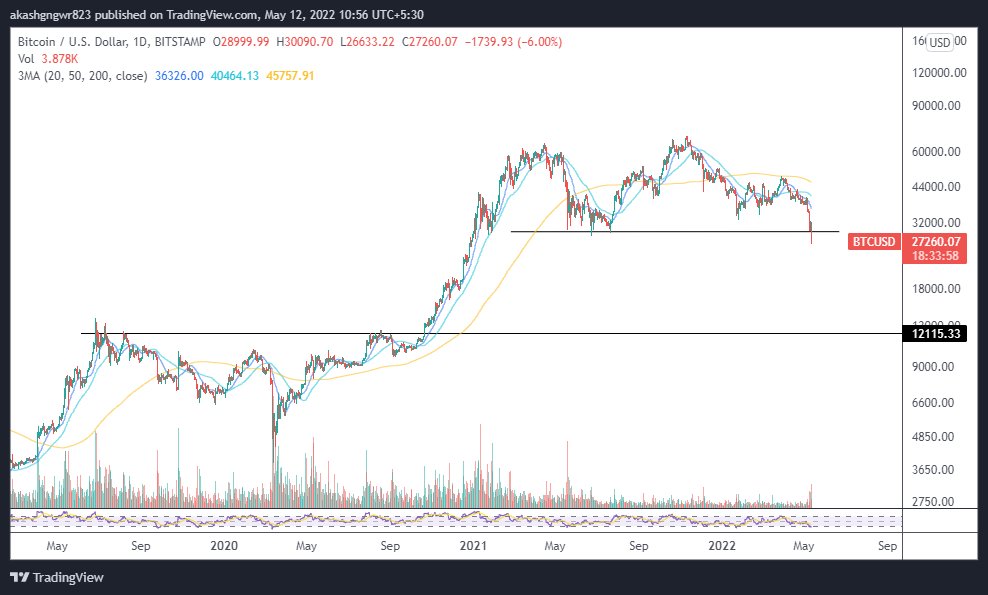
#BTC https://t.co/Yd4iZqC42s
I don't know why Crypto YouTubers are so bullish on BTC right from the top \U0001f61b while the charts are saying something else. Won't be surprised to see the entire retracement of the marked rise. #BTC pic.twitter.com/SQJkjAfZme
— Aakash Gangwar (@akashgngwr823) April 30, 2022


1/THREAD: WHEN WAS IT CLEAR?
Oct. 8, 2020: The purpose of this thread is to document and timestamp when it first became clear that #Bitcoin was likely to become a major reserve asset for public corporations, and eventually states, with Square's purchase of $50M in BTC.
The purpose is to give something to cite when ppl later claim "But there was NO WAY OF KNOWING..."
h/t @ErikSTownsend who used the same format to call out the impact of Covid on Feb 8 and made me personally aware of the looming shutdown of the country https://t.co/opuiNgSeqC !
Bitcoiners smarter than me have been predicting the takeover of the dollar by Bitcoin for many years.
In 2014 with Bitcoin barely at $1B, @pierre_rochard wrote https://t.co/EGHa58KqHq, covering all the incorrect narratives of Bitcoin and stating it will overtake the dollar.
"[skeptics] misunderstand how strong currencies like bitcoin overtake weak currencies like the dollar: it is through speculative attacks and currency crises caused by investors, not through the careful evaluation of tech journalists and 'mainstream consumers'" - @pierre_rochard
I first became bullish on Bitcoin in the summer of 2016, around a $3B market cap, but it was still a toy project at that time in the eyes of most in the financial world, while many technologists thought of it as a v1 technology to be improved on.
Oct. 8, 2020: The purpose of this thread is to document and timestamp when it first became clear that #Bitcoin was likely to become a major reserve asset for public corporations, and eventually states, with Square's purchase of $50M in BTC.
The purpose is to give something to cite when ppl later claim "But there was NO WAY OF KNOWING..."
h/t @ErikSTownsend who used the same format to call out the impact of Covid on Feb 8 and made me personally aware of the looming shutdown of the country https://t.co/opuiNgSeqC !
1/THREAD: WHEN WAS IT CLEAR?
— Erik Townsend \U0001f6e2\ufe0f (@ErikSTownsend) February 8, 2020
Feb. 8, 2020: The purpose of this thread is to document and timestamp when it first became clear that nCov was likely to lead to a global pandemic.
The purpose is to give something to cite when ppl later claim "But there was NO WAY OF KNOWING..."
Bitcoiners smarter than me have been predicting the takeover of the dollar by Bitcoin for many years.
In 2014 with Bitcoin barely at $1B, @pierre_rochard wrote https://t.co/EGHa58KqHq, covering all the incorrect narratives of Bitcoin and stating it will overtake the dollar.
"[skeptics] misunderstand how strong currencies like bitcoin overtake weak currencies like the dollar: it is through speculative attacks and currency crises caused by investors, not through the careful evaluation of tech journalists and 'mainstream consumers'" - @pierre_rochard
I first became bullish on Bitcoin in the summer of 2016, around a $3B market cap, but it was still a toy project at that time in the eyes of most in the financial world, while many technologists thought of it as a v1 technology to be improved on.

1/ outlook for bitcoin: positive 🚀
in this thread, i'll quickly outline key data points on #bitcoin sentiment, demand, market structure, and macro conditions
disclosure: i own BTC, obvi. this is not investment advice. DYOR. further disclosures at
2/ let's start w sentiment ☺️
first, investor sentiment:
✅ @blackrock filed to add BTC to 2 funds, CIO has 400k price target
✅ @RayDalio's Bridgewater reportedly issuing BTC research report
✅JPM, Goldman, and other bulge brackets initiated research coverage
3/ next, trader sentiment:
🚨 most important indicator is the forward curve
normally BTC futures trade in backwardation after a price drop.
this time, the curve stayed in contango following drop, meaning market makers are bullish 🐂📈 despite funding rate increase!
4/ sentiment drives demand. so DEMAND next.
💸 let's talk fund flows
🤑 our research shows $359M of inflows into crypto products last week alone (https://t.co/6Kky96m3ob)
🤑 our @CoinSharesCo @xbtprovider ETPs saw $200M trading volume on jan
4/ let's talk bitcoin fundamentals
post-halving, 900 BTC mined per day, 312,000 this year.
👀 47M millionaires. 21M bitcoin.
🏆 collectibles selling at all time highs. bitcoin is the ultimate collector's item. (see
in this thread, i'll quickly outline key data points on #bitcoin sentiment, demand, market structure, and macro conditions
disclosure: i own BTC, obvi. this is not investment advice. DYOR. further disclosures at
2/ let's start w sentiment ☺️
first, investor sentiment:
✅ @blackrock filed to add BTC to 2 funds, CIO has 400k price target
✅ @RayDalio's Bridgewater reportedly issuing BTC research report
✅JPM, Goldman, and other bulge brackets initiated research coverage
3/ next, trader sentiment:
🚨 most important indicator is the forward curve
normally BTC futures trade in backwardation after a price drop.
this time, the curve stayed in contango following drop, meaning market makers are bullish 🐂📈 despite funding rate increase!
4/ sentiment drives demand. so DEMAND next.
💸 let's talk fund flows
🤑 our research shows $359M of inflows into crypto products last week alone (https://t.co/6Kky96m3ob)
🤑 our @CoinSharesCo @xbtprovider ETPs saw $200M trading volume on jan
4/ let's talk bitcoin fundamentals
post-halving, 900 BTC mined per day, 312,000 this year.
👀 47M millionaires. 21M bitcoin.
🏆 collectibles selling at all time highs. bitcoin is the ultimate collector's item. (see
You May Also Like





1/12
RT-PCR corona (test) scam
Symptomatic people are tested for one and only one respiratory virus. This means that other acute respiratory infections are reclassified as
2/12
It is tested exquisitely with a hypersensitive non-specific RT-PCR test / Ct >35 (>30 is nonsense, >35 is madness), without considering Ct and clinical context. This means that more acute respiratory infections are reclassified as
3/12
The Drosten RT-PCR test is fabricated in a way that each country and laboratory perform it differently at too high Ct and that the high rate of false positives increases massively due to cross-reaction with other (corona) viruses in the "flu
4/12
Even asymptomatic, previously called healthy, people are tested (en masse) in this way, although there is no epidemiologically relevant asymptomatic transmission. This means that even healthy people are declared as COVID
5/12
Deaths within 28 days after a positive RT-PCR test from whatever cause are designated as deaths WITH COVID. This means that other causes of death are reclassified as
RT-PCR corona (test) scam
Symptomatic people are tested for one and only one respiratory virus. This means that other acute respiratory infections are reclassified as
4/10
— Dr. Thomas Binder, MD (@Thomas_Binder) October 22, 2020
...indication, first of all that testing for a (single) respiratory virus is done outside of surveillance systems or need for specific therapy, but even so the lack of consideration of Ct, symptoms and clinical findings when interpreting its result. https://t.co/gHH6kwRdZG
2/12
It is tested exquisitely with a hypersensitive non-specific RT-PCR test / Ct >35 (>30 is nonsense, >35 is madness), without considering Ct and clinical context. This means that more acute respiratory infections are reclassified as
6/10
— Dr. Thomas Binder, MD (@Thomas_Binder) October 22, 2020
The neither validated nor standardised hypersensitive RT-PCR test / Ct 35-45 for SARS-CoV-2 is abused to mislabel (also) other diseases, especially influenza, as COVID-19.https://t.co/AkFIfTCTkS
3/12
The Drosten RT-PCR test is fabricated in a way that each country and laboratory perform it differently at too high Ct and that the high rate of false positives increases massively due to cross-reaction with other (corona) viruses in the "flu
External peer review of the RTPCR test to detect SARS-CoV-2 reveals 10 major scientific flaws at the molecular and methodological level: consequences for false positive results.https://t.co/mbNY8bdw1p pic.twitter.com/OQBD4grMth
— Dr. Thomas Binder, MD (@Thomas_Binder) November 29, 2020
4/12
Even asymptomatic, previously called healthy, people are tested (en masse) in this way, although there is no epidemiologically relevant asymptomatic transmission. This means that even healthy people are declared as COVID
Thread web\u2b06\ufe0f\u2b07\ufe0f
— Dr. Thomas Binder, MD (@Thomas_Binder) December 16, 2020
The fabrication of the "asymptomatic (super) spreader" is the coronation of the total nons(ci)ense in the belief system of #CoronasWitnesses.
Asymptomatic transmission 0.7%; 95% CI 0%-4.9% - could well be 0%!https://t.co/VeZTzxXfvT
5/12
Deaths within 28 days after a positive RT-PCR test from whatever cause are designated as deaths WITH COVID. This means that other causes of death are reclassified as
8/8
— Dr. Thomas Binder, MD (@Thomas_Binder) March 24, 2020
By the way, who the f*** created this obviously (almost) worldwide definition of #CoronaDeath?
This is not only medical malpractice, this is utterly insane!https://t.co/FFsTx4L2mw


MASTER THREAD on Short Strangles.
Curated the best tweets from the best traders who are exceptional at managing strangles.
• Positional Strangles
• Intraday Strangles
• Position Sizing
• How to do Adjustments
• Plenty of Examples
• When to avoid
• Exit Criteria
How to sell Strangles in weekly expiry as explained by boss himself. @Mitesh_Engr
• When to sell
• How to do Adjustments
• Exit
Beautiful explanation on positional option selling by @Mitesh_Engr
Sir on how to sell low premium strangles yourself without paying anyone. This is a free mini course in
1st Live example of managing a strangle by Mitesh Sir. @Mitesh_Engr
• Sold Strangles 20% cap used
• Added 20% cap more when in profit
• Booked profitable leg and rolled up
• Kept rolling up profitable leg
• Booked loss in calls
• Sold only
2nd example by @Mitesh_Engr Sir on converting a directional trade into strangles. Option Sellers can use this for consistent profit.
• Identified a reversal and sold puts
• Puts decayed a lot
• When achieved 2% profit through puts then sold
Curated the best tweets from the best traders who are exceptional at managing strangles.
• Positional Strangles
• Intraday Strangles
• Position Sizing
• How to do Adjustments
• Plenty of Examples
• When to avoid
• Exit Criteria
How to sell Strangles in weekly expiry as explained by boss himself. @Mitesh_Engr
• When to sell
• How to do Adjustments
• Exit
1. Let's start option selling learning.
— Mitesh Patel (@Mitesh_Engr) February 10, 2019
Strangle selling. ( I am doing mostly in weekly Bank Nifty)
When to sell? When VIX is below 15
Assume spot is at 27500
Sell 27100 PE & 27900 CE
say premium for both 50-50
If bank nifty will move in narrow range u will get profit from both.
Beautiful explanation on positional option selling by @Mitesh_Engr
Sir on how to sell low premium strangles yourself without paying anyone. This is a free mini course in
Few are selling 20-25 Rs positional option selling course.
— Mitesh Patel (@Mitesh_Engr) November 3, 2019
Nothing big deal in that.
For selling weekly option just identify last week low and high.
Now from that low and high keep 1-1.5% distance from strike.
And sell option on both side.
1/n
1st Live example of managing a strangle by Mitesh Sir. @Mitesh_Engr
• Sold Strangles 20% cap used
• Added 20% cap more when in profit
• Booked profitable leg and rolled up
• Kept rolling up profitable leg
• Booked loss in calls
• Sold only
Sold 29200 put and 30500 call
— Mitesh Patel (@Mitesh_Engr) April 12, 2019
Used 20% capital@44 each
2nd example by @Mitesh_Engr Sir on converting a directional trade into strangles. Option Sellers can use this for consistent profit.
• Identified a reversal and sold puts
• Puts decayed a lot
• When achieved 2% profit through puts then sold
Already giving more than 2% return in a week. Now I will prefer to sell 32500 call at 74 to make it strangle in equal ratio.
— Mitesh Patel (@Mitesh_Engr) February 7, 2020
To all. This is free learning for you. How to play option to make consistent return.
Stay tuned and learn it here free of cost. https://t.co/7J7LC86oW0