Another #FreeLoveFriday. So far, I’ve covered Bitcoin, Mastercoin/Omni, and last week ChainLink and the importance of decentralized oracles. Today, let’s talk about one of the most fascinating projects in crypto - @MakerDAO

In my thread about Mastercoin, I briefly touched on the vital role fiat-backed stablecoins play in crypto markets, but there’s a catch with them:

The counterparty risk of a third-party holding fiat in reserves.
Enter MakerDAO, which set out to create a decentralized, collateral-backed cryptocurrency, DAI, that would be “soft-pegged” to the U.S. Dollar using the power of algorithms. In crypto tradition, its supporters said trust game theory, not operators.
In 2017, MakerDAO published a whitepaper describing a system where anyone could create DAI by leveraging ETH as collateral to create Collateralized Debt Positions. Essentially, you take out a digital USD loan against your crypto.
The game theory of the system is structured such that DAI issuance is controlled to keep the price pegged to $1.00. In essence, it buffers the fluctuations of the underlying collateral to create a synthetic dollar bill.
This obviates the need for a backing bank, or fiat in reserve, or any kind of dependence on fiat, save as a unit of account.
In 2019, the project innovated further to accept forms of collateral beyond just ETH. Now, there’s a whole ecosystem built on MakerDAO’s governance, including the DAI stablecoin, collateral vaults, and oracles.
While DAI seems to be similar to USD, it offers advantages that fiat cannot match. Namely, it is trivial to send even large quantities. No need for costly and slow bank transfers. So that’s why the price for DAI sometimes even exceeds its peg of $1.00.
Admittedly, it took me a while to understand exactly how Maker works -- our paper on the taxonomy of stablecoins sheds some light on its internals. It’s always amazed me how stable DAI has stayed over the years.
https://t.co/Pz3BkJLUM7
My greatest worry about algorithmic stablecoins like DAI had been the game theory. They work well as long as demand has them operating at or above $1.00, but the dynamics of when they fail are not well understood.
But last March, we saw that the biggest threat to the stable value of DAI isn’t governance, but the constraints of its underlying network.
As the Covid-19 pandemic triggered a meltdown of the traditional financial markets, a liquidity shock rang throughout the crypto markets. Ethereum network fees were outrageously high, and that’s if you could get a transaction confirmed.
You’ll recall, DAI is a collateralized product. If you can’t sufficiently re-capitalize your position as the price of your collateral plummets, the Maker contract follows its rules and liquidates your position.
It was sad to see people losing their money & being turned away from crypto. It was also disappointing to see an innovative project take a reputational hit for circumstances that were out of their immediate control.
I’m certain that the MakerDAO ecosystem will continue to innovate and seemingly make magic happen with math. I’m also curious to hear what you all and @RuneKek want to see built around MakerDAO next.

More from Bitcoin

$BTC views

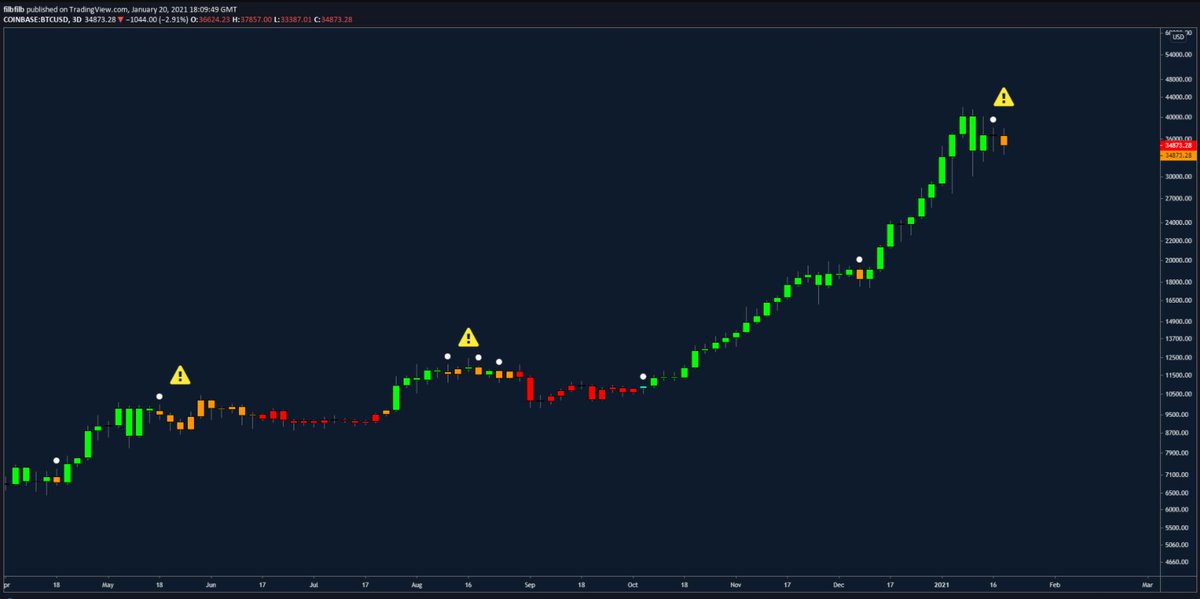
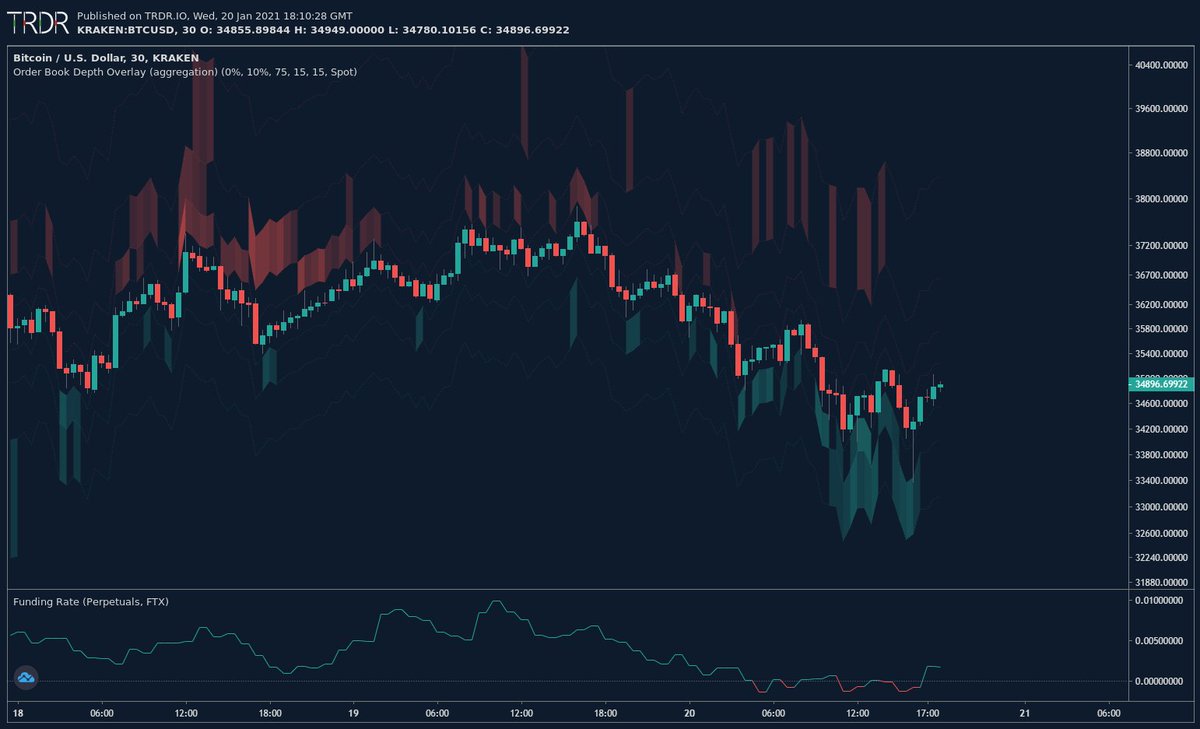
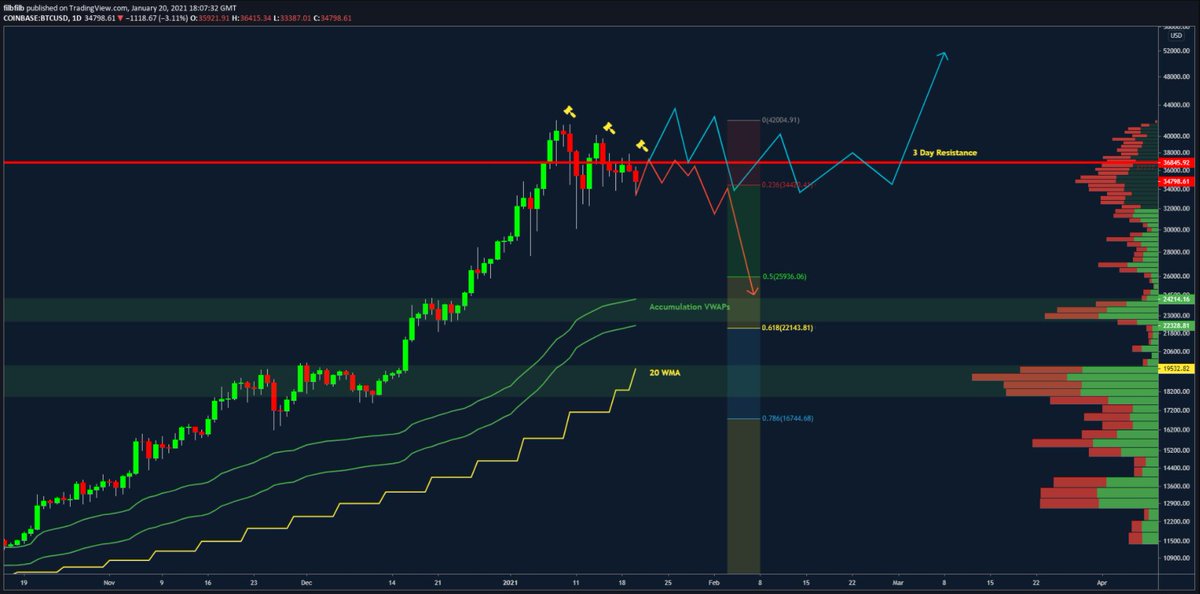
Price needs to let volatility wear off before its next big move. Thinking 30K-40K range for the next 1-2 weeks. Then either 50K straight or after piercing 30K and bouncing back above 30K within 1-2 days.


$27500-$27000 is the key area. If price heads back down to 30K, expect 30K to be breached, fall to that area, and bounce back. FAST. All very fast.


What do I do with this information?

Simple.

I'm trading the range against a core position. Buying when price pushes lower, selling when higher. It's like playing the achordeon. There's always air left inside.

Where exactly?

Nowhere.

I don't use limits for that. $BTC is liquid enough to trade at market without issues.

I'm watching PA, volume and rates for buying and euphoria as reflected in rates for reducing.

Decision making is dynamic. Nothing is set in stone. But most likely if price heads back down to 30K 'll be holding off next time. The gameplan is to have ammo to buy the dip (to redeploy). If 30K breaks absolutely no buying until down to 27Ks or back above 30K.

You May Also Like

MASTER THREAD on Short Strangles.

Curated the best tweets from the best traders who are exceptional at managing strangles.

• Positional Strangles
• Intraday Strangles
• Position Sizing
• How to do Adjustments
• Plenty of Examples
• When to avoid
• Exit Criteria

How to sell Strangles in weekly expiry as explained by boss himself. @Mitesh_Engr

• When to sell
• How to do Adjustments
• Exit


Beautiful explanation on positional option selling by @Mitesh_Engr
Sir on how to sell low premium strangles yourself without paying anyone. This is a free mini course in


1st Live example of managing a strangle by Mitesh Sir. @Mitesh_Engr

• Sold Strangles 20% cap used
• Added 20% cap more when in profit
• Booked profitable leg and rolled up
• Kept rolling up profitable leg
• Booked loss in calls
• Sold only


2nd example by @Mitesh_Engr Sir on converting a directional trade into strangles. Option Sellers can use this for consistent profit.

• Identified a reversal and sold puts

• Puts decayed a lot

• When achieved 2% profit through puts then sold
So the cryptocurrency industry has basically two products, one which is relatively benign and doesn't have product market fit, and one which is malignant and does. The industry has a weird superposition of understanding this fact and (strategically?) not understanding it.


The benign product is sovereign programmable money, which is historically a niche interest of folks with a relatively clustered set of beliefs about the state, the literary merit of Snow Crash, and the utility of gold to the modern economy.

This product has narrow appeal and, accordingly, is worth about as much as everything else on a 486 sitting in someone's basement is worth.

The other product is investment scams, which have approximately the best product market fit of anything produced by humans. In no age, in no country, in no city, at no level of sophistication do people consistently say "Actually I would prefer not to get money for nothing."

This product needs the exchanges like they need oxygen, because the value of it is directly tied to having payment rails to move real currency into the ecosystem and some jurisdictional and regulatory legerdemain to stay one step ahead of the banhammer.