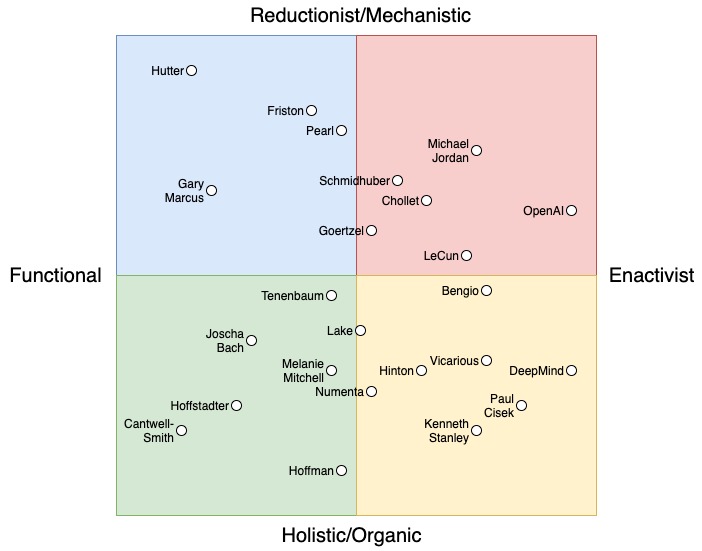
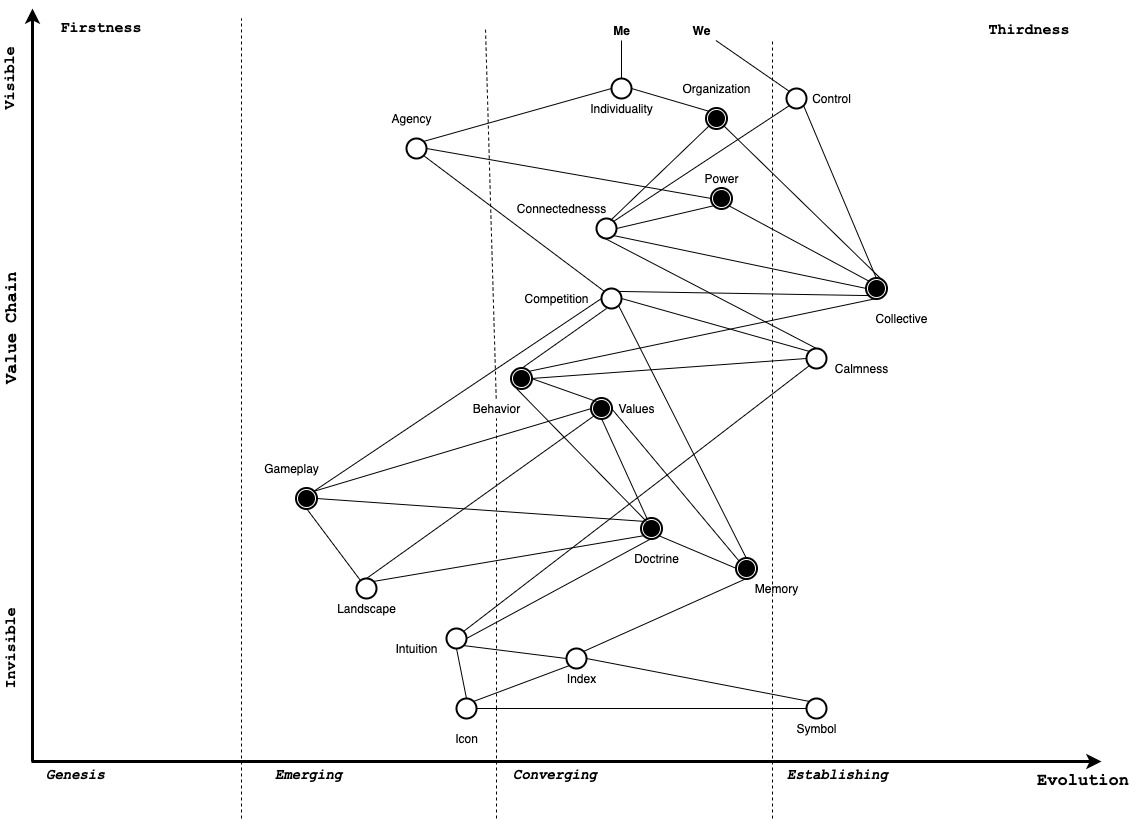
My attempt to map the research *doctrines* of various groups working on Artificial General Intelligence.
More from Carlos E. Perez
Nice to discover Judea Pearl ask a fundamental question. What's an 'inductive bias'?
I crucial step on the road towards AGI is a richer vocabulary for reasoning about inductive biases.
explores the apparent impedance mismatch between inductive biases and causal reasoning. But isn't the logical thinking required for good causal reasoning also not an inductive bias?
An inductive bias is what C.S. Peirce would call a habit. It is a habit of reasoning. Logical thinking is like a Platonic solid of the many kinds of heuristics that are discovered.
The kind of black and white logic that is found in digital computers is critical to the emergence of today's information economy. This of course is not the same logic that drives the general intelligence that lives in the same economy.
Help! What precisely is "inductive bias"? Some ML researchers are in the opinion that the machine learning category of \u2018inductive biases\u2019 can allow us to build a causal understanding of the world. My Ladder of Causation says: "This is mathematically impossible". Who is right? 1/
— Judea Pearl (@yudapearl) February 14, 2021
I crucial step on the road towards AGI is a richer vocabulary for reasoning about inductive biases.
explores the apparent impedance mismatch between inductive biases and causal reasoning. But isn't the logical thinking required for good causal reasoning also not an inductive bias?
An inductive bias is what C.S. Peirce would call a habit. It is a habit of reasoning. Logical thinking is like a Platonic solid of the many kinds of heuristics that are discovered.
The kind of black and white logic that is found in digital computers is critical to the emergence of today's information economy. This of course is not the same logic that drives the general intelligence that lives in the same economy.