Sharing the latest holdings and some random thoughts.
@FromValue @dhaval_kotecha @SeifelCapital @saxena_puru @BahamaBen9 @richard_chu97 @TMFJMo @7Innovator @investing_city @SagaPartners @adventuresinfi

✔️Ignoring most of the daily Market news and also ignoring the random stock price movements on most days.
Big-Tech💻
Cloud/SaaS☁️
E-Commerce🛒
Ad-Tech🖥️
Fin-Tech💳
Digital Services📲
Medical Devices & Services🩺
Consumer🛍️
Few stable Dividend paying Co's💰
✔️About 20 of these holdings require very little due diligence from me (other than a 15 min quarterly check about Financial results). Ex : $AAPL $AMZN $GOOG $FB $V $MA $V $BRK $ISRG $NKE.
-filtering for the important stuff
-adding your experience/process to make good decisions
-letting Quality & compounding work in your favor over the long-term
-learning from your mistakes and improving your process over time.
-trying to keeping up with the firehose of daily information
-obsessing over the minute details
-trying to impress others with how much you know about a specific company
-or endlessly arguing online about a stock you love/hate.
More from Ram Bhupatiraju
Excellent collection of articles related to Financial Statement Analysis and related topics, on Harvard Business School Online blog. h/t @online_HBS 👏
✔️The Beginner's Guide to Reading & Understanding Financial
How to Read & Understand
✔️Income Statement
https://t.co/sx2QP2kDvx
✔️Balance Sheet
https://t.co/xK5r04EmPT
✔️Cash Flow
✔️GAAP vs. IFRS : What are the Key Differences?
https://t.co/9vqtZVmOys
✔️20 Financial Terms to
✔️How to quickly & effectively read an Annual Report
https://t.co/6vNPoHY3yi
✔️Cash Flow vs Profit : What's the
✔️How to Value a Company : 6 Methods &
✔️The Beginner's Guide to Reading & Understanding Financial
How to Read & Understand
✔️Income Statement
https://t.co/sx2QP2kDvx
✔️Balance Sheet
https://t.co/xK5r04EmPT
✔️Cash Flow
✔️GAAP vs. IFRS : What are the Key Differences?
https://t.co/9vqtZVmOys
✔️20 Financial Terms to
✔️How to quickly & effectively read an Annual Report
https://t.co/6vNPoHY3yi
✔️Cash Flow vs Profit : What's the
✔️How to Value a Company : 6 Methods &
The (investing) world is full of noise📢. Tune that out and find your signal.🗼
Investing websites/blogs that I shared during the @FintwitSummit last weekend. With some minor changes and lot of additional commentary in the thread below. ⬇️⬇️
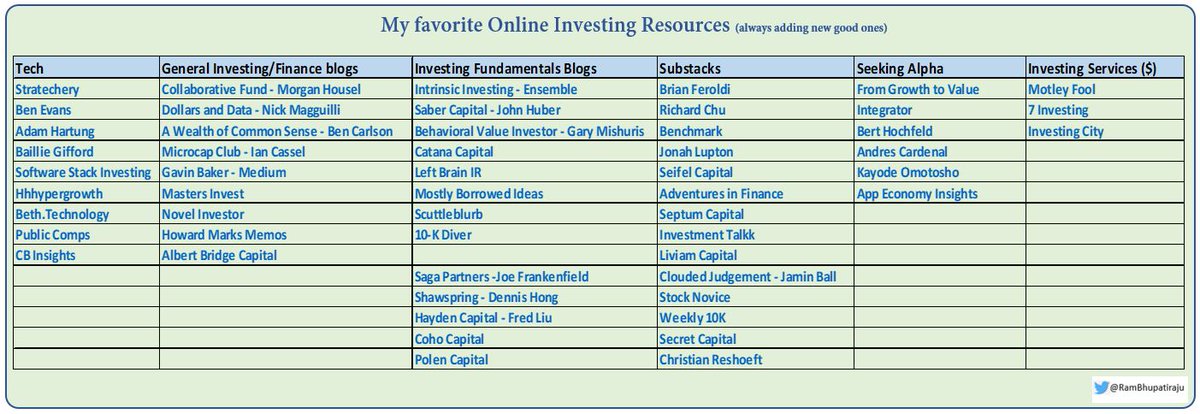
My investing diet 🗒️
✔️Zero Financial TV.
✔️Very little Market & Stock prices commentary/content.
✔️Lot of Company produced presentations/statements.
✔️ Lot of Investing Podcasts (thread some other time).
✔️Lot of below awesome content whenever I find time.
Tech : Have to start with my favorite sector
✅ @stratechery
For deeper understanding of Platforms and Aggregators.
https://t.co/VsNwRStY9C
✅ @benedictevans
Phenomenal essays related to
✅ @adam_hartung
Extremely good if you are into following & investing in strong/durable trends.
https://t.co/IOE1pmkqbi
✅ @BaillieGifford
Mind blowing, if you're into extremely patient and visionary style of
✅ @StackInvesting
Must read if you love the combination of Software + Investing
https://t.co/WQ1yBYzT2m
✅ @hhhypergrowth
Phenomenal writing if you love technical deep dives into SaaS
https://t.co/kcLKITRLz1
✅ @Beth_Kindig
Sharp Tech focused
Investing websites/blogs that I shared during the @FintwitSummit last weekend. With some minor changes and lot of additional commentary in the thread below. ⬇️⬇️
My investing diet 🗒️
✔️Zero Financial TV.
✔️Very little Market & Stock prices commentary/content.
✔️Lot of Company produced presentations/statements.
✔️ Lot of Investing Podcasts (thread some other time).
✔️Lot of below awesome content whenever I find time.
Tech : Have to start with my favorite sector
✅ @stratechery
For deeper understanding of Platforms and Aggregators.
https://t.co/VsNwRStY9C
✅ @benedictevans
Phenomenal essays related to
✅ @adam_hartung
Extremely good if you are into following & investing in strong/durable trends.
https://t.co/IOE1pmkqbi
✅ @BaillieGifford
Mind blowing, if you're into extremely patient and visionary style of
✅ @StackInvesting
Must read if you love the combination of Software + Investing
https://t.co/WQ1yBYzT2m
✅ @hhhypergrowth
Phenomenal writing if you love technical deep dives into SaaS
https://t.co/kcLKITRLz1
✅ @Beth_Kindig
Sharp Tech focused


More from All














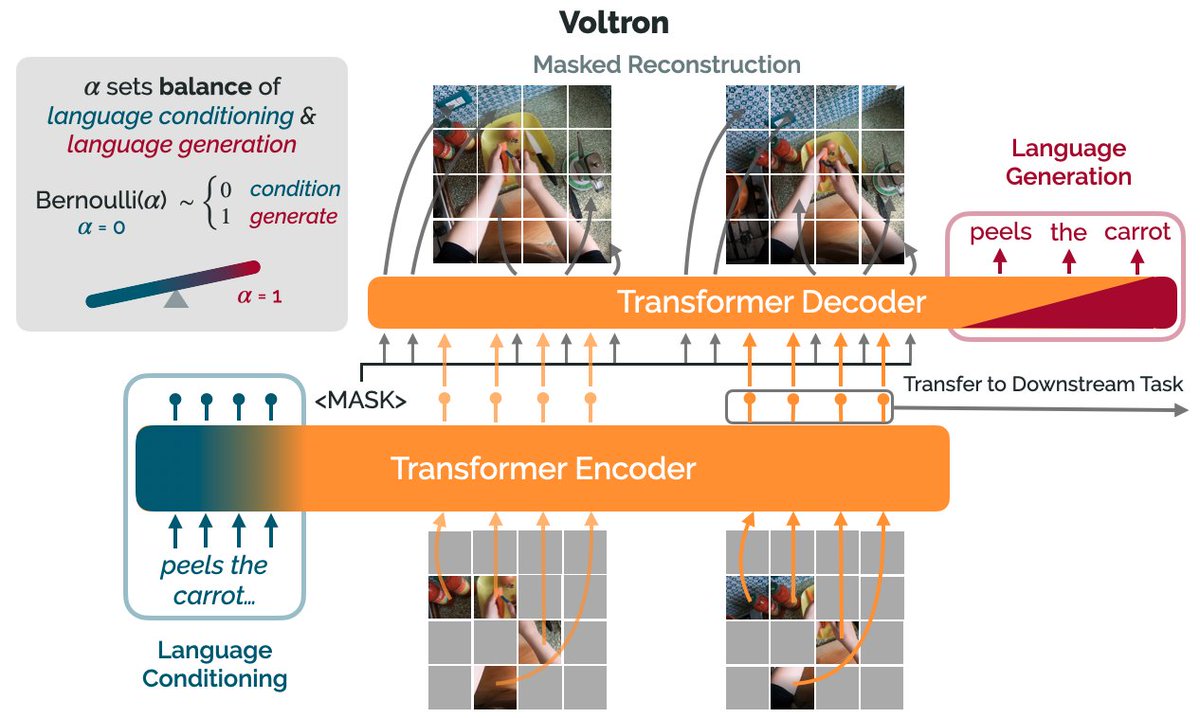
How can we use language supervision to learn better visual representations for robotics?
Introducing Voltron: Language-Driven Representation Learning for Robotics!
Paper: https://t.co/gIsRPtSjKz
Models: https://t.co/NOB3cpATYG
Evaluation: https://t.co/aOzQu95J8z
🧵👇(1 / 12)
Videos of humans performing everyday tasks (Something-Something-v2, Ego4D) offer a rich and diverse resource for learning representations for robotic manipulation.
Yet, an underused part of these datasets are the rich, natural language annotations accompanying each video. (2/12)
The Voltron framework offers a simple way to use language supervision to shape representation learning, building off of prior work in representations for robotics like MVP (https://t.co/Pb0mk9hb4i) and R3M (https://t.co/o2Fkc3fP0e).
The secret is *balance* (3/12)
Starting with a masked autoencoder over frames from these video clips, make a choice:
1) Condition on language and improve our ability to reconstruct the scene.
2) Generate language given the visual representation and improve our ability to describe what's happening. (4/12)
By trading off *conditioning* and *generation* we show that we can learn 1) better representations than prior methods, and 2) explicitly shape the balance of low and high-level features captured.
Why is the ability to shape this balance important? (5/12)
Introducing Voltron: Language-Driven Representation Learning for Robotics!
Paper: https://t.co/gIsRPtSjKz
Models: https://t.co/NOB3cpATYG
Evaluation: https://t.co/aOzQu95J8z
🧵👇(1 / 12)
Videos of humans performing everyday tasks (Something-Something-v2, Ego4D) offer a rich and diverse resource for learning representations for robotic manipulation.
Yet, an underused part of these datasets are the rich, natural language annotations accompanying each video. (2/12)
The Voltron framework offers a simple way to use language supervision to shape representation learning, building off of prior work in representations for robotics like MVP (https://t.co/Pb0mk9hb4i) and R3M (https://t.co/o2Fkc3fP0e).
The secret is *balance* (3/12)
Starting with a masked autoencoder over frames from these video clips, make a choice:
1) Condition on language and improve our ability to reconstruct the scene.
2) Generate language given the visual representation and improve our ability to describe what's happening. (4/12)
By trading off *conditioning* and *generation* we show that we can learn 1) better representations than prior methods, and 2) explicitly shape the balance of low and high-level features captured.
Why is the ability to shape this balance important? (5/12)
You May Also Like




https://t.co/6cRR2B3jBE
Viruses and other pathogens are often studied as stand-alone entities, despite that, in nature, they mostly live in multispecies associations called biofilms—both externally and within the host.
https://t.co/FBfXhUrH5d

Microorganisms in biofilms are enclosed by an extracellular matrix that confers protection and improves survival. Previous studies have shown that viruses can secondarily colonize preexisting biofilms, and viral biofilms have also been described.

...we raise the perspective that CoVs can persistently infect bats due to their association with biofilm structures. This phenomenon potentially provides an optimal environment for nonpathogenic & well-adapted viruses to interact with the host, as well as for viral recombination.

Biofilms can also enhance virion viability in extracellular environments, such as on fomites and in aquatic sediments, allowing viral persistence and dissemination.

Viruses and other pathogens are often studied as stand-alone entities, despite that, in nature, they mostly live in multispecies associations called biofilms—both externally and within the host.
https://t.co/FBfXhUrH5d
Microorganisms in biofilms are enclosed by an extracellular matrix that confers protection and improves survival. Previous studies have shown that viruses can secondarily colonize preexisting biofilms, and viral biofilms have also been described.
...we raise the perspective that CoVs can persistently infect bats due to their association with biofilm structures. This phenomenon potentially provides an optimal environment for nonpathogenic & well-adapted viruses to interact with the host, as well as for viral recombination.
Biofilms can also enhance virion viability in extracellular environments, such as on fomites and in aquatic sediments, allowing viral persistence and dissemination.