Most people recommend Python to start.
I do too.
You can do machine learning with many different languages, but today, Python is the best option.
My advice: Get comfortable writing code before looking into machine learning.
You don't have to be a great developer to start.
But if you are, it helps.
Everything you know about building software is helpful to build machine learning systems.
Good developers have the odds in their favor.
"How much Python do I need to know before starting?"
If you ask, you aren't ready yet.
Ideal scenario: You should be comfortable building software. Most people get here within a year.
Let's move on to the 2nd item from the list: A place to write and run your code.
Get familiar with Google Colab.
• It's free.
• Requires no setup to start.
• It's available from anywhere.
Alternative: Kaggle.
Why not your favorite IDE running on your computer?
That also works, but I'd recommend you get familiar with notebooks from day 1 (@code supports Jupyter notebooks!)
If/when you need a GPU, Google Colab has them for free.
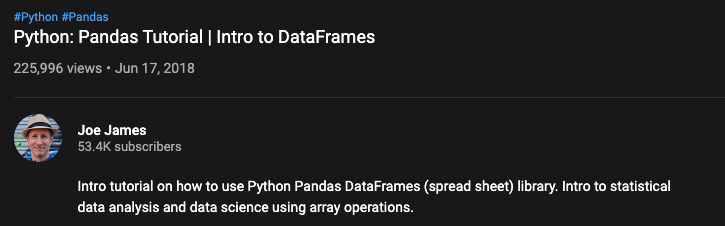
3rd item: You need a way to load and manipulate data.
Pandas is Python's most popular library to do this.
You can go through this tutorial in about 4 hours:
https://t.co/RMJJSAVPwT.
Why the big deal with a library to handle data?
Most of the work is just that.
This sounds boring, but I promise it isn't. I can also tell you that it's one of the places where you'll get to show off your creativity.
Visualizing results is number 4 in the list.
Many people skip this step. That's a mistake.
A couple of popular options for you:
• Matplotlib
• Seaborn
Communication is one of the most powerful traits you could build. These libraries will help you do that.
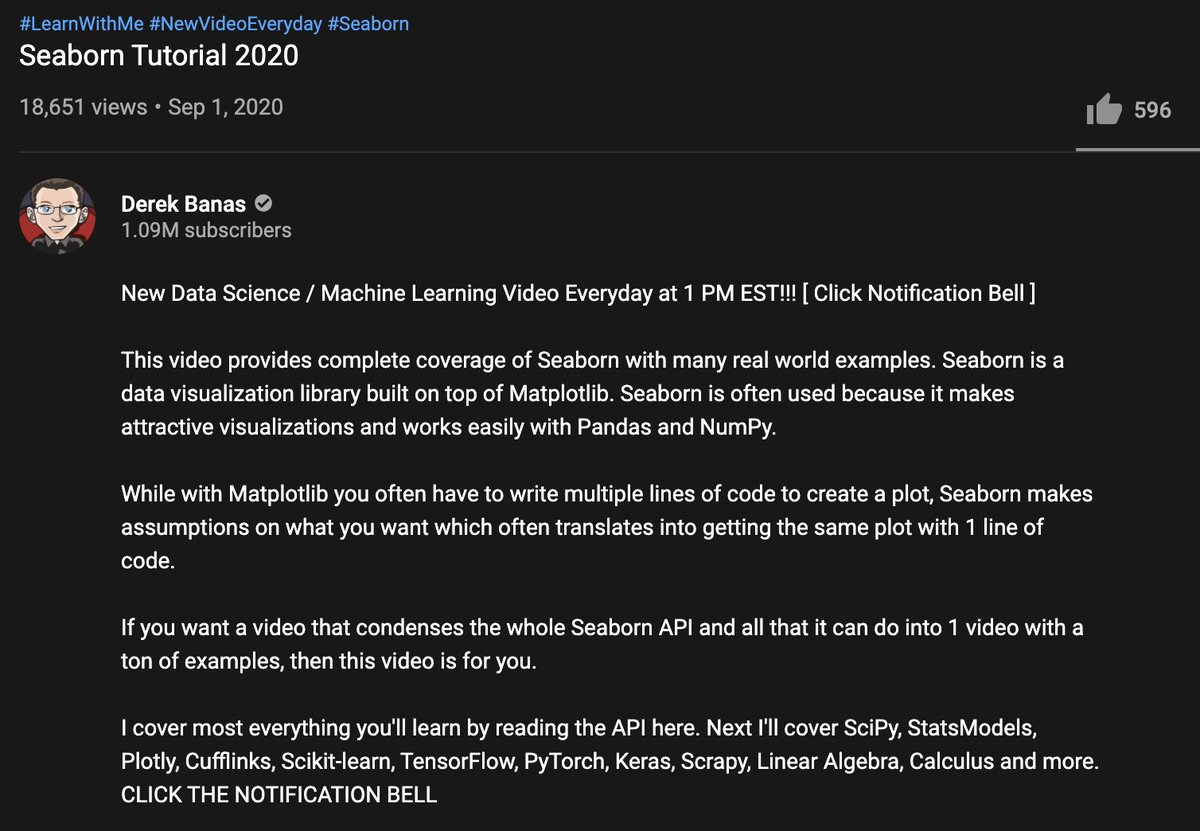
Another 4-hour tutorial:
https://t.co/V0ya8kLeCW This will give you everything you need to start with Seaborn.
At this point, you should be ready to start with specific machine learning content.
Many people go right away and start a course.
Here is a different way: Learn about one algorithm that could solve a problem for you.
This will motivate you to dive deeper.
As a developer, you already have experience learning new things.
• You find a problem.
• You look for a solution.
• You learn about it.
• You implement it.
I want you to try the same here.
Algorithm recommendation: Learn about Decision Trees to start.
Listen up: you don't need to go and become an expert on Decision Trees.
At this point:
• You don't need to worry about the math.
• You don't need to understand the full theory.
All of that can come later.
For now: How can you use Decision Trees? How are they helpful?
A couple of recommendations to get into Decision Trees:
• A tutorial with a lot of code:
https://t.co/xz1yUaDxF6 • A video that builds a Decision Tree from scratch:
https://t.co/tKtUpO1K3l
It's time for a machine learning introductory course.
(If you looked into Decision Trees already, great! This course will be easy.)
Starting from scratch, in 3 hours, you can go through this:
https://t.co/qQXBcdvnsj.
This course puts together everything we just discussed.
It even takes you through a simple problem and helps you solve it!
Good news: The course focuses on building and doesn't worry too much about math or theory.
(These are important, but not now.)
Final item from the list: You need a project.
One of the best problems to start: "Titanic - Machine Learning from Disaster."
You can find it here:
https://t.co/eQzuGeePe2.
Optionally, you can take a look at this tutorial on how to solve the Titanic challenge:
https://t.co/DTA0B3GncE A step-by-step guide that will help you get your first problem done!
Let's recap:
1. You need experience with Python
2. Learn Google Colab
3. Pandas for data
4. Seaborn for visualizations
5. Decision Trees is a good start
6. Finish "Intro to Machine Learning."
7. Solve the Titanic challenge