Ratha Saptami, Surya Jayanti - Importance - #Thread
The seventh day of the lunar calendar in the bright half of ‘Magha’ month is called ‘Ratha Saptami’. Worship of Sun on this day grants immense merits equal to the worship of Sun for one complete year.


जननि सर्व लोकानां सप्तमी सप्त सप्तिकौ
सप्त व्याहृति के देवि नमस्ते सूर्य मण्डले॥
Those who want to have health, knowledge, wealth & good life should worship Sun irrespective of caste, creed, & gender.
As this time is equivalent to the time when the eclipse of sun is happening, it is very auspicious for bathing, charity and Japa. Offering of pumpkin is very meritorious on this day.
नियमव्रतचारीच भवेद्भक्तिसमन्वितः ॥
सप्तम्यां वा महाभागाः सोఽश्वमेधफलं लभेत्
Those who worship ‘Ravi’ following the Vrata by eating only once on Māgha Śuddha Ṣaṣṭhi or Saptami will get the result of performing Aśvamēdha Yāga.
सप्तम्यामथवा षष्ठ्यां स याति परमां गतिं !!
Those who worship ‘Bhāskara’ doing fasting on Māgha Śuddha Ṣaṣṭhi/Saptami will attain exalted state.
सर्वशुक्लोपहारेण पूजयेद्यस्तु भास्करं
सर्वपापविनिर्मुक्तः सूर्यलोकं स गच्छति॥
Those who fast & perform worship of ‘Bhāskara’ contemplating to be present in white hue on Śukla Saptami day will be relieved from all sins & reach abode of Sūrya.
More from Brahmasri Samavedam Shanmukha Sarma




More from All





How can we use language supervision to learn better visual representations for robotics?
Introducing Voltron: Language-Driven Representation Learning for Robotics!
Paper: https://t.co/gIsRPtSjKz
Models: https://t.co/NOB3cpATYG
Evaluation: https://t.co/aOzQu95J8z
🧵👇(1 / 12)
Videos of humans performing everyday tasks (Something-Something-v2, Ego4D) offer a rich and diverse resource for learning representations for robotic manipulation.
Yet, an underused part of these datasets are the rich, natural language annotations accompanying each video. (2/12)
The Voltron framework offers a simple way to use language supervision to shape representation learning, building off of prior work in representations for robotics like MVP (https://t.co/Pb0mk9hb4i) and R3M (https://t.co/o2Fkc3fP0e).
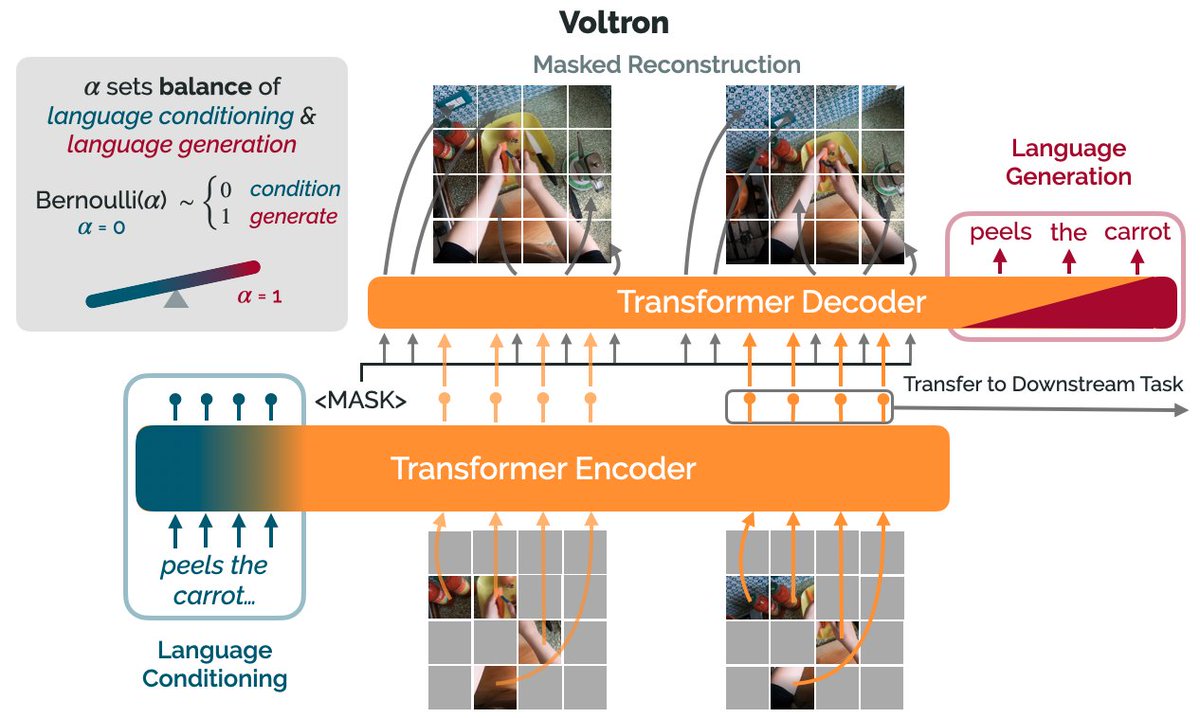
The secret is *balance* (3/12)
Starting with a masked autoencoder over frames from these video clips, make a choice:
1) Condition on language and improve our ability to reconstruct the scene.
2) Generate language given the visual representation and improve our ability to describe what's happening. (4/12)
By trading off *conditioning* and *generation* we show that we can learn 1) better representations than prior methods, and 2) explicitly shape the balance of low and high-level features captured.
Why is the ability to shape this balance important? (5/12)
Introducing Voltron: Language-Driven Representation Learning for Robotics!
Paper: https://t.co/gIsRPtSjKz
Models: https://t.co/NOB3cpATYG
Evaluation: https://t.co/aOzQu95J8z
🧵👇(1 / 12)
Videos of humans performing everyday tasks (Something-Something-v2, Ego4D) offer a rich and diverse resource for learning representations for robotic manipulation.
Yet, an underused part of these datasets are the rich, natural language annotations accompanying each video. (2/12)
The Voltron framework offers a simple way to use language supervision to shape representation learning, building off of prior work in representations for robotics like MVP (https://t.co/Pb0mk9hb4i) and R3M (https://t.co/o2Fkc3fP0e).
The secret is *balance* (3/12)
Starting with a masked autoencoder over frames from these video clips, make a choice:
1) Condition on language and improve our ability to reconstruct the scene.
2) Generate language given the visual representation and improve our ability to describe what's happening. (4/12)
By trading off *conditioning* and *generation* we show that we can learn 1) better representations than prior methods, and 2) explicitly shape the balance of low and high-level features captured.
Why is the ability to shape this balance important? (5/12)