[THREAD]: Here are 10 (painful) lessons I've learned writing 3,000+ articles on the internet over the past 7 years.

On writing advice, growth hacks, going viral, and feeling fulfilled in the process 👇

1/ There is only 1 secret to online writing.

Volume wins.

There isn't a writing platform on the internet where this ISN'T the case. Social platforms. Major publications. Every growth period of my writing career happened during months/years of consistent volume.

Period.
2/ Growth hacks are overrated.

In my early 20s, I spent a LOT of time reading digital marketing blogs about how to get 50% more views here, or 20% more subscribers there.

A lot of it is mental masturbation.

You're far better off just consistently creating new content.
3/ Writing that engages/goes viral is emotional.

You don't have to "air your dirty laundry," but you do have to say something that makes the person on the other side of the screen pause, *feel you*, and engage.

This can be done through story, tone, before/after photos, etc.
4/ You don't go viral by getting lucky.

You go viral by publishing day after day, week after week, year after year.

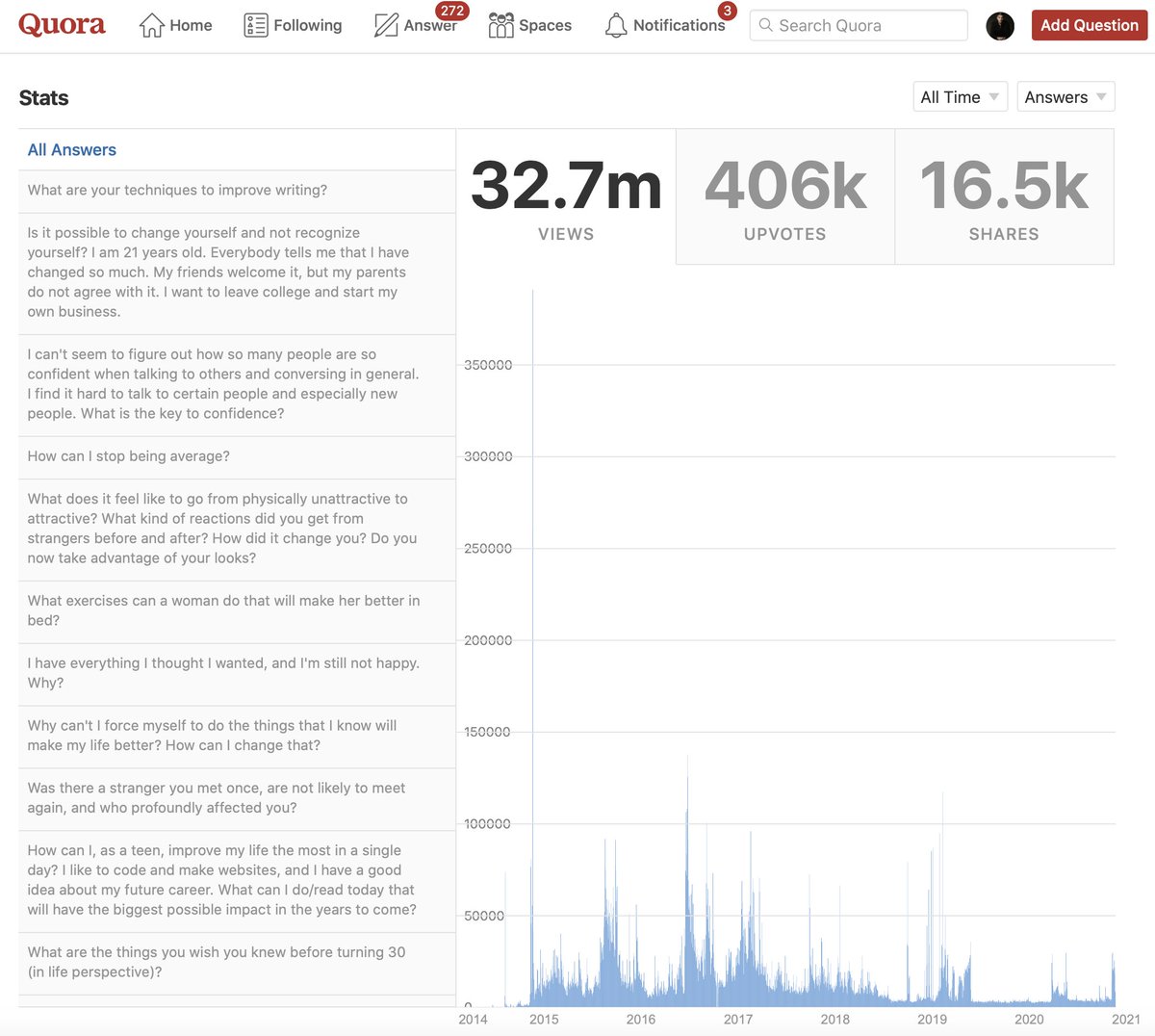
My Quora dashboard is a great example. Out of 1,200+ Answers, less than 100 have gone viral.

That's not luck. That's rolling the dice 1,200+ times.
5/ Not everyone has something interesting to say.

This is a brutal truth, and one of the first big hurdles you have to overcome as a writer online. If your writing isn't engaging, you might not be saying anything unique/compelling/original.

So? Dig deeper.
6/ There is more than 1 way to "make it" ($$$) as a writer.

The publishing world celebrates best-selling authors. The reality? Most are broke.

The writers with the most creative AND financial freedom are all independent. They monetize in a variety of ways—not just book sales.
7/ Ghostwriting is gasoline for your career.

It's lucrative. It's a supercharger for building a powerful network. It teaches you how to write in different voices. It allows you to play with words all day long & practice your craft.

Every writer should also ghostwrite.
8/ Your personal projects will always give you the biggest ROI.

I became a ghostwriter after I had already built myself as a writer on Quora. Nobody paid me to write online. That was a personal investment in myself, and it changed my life.

Always always invest in yourself.
9/ Any writer can make $$ online. Not every writer can get rich.

The easiest ways to make $$ as a writer is by providing a service or teaching. Both, low barrier to entry.

Get here, first. THEN, once you're established as a full-time writer, chase the Great American Novel dream
10/ Being a Writer is not a destination. It's a habit.

Anyone who is actively writing is a writer.

Anyone no longer actively writing (IMO) is not. They're a "retired writer."

Don't wait for the accolade to tell you who you are.

Let your habits speak for you.
Want more Daily Writing Habits?

Join 10,000+ other writers and get them straight to your inbox, every morning M-F:

https://t.co/aB6kuANb2l

More from Nicolas Cole

I started writing threads on Twitter in 2019.

Since then, I've written more than 200 threads and accumulated over 50,000,000 views on Twitter alone.

Want to know a secret?

I (pretty much) use the same 7 thread templates every time.

🧵👇

Template #1: The Framework Thread

The best frameworks all follow this same recipe:

• To solve X [well-known & difficult] problem
• I do Y [unconventional] thing
• To achieve Z [highly desirable]


Template #2: The Curation Thread

Recipe: "I did all this work—so you don't have to."

But the secret w/ curation threads is to niche down HARD.

"Biz books to read on investing" > "Best biz books" > "Best


Template #3: The "This Just Happened" Thread

Breaking News always has a 24-48 hour hype cycle.

The recipe here is:

• Write about a trending topic
• Provide your own unique take
• Unique take must be relevant to your


Template #4: The "If I Had To Do It Over Again" Thread

Recipe =

• I achieved X
• And made a lot of mistakes along the way
• If I were you, and had to do it all over again, here's what I would do

More from Writing

Things we don’t learn in this article: that the author wrote David Cameron’s speeches during the period when they were intentionally underfunding the NHS and other services, directly creating the problem the author is concerned about now.


We also don’t learn that the paper it’s written in stridently supported those measures and attacked junior doctors threatening strike action over NHS cuts and long working hours, accusing them of holding the country to ransom.

We aren’t reminded that NHS funding and the future of health provision was a central part of previous election campaigns, and that attempts to highlight these problems were swiftly stomped on or diverted and then ignored by most of the press, including the Times.

I’d underline here that “corruption” doesn’t just mean money in brown envelopes: it describes a situation where much of an organisation is personally motivated to ignore, downplay or divert from malfeasance for personal reasons - because highlighting them would be bad for careers

Foges was Cameron’s speechwriter at the height of austerity; Forsyth is married to the PM’s spokesman; Danny F is a Tory peer; Parris is a former MP; Gove used to write for them regularly, and that’s before we get to professional mates-with-ministers like Shipman or Montgomerie.
I want to talk about how western editors and readers often mistake protags written by BIPOC as "inactive protagonists." It's too common an issue that's happened to every BIPOC author I know.


Often, our protags are just trying to survive overwhelming odds. Survival is an active choice, you know. Survival is a story. Choosing to be strong in the face of the world ending, even if you can't blast a wall down to do it, is a choice.

It's how we live these days.

Western editors, readers, and writers are too married to the three-act structure, to the type of storytelling that is driven by conflict, to that go-getter individualism. Please read more widely out of your comfort zone. A lot of great non-western stories do not hinge on these.

Sometimes I wonder if you're all so hopped up on the conflict-driven story because that's exactly how your colonizer ancestors dealt with people different from them. Oops, I said it, sorry not sorry. Yes, even this mindset has roots in colonialism, deal with it.

If you want examples of non-conflict-driven storytelling google the following: kishoutenketsu, johakyu, daisy chain storytelling/wheel spoke storytelling. There was another one whose name I forgot but I will tweet it when I recall it.

You May Also Like

MASTER THREAD on Short Strangles.

Curated the best tweets from the best traders who are exceptional at managing strangles.

• Positional Strangles
• Intraday Strangles
• Position Sizing
• How to do Adjustments
• Plenty of Examples
• When to avoid
• Exit Criteria

How to sell Strangles in weekly expiry as explained by boss himself. @Mitesh_Engr

• When to sell
• How to do Adjustments
• Exit


Beautiful explanation on positional option selling by @Mitesh_Engr
Sir on how to sell low premium strangles yourself without paying anyone. This is a free mini course in


1st Live example of managing a strangle by Mitesh Sir. @Mitesh_Engr

• Sold Strangles 20% cap used
• Added 20% cap more when in profit
• Booked profitable leg and rolled up
• Kept rolling up profitable leg
• Booked loss in calls
• Sold only


2nd example by @Mitesh_Engr Sir on converting a directional trade into strangles. Option Sellers can use this for consistent profit.

• Identified a reversal and sold puts

• Puts decayed a lot

• When achieved 2% profit through puts then sold
IMPORTANCE, ADVANTAGES AND CHARACTERISTICS OF BHAGWAT PURAN

It was Ved Vyas who edited the eighteen thousand shlokas of Bhagwat. This book destroys all your sins. It has twelve parts which are like kalpvraksh.

In the first skandh, the importance of Vedvyas


and characters of Pandavas are described by the dialogues between Suutji and Shaunakji. Then there is the story of Parikshit.
Next there is a Brahm Narad dialogue describing the avtaar of Bhagwan. Then the characteristics of Puraan are mentioned.

It also discusses the evolution of universe.(
https://t.co/2aK1AZSC79 )

Next is the portrayal of Vidur and his dialogue with Maitreyji. Then there is a mention of Creation of universe by Brahma and the preachings of Sankhya by Kapil Muni.


In the next section we find the portrayal of Sati, Dhruv, Pruthu, and the story of ancient King, Bahirshi.
In the next section we find the character of King Priyavrat and his sons, different types of loks in this universe, and description of Narak. ( https://t.co/gmDTkLktKS )


In the sixth part we find the portrayal of Ajaamil ( https://t.co/LdVSSNspa2 ), Daksh and the birth of Marudgans( https://t.co/tecNidVckj )

In the seventh section we find the story of Prahlad and the description of Varnashram dharma. This section is based on karma vaasna.