How to navigate the
https://t.co/6Ne99JDfyv page
1. Type
https://t.co/6Ne99JDfyv in your browser and hit the enter button
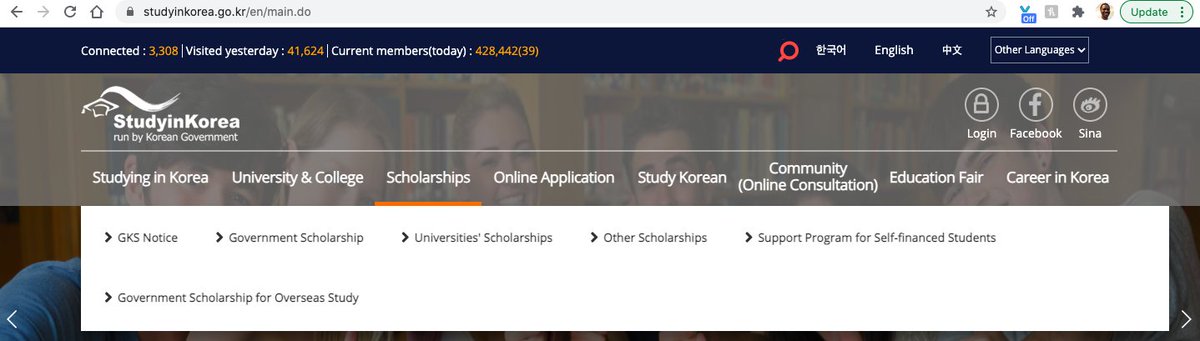
2. Click on scholarships and select GKS notice as attached in the picture👇
3. Play with the notice dashboard to see various announcements from NIIED.
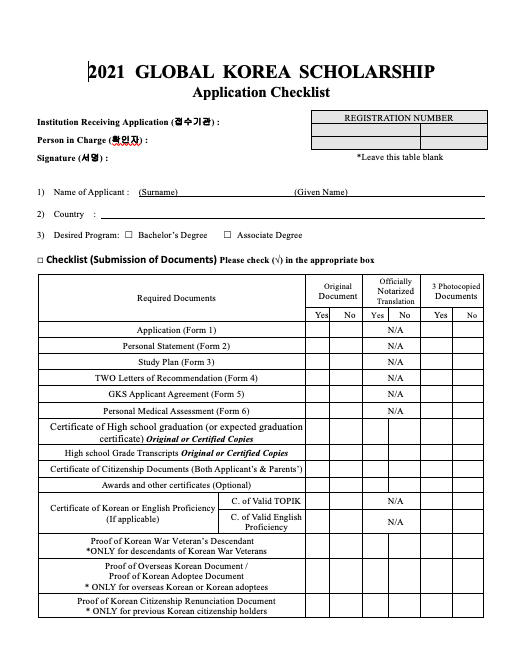
4. E.g in 2020, the Global Korea Scholarship for undergraduate Degrees was announced on the 8th, September as indicated by no 210. You can click to download the application materials to get familiar with what is expected. I attached series of links in this thread to assist too.
Category- All fields
Benefits
1. Visa fee
2. Airfare: Actual cost (To and fro from your home country to Korea and upon completion to your home country)
3. Resettlement Allowance: KRW 200,000 (Given upon arrival in Korea)
4. Monthly Allowance: 900,000 KRW (311,828.81 Nigerian Naira) per month
5. 1-Year Korean Language Training Fee: Fully covered
6. Degree Program Tuition: Fully covered
- Tuition amount covered by NIIED is maximum 5million KRW, and the amount that exceeds 5 million KRW will be covered by scholar’s university.
7. University Admission fees are waived for GKS scholars.
8. Medical Insurance: 60,000 KRW per month
9. Korean Proficiency Grants: 100,000 KRW per month
- This special additional grant is given only to GKS scholars in the degree program who hold valid TOPIK level 5 or 6 for the period of exam validity.
10. Degree Completion Grants: 100,000 KRW (offered once)
- Offered to GKS scholars who return to their home countries after completing their degree coursework under the scholarship program.
Eligibility
1. All applicants and their parents must be citizens of GKS program’s partner countries that are invited to take part in this program and must not hold Korean citizenship.
2. Korean citizens and dual citizenship holders (one who have Korean citizenship and citizenship of another country) are NOT eligible to apply.
3. Applicants and their parents who had previously held Korean citizenship must submit the document that proves their renunciation of Korean citizenship.
4. Must be under 25 years of age as of March 2, 2022 (born after March 1, 1997) High School Graduates (or expected graduates)
Must hold high school diploma as of March 1st , 2022 or must be expected to graduate high school by March 1st, 2022.
Grades
※ GPA: Grade Point Average, CGPA: Cumulative (overall) Grade Point Average
1. All applicants must have maintained the overall grade point average (CGPA) equivalent to or higher than any ONE of the following from their respective universities:
- Bachelor’s Degree Applicant: 80% or above on a 100 point scale or be ranked within the top 20% within one’s class
- Associate Degree Applicant: 75% or above on a 100 point scale or be ranked within the top 25% within one’s class
Preference
1. Applicants who received TOPIK level 3 or above will be given additional 10% points of the total marks during the evaluation.
2. Associate degree track applicants who received awards of national or international competition in the field of their
interests are given preference.
3. Applicants from low income families or underprivileged backgrounds will be given preference.
4. Applicants who received outstanding scores for their proficiency in English (TOEFL, TOEIC, IELTS) may be given preference. Any language proficiency test scores or certificates that are outdated or have passed the validity period will not be considered.
5. Embassy track applicants who apply for majors in the field of Natural Science and Engineering may be given priority during the evaluation process when they receive same marks with other candidates.
How to apply
To submit your application, you either apply via the embassy or university track.
[Embassy Track]
Korean government invites 125 international students from 67 countries who wish to pursue a bachelor's degree in Korea.
To be selected as a GKS grantee, any applicant should successfully pass through the 1st selection process set by the Korean Embassy of his or her country of origin.
In 2020, 1 applicant from Nigeria was selected for this track
[University Track]
Korean government invites 60 international students from 72 countries who wish to pursue a bachelor's degree(Engineering or Nature Science majors) and also 35 international students from 17 countries who wish to pursue an associate degree in Korea.
To be selected as a GKS grantee, any applicant should successfully pass through the 1st selection process set by the designated universities.
In 2020, 2 applicants from Nigeria were selected for this track
2021 UG guideline
https://t.co/WFFDi0xKl2 2021 UG Available Department
https://t.co/xZPJGfXCpJ 2021 GKS-U Overview of Universities
https://t.co/oIzV9kKcxZ 2021 Application Form
https://t.co/7UweDM5Eau