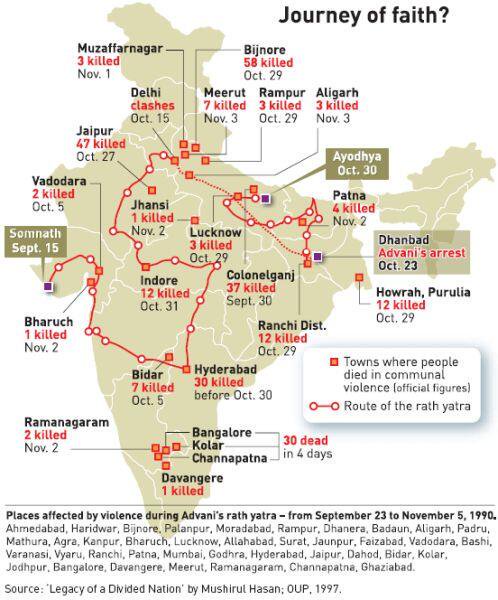
BJP is planning to undertake 'Rath Yatra' in Delhi's riot-affected areas to seek donations for Ram Temple on Feb 1. In 1990, L.K. Advani had launched Rath Yatra from Somnath to Ayodhya.

This thread covers the large scale killing which took place during the Yatra and it's impact.

Between April 1989 and April 1990, 262 people died in Gujarat, mostly were Muslims. In October 1990, days after Advani’s yatra began, 41 were killed in Ahmedabad. The same month, 52 were killed in Jaipur, 20 in Jodhpur, 33 in Lucknow, over 100 in Delhi, 37 in Assam,

[1]
18 in Patna and 165 in Hyderabad. Also in October, a pogrom against Muslims in Bhagalpur, Bihar, saw 960 killed in which 900 were Muslims. In November, 31 were killed in Agra, again mostly Muslim and 13 in Indore. In Dec, 60 were killed in Karnataka and 134 in Hyderabad.

[2]
Many parts of India remained tense for long periods of time. Between April and May 1990, three riots in Kanpur killed 30; between May and November 1991 more than 50 were killed in Varanasi. In May 1991, 26 including 24 Muslims were killed in Vadodara.

[3]
In October 1992, 44 were killed in Sitamarhi. On 6 December 1992, immediately after the Babri Masjid was destroyed, pogroms against Muslims broke out in Surat where 200 died, of whom some 95 per cent were Muslims. In Bhopal in December, 143 were killed.

[4]
Bombay riots broke out in which more than 1000 killed; again the majority were innocent Muslims.
The reward of mass killings was a doubling of the BJP’s vote share. In the general elections held in mid-1991, the BJP got 20 per cent of the total vote and won 120 seats.

[5]
From 1951 to 1990 Bharatiya Jana Sangh which formed BJP in 1980 could not win a single state. The first elections after demolition of Babri Mosque were held in 1996. The BJP won 161 seats. BJP’s success was built on the corpses of Muslims and cemented with their blood.

[6]
Over 3,400 Indians were killed in the violence triggered by Advani’s campaign and it brought the BJP to the doorstep of power. In the 1984 elections, the BJP won only two Lok Sabha seats but in the 1991 general elections after the Rath Yatra, the BJP won 120 seats.

[7]
In July 1992, L.K. Advani said in the Lok Sabha Speaker’s chamber: “You must recognise the fact that from two seats in Parliament in 1985 we have come to 117 seats in 1991. This has happened primarily because we took up this issue [Ayodhya].”

[8]
On June 18, 1991, L.K. Advani said: “Had I not played the Ram factor effectively, I would have definitely lost from the New Delhi constituency.”

India's Prime Minister Narendra Modi played a leading role in the first stage of Advani's Rath Yatra.

[9]
Rajeshwari writes in “Communal Riots in India: A Chronology 1947-2003”:

‘The mobilisation campaign for kar sevaks to construct the proposed Ram Janma Bhoomi Temple at Ayodhya on 30 October 1990 aggravated the communal atmosphere in the country.

[10]
Communal riots occurred in the wake of L.K. Advani’s Rath Yatra wherever it went. These riots were led by RSS-BJP men to consolidate the “Hindu” vote bank. They were widespread over almost all the states from Assam to West Bengal, Bihar, Orissa, Uttar Pradesh,

[11]
Madhya Pradesh, Rajasthan, Andhra Pradesh, Karnataka, Gujarat, Maharashtra and Delhi.’

Reference:
Aakar Patel, Our Hindu Rashtra

More from Fidato

Here's a list of all my threads on the fall of Dhaka. I dedicate this small effort to the soldiers who fought valiantly for their country in 1971. May Allah bless their souls and also of those in East Pakistan who were martyred in the cause of Pakistan.

#Bangabandhu
#BlackDay

1. Myth of three million Bengali, 2 lac women raped by Pakistan Army
👇
https://t.co/1AdyFGjCtK

2. Mukti Bahini the forgotten terrorists


3. Why was Operation Search Light launched

https://t.co/kAYLjAj92P

4. Myth of Bengalis being discriminated during the selection process for the armed forces.


5. The nexus of RAW and Mukti Bahini

https://t.co/jzGaUznN9N

6. The Bengali representation in bureaucracy


7. Tragedy of #EastPakistan
👇
https://t.co/txcGOFcKyr

8. Forgotten Massacres in East Pakistan
👇
https://t.co/3uB1UOADqr

#Bangabandhu
#VictoryDay
#BlackDay
#SheikhMujibUrRehman

More from World

Watch the entire discussion if you have the time to do so. But if not, please make sure to watch Edhem Eldem summarizing ~150 years of democracy in Turkey in 6 minutes (starting on 57'). And if you can't watch it, fear not; I've transcribed it for you (as public service). Thread:


"Let me start by saying that I am a historian, I see dead people. But more seriously, I am constantly torn between the temptation to see patterns developing over time, and the fear of hasty generalizations and anachronistic comparisons. 1/n

"Nevertheless, the present situation forces me to explore the possible historical dimensions of the problem we're facing today. 2/n

"(...)I intend to go further back in time and widen the angle in order to focus on the confusion I  believe exists between the notions of 'state', 'government', and 'public institutions' in Turkey. 3/n

"In the summer of 1876, that's a historical quote, as Midhat Pasa was trying to draft a constitution, Edhem Pasa wrote to Saffet Pasa, and I quote in Turkish, 'Bize Konstitusyon degil enstitusyon lazim' ('It is not a constitution we need but institutions'). 4/n

You May Also Like

A brief analysis and comparison of the CSS for Twitter's PWA vs Twitter's legacy desktop website. The difference is dramatic and I'll touch on some reasons why.

Legacy site *downloads* ~630 KB CSS per theme and writing direction.

6,769 rules
9,252 selectors
16.7k declarations
3,370 unique declarations
44 media queries
36 unique colors
50 unique background colors
46 unique font sizes
39 unique z-indices

https://t.co/qyl4Bt1i5x


PWA *incrementally generates* ~30 KB CSS that handles all themes and writing directions.

735 rules
740 selectors
757 declarations
730 unique declarations
0 media queries
11 unique colors
32 unique background colors
15 unique font sizes
7 unique z-indices

https://t.co/w7oNG5KUkJ


The legacy site's CSS is what happens when hundreds of people directly write CSS over many years. Specificity wars, redundancy, a house of cards that can't be fixed. The result is extremely inefficient and error-prone styling that punishes users and developers.

The PWA's CSS is generated on-demand by a JS framework that manages styles and outputs "atomic CSS". The framework can enforce strict constraints and perform optimisations, which is why the CSS is so much smaller and safer. Style conflicts and unbounded CSS growth are avoided.